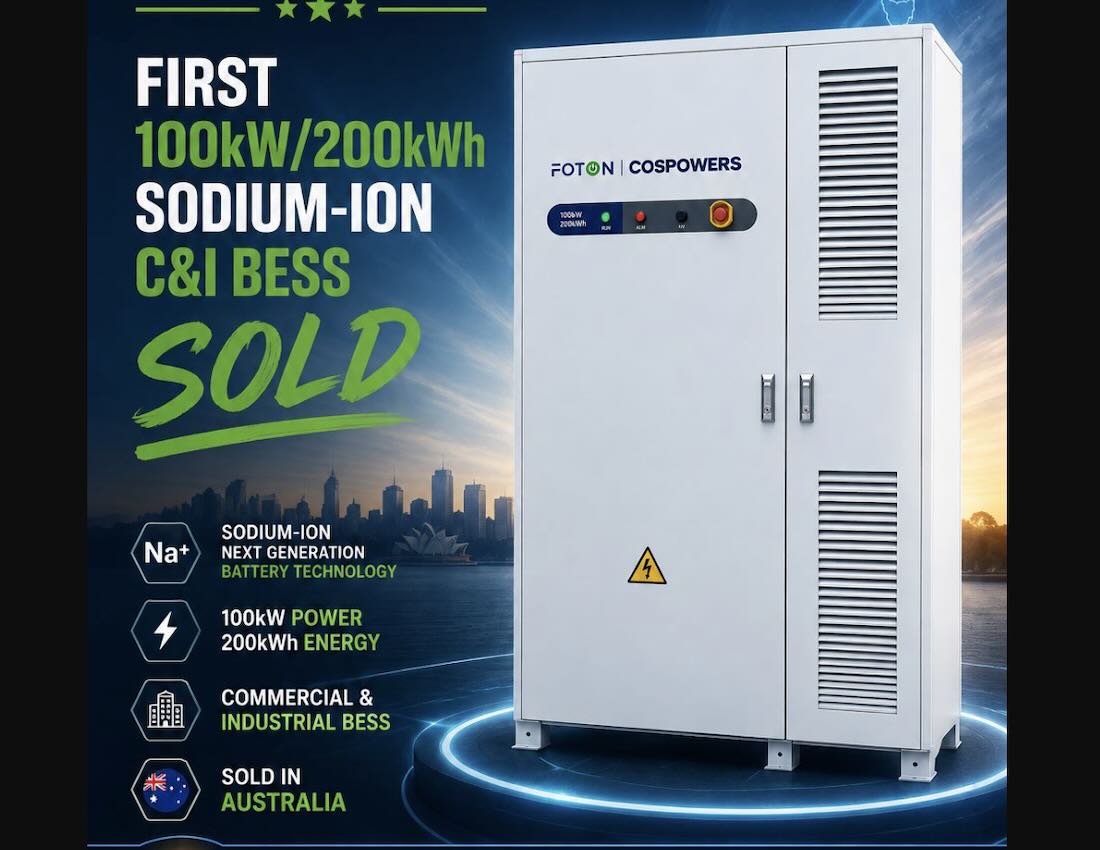
The sale of a 100 kilowatt and 200 kilowatt-hour battery system wouldn’t usually make the news, but an announcement posted on LinkedIn earlier this week is attracting attention for its claim as a potential first in Australia, given the chemistry of the battery is sodium-ion, instead of the ubiquitous lithium.
Foton Pty Ltd, which is the name of the exclusive Australian distributor of the battery storage technologies of China-based global manufacture Cospowers, said on Wednesday that it has sold its first ever C&I battery with sodium-ion chemistry, describing it as “an important first step” for the company.
According to Foton managing director Krishna Thota, it could also be a first for Australia.
“Based on our review of publicly available projects and announcements, we believe this represents Australia’s first commercially sold 100kW / 200kWh sodium-ion C&I BESS,” Thota wrote in his own LinkedIn post.
“This isn’t a prototype sitting in a laboratory. It’s a commercial system. And it has a customer.
“For Foton, today represents something bigger than the sale of one battery. It represents the beginning of bringing next generation battery chemistries into real commercial projects in Australia.
“Lithium built today’s BESS market. Sodium may help build the next generation.”
Sodium-ion battery technology is a hot topic in energy storage at the moment as one of the biggest contenders to challenge the rein of lithium-ion, while also promising to be a safer and more stable alternative that is made from cheaper and much more abundant materials, like common salt.
Sodium-ion batteries are also better performers in very cold or very hot weather and are able to charge much faster that li-ion batteries. But li-ion wins out on maturity and on energy density, which means they can store more usable energy than a comparable sodium-ion battery.
In Australia, the use of sodium-ion technology is limited to C&I and larger-scale applications, due to the fact that the Clean Energy Council (CEC), which responsible for ticking off solar and storage technologies used in Australian homes, only registers lithium-ion batteries.
Meanwhile, most of the world’s major battery manufacturers – particularly those closely connected to the electric vehicle market, including CATL and BYD – are investing serious time and money in the commercialisation of sodium-ion technology that can compete in the mainstream.
Cospowers, which has been working closely with a range of Chinese universities on sodium-ion research and development, in March 2024 broke ground on a 1.5 gigawatt-hour (GWh) sodium-ion battery production line in its Changde Factory.
On its website, Foton says Cospowers publishes sodium-ion battery performance data for Australian conditions. And in a Q&A on home batteries, it says the debate over which chemistry is better depends on what the battery is being used for – and what the customer wants from it.
“Upfront pricing is similar between lithium and sodium-ion systems,” the site says. “The difference appears over time. Sodium-ion batteries deliver more usable energy over their lifetime, lowering the real cost per kilowatt-hour stored.
“For hot regions and VPP participation, this advantage becomes more meaningful. However, buyers should verify that their chosen sodium-ion model is Clean Energy Council approved to ensure full federal rebate eligibility.”
In its LinkedIn post on Wednesday, Foton said its sodium-ion milestone was “about much more than selling one battery system.
“For a long time, sodium-ion has been talked about as an emerging technology with potential. Today, we’re seeing it take another step forward, out of the discussion and demonstration stage and into a real commercial project.
“Lithium-ion has built much of the BESS market we know today, and it will continue to play a major role. But as energy storage grows, not every application will need the same chemistry or the same solution.
“That’s where things get interesting.
“Sodium-ion is one of the technologies worth watching.”
Renew Economy reached out to Thota with some questions about the battery sale, but had not heard back before publication.