Two South Australia-based companies have joined forces to help deliver what the world-leading renewable energy powered state needs much more of: Smart and nimble battery systems with longer storage duration than two hours offered by most of its current fleet of big batteries.
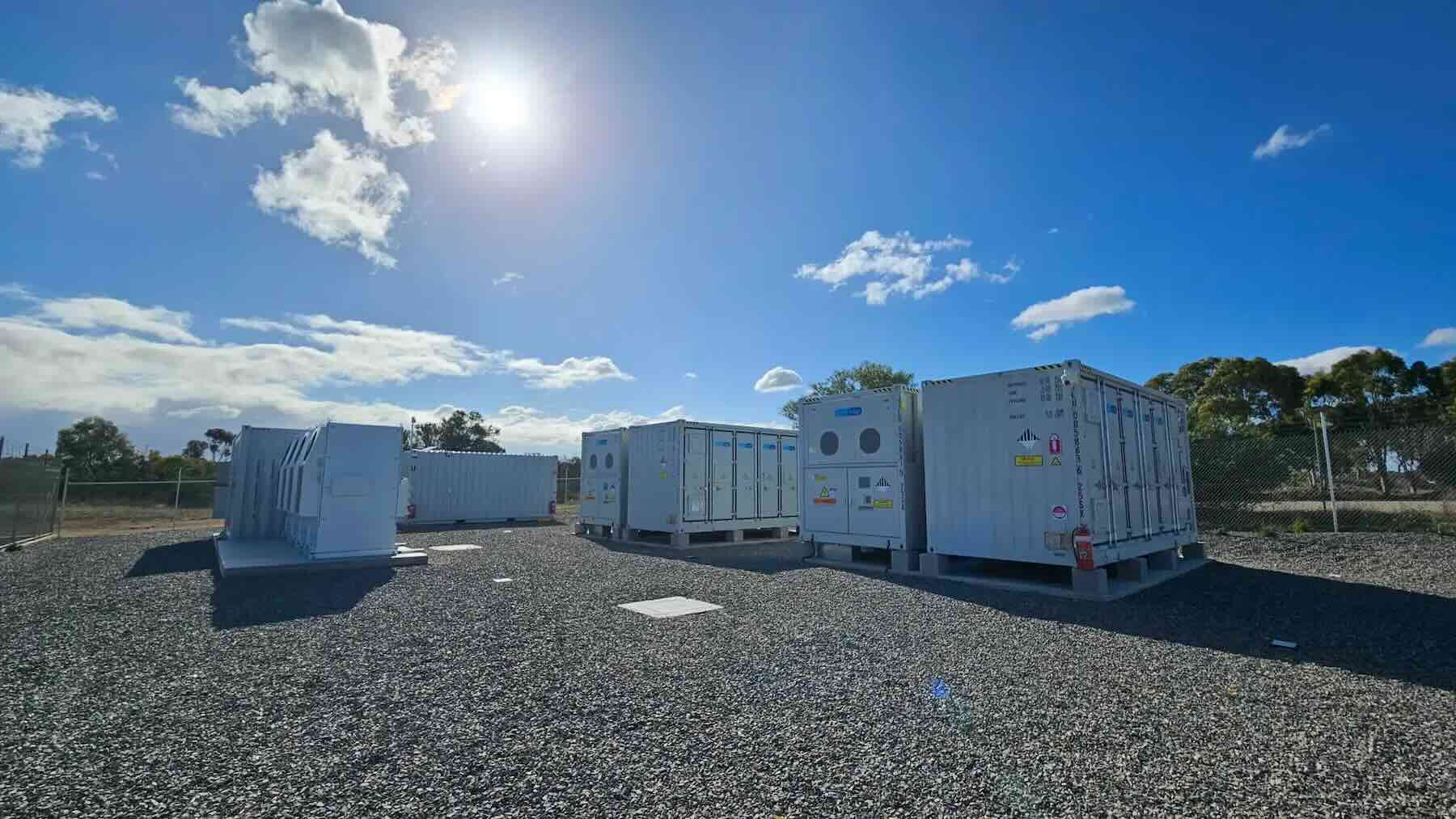
In this case, the new big battery is the relatively small 5 megawatt (MW), 20 megawatt-hour Strathalbyn battery energy storage system (BESS), which was energised and began trading on the National Electricity Market (NEM) on Monday, marking the first operational battery for new developer Lunio Energy.
Lunio Energy, an offshoot of Australian tech-infrastructure outfit Lunio Group, is setting off to develop, own and operate grid-scale battery storage, starting with the Strathalbyn BESS and “further storage projects underway across South Australia.”
“Storage like ours plays a supporting role, filling the gap so that renewable energy is dependable around the clock and the grid holds stable as more wind and solar come on,” says Lunio Energy CEO and founder Seth Thuraisingham.
“It is one important piece of a much bigger effort still ahead, and Strathalbyn is our first step,” Thuraisingham says. “This is the moment Lunio goes from developing projects to running them.”
The smart and nimble part of the new BESS comes from another home-grown energy start-up, OptiGrid, which has marked its own first with the Strathalbyn project – the first four-hour battery to use its OptiBidder forecasting and optimisation platform that was spun out of the University of Adelaide.
OptiGrid, which officially launched in 2024, is the product of the combined research of two of its co-founders: Sahand Karimi, a power system engineer who did a PhD on battery operation optimisation at University of Adelaide, and Nam Dinh, a data scientist whose studies focused on electricity price forecasting.
OptiBidder uses AI and machine learning to manage energy market bidding for battery-connected solar and wind farms, maximising revenue while adapting to market rules and technical constraints.
Following a successful seed-funding round backed by the Clean Energy Finance Corporation, IP Group, Hostplus, University of Adelaide, EnergyLab, and the UNSW, the company now manages around 170 MW of hybrid and standalone battery projects, including the Hepburn Energy Park.
And while there are numerous 5 MW batteries under OptiGrid’s management, Karimi says the Lunio BESS is the first four-hour system in the company’s rapidly growing portfolio; a small start at addressing what is a big gap in the South Australian energy mix.
Last month, the worst one-day wind drought in more than two years on Australia’s main grid caused a series of major price spikes in South Australia and highlighted the urgent need for more battery storage in a state with the highest penetration of renewables.
As OptiGrid noted at the time, the combination of “close to zero” contribution from wind power, with elevated demand and the market operator’s introduction of a new thermal constraint to protect the network near Balranald, all added up to leave South Australia short of cheap supply.
“That was close,” Karimi told Renew Economy in an interview. “I mean, that morning … we were just on the brink of load shedding because … [we] couldn’t import from Victoria because of the grid constraints.
“And then wind was low, demand was high, and… literally, we were on the brink of load shedding, if you look at available generation and demand, they were equal. No other available generation if the demand went higher.”
As OptiGrid explained it on LinkedIn, during the two-day wind drought many of South Australia’s batteries discharged heavily through the afternoon and early evening of day one and, as they ran low on charge, several dispatch intervals cleared above $3,000/MWh, with prices peaking above $20,000/MWh.
“Around half managed to catch the first extreme price interval,” OptiGrid said, “but far fewer were able to discharge in the later spikes. A couple of batteries were even charging through dispatch intervals above $10,000/MWh.
“By [Monday] morning, many batteries still had limited energy available after the overnight price event. Despite another period of $20k prices, relatively little battery capacity was able to respond.”
What is needed is more batteries with longer duration, starting a four hours and stretching all the way to 12.
These are being incentivised by a range of state and federal government schemes, including through the Firm Energy Reliability Mechanism (FERM) in South Australia, which has contracted six new battery projects – all with a minimum of four hours storage that can deliver up to eight hours at lower outputs at certain times.
Karimi says that, on its own, the market is currently signalling for batteries with four-hours of storage – but that even with some of the much longer duration examples, these batteries need to be carefully managed to survive and thrive, commercially, under conditions like dunkelflautes, or wind droughts.
“I think the the basic the trend is towards longer duration,” says Karimi. “I think the market is not sending the signal for six to eight hour at the moment. I think four-hour is probably the optimal size based on the market signals that we are seeing, and it’s now reflected into the recent investments.
“Still … from our perspective… even with a 10-hour battery there’s still a lot to optimise in terms of how you should trade the battery over, instead of just one day, over three days.
“If there’s a wind drought coming up in the next couple of days, it is very important to be able to forecast it and then … position the battery for that. Even and especially with the longer duration battery, it just takes a lot of time for them to charge,” Karimi says.
“So that optimisation challenge is still there. There are differences in the sense that we need to take into account a longer horizon for optimisation, rather than just a single day or 24 hours or 36 hours, but it’s still there.
“Our forecasting models and optimisation algorithms have been developed through years of research, and they’re built to turn that complexity into revenue.”
And while the bigger a battery’s total stored capacity the better – and Karimi says OptiGrid has some much larger-scale batteries in its asset development pipeline – there are advantages to smaller systems like the Strathalbyn BESS.
“My PhD research was mainly focused on the big schedule batteries rather than [commercial and industrial] or sub-five megawatt. But ultimately, we found that …there is a lot of value in optimising those 5 MW and C&I batteries, and that’s why we simplified the optimiser to work for them,” he tells RE.
“[You can] go live with these 5 MW assets much faster than utility-scale assets. From … financial close to the full go-live takes about two years for utility- scale scheduled batteries of 100-200 MW, and the bigger it is often the longer it takes for the [network] and AEMO to be happy with the commissioning.
“But these 5 MW [batteries] can go live, as you can see in the case of Lunio, very fast… from, like, literally nothing on the ground to… trading live just took them I think eight or nine months.
“And that just means if the grid needs [these sort of] batteries now, then with 5 MW you can actually build and operate them much faster.
“The other advantage they have is that they’re at the distribution network level, so they can provide other services,” Karimi says.
“I think we need a lot more innovation in that area, and we are actually talking with some companies that are now in the midst of like working something out with the DNSP to provide some network support services.
“These 5 MW batteries … [are also] very close to the centre of load in each region, which means the chance of a separation from the load is much lower.”
For Lunio’s first operational BESS, OptiGrid’s role will be to maximise financial returns, by optimising its energy trading in the market, including its bids into the FCAS [frequency control ancillary services] market and timing the charge and discharge.
“And the other thing is just to take into account all the technical limitations that … SA Power Networks might apply to this asset, because they have a flexible connection agreement, which means they’re subject to dynamic operating envelopes that [SAPN] might apply throughout the day.
“So we essentially take all those constraints into account, and then trade the battery in the energy market, and then bid into the FCAS for them to maximise the revenue.
“On top of all this … one of the things we’ve also seen is that the spreads have basically gone very low in recent months … and one of the things that we are helping all our clients, including Lunio, is with the trading strategy.
“Like, rather than just looking at the next day, next week, to think about the long term and how they can maximise the project value over its lifetime, which is 20 years.
“So, in some cases, it might mean they need to cycle more, depending on how they finance the project. In some cases they mean they need to cycle less because they can save the cycling life of the battery for when there’s no coal in a couple of years.”
For OptiGrid, working with Lunio has offered the bonus of working on an all-local South Australian collaboration, right down to the companies contracted to collaborate on the project.
“So [the Strathalbyn project] was basically a group of South Australian companies, from the battery development to control system to optimisation,” Karimi tells Renew Economy.
From here, OptiGrid’s plan is to continue to grow its portfolio of assets under management around Australia, and to shift it up a gear into giga-scale territory.
“We have now 170 MW of assets under management, which is a combination of 5 MW batteries and solar, mostly batteries, and then we’ve got also a few more than 200 MW assets that are going live, actually, later this year and first half of next year,” Karimi tells Renew Economy.
“We haven’t announced them, but those will be like the biggest assets in our portfolio and probably our … assets under management will jump to about a gigawatt, I think, by mid next year.”
If you would like to join more than 29,000 others and get the latest clean energy news delivered straight to your inbox, for free, please click here to subscribe to our free daily newsletter.