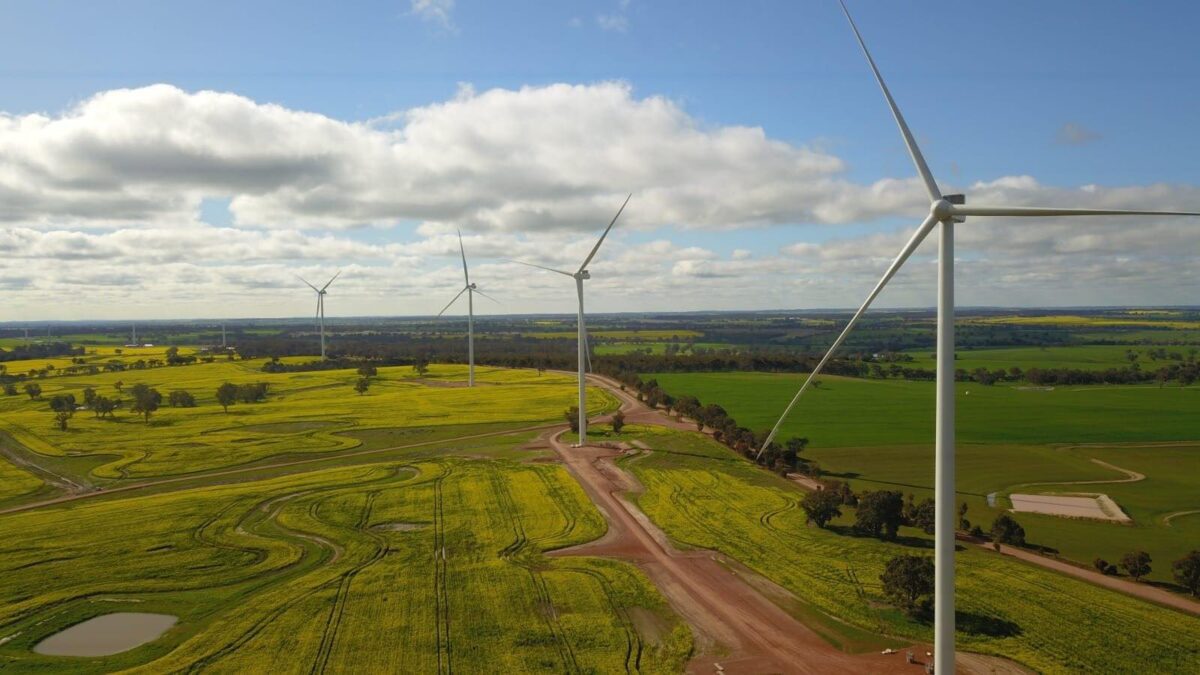
After speeding through the Western Australia planning process in just three months, the owners of the 204 megawatt Kojonup wind project and its eight hour battery are now looking for sign off from the state’s environmental regulator.
The $750 million wind project deep inside the Great Southern region is being developed by Moonies Hill New Energy, a local outfit, and is backed by a development agreement with government-owned Synergy.
The plan if for 33 turbines, each one rated at 6.2 MW, with a battery sized at 100 MW battery with up to 800 megawatt-hours (MWh) of electricity supply.
Moonies Hill New Energy managing director Sarah Rankin says the project was approved as a wind-battery hybrid, with one connection to the grid.
But given wind-battery hybrid technology and the ways it will connect to the grid are still very new, they are still working through what that might look like in Western Australia.
“Like most jurisdictions, [connecting to the] grid is slow. That’s a challenge for everybody. We’re half way through our grid connection so that’s going to determine how we get through the next few months,” Rankin says.
The plans were signed off in February by the regional planning agency, and they’re now with the Environmental Protection Authority (EPA).
Rankin expects to start construction next year.
“We’re trying to get ahead of the coal closures in Western Australia, and we’re hoping that we can be up and running in late 2028, early 2029,” she told Renew Economy.
“We’re keen to bring this project through and manage those community expectations. There’s still a lot of work to do on the community structure… we’re certainly advocating for the region.”
The EPA referral shows the project is expected to produce scope 1 emissions from land use change, that is vegetation clearing and plant and equipment emissions, of about 6,100 tonnes of carbon dioxide equivalent (t/CO2-e).
The equipment itself will contain embodied emissions of up to approximately 350,000 t/CO2-e, but it will offset 402,000 t/CO2-e each year of avoided fossil fuel power generation.
The 41 lots that Moonie Hills New Energy has locked in for the project covered 3,816 hectares, but the project will sit on just 184 hectares of that and it will need to clear some 4.54 hectares of native vegetation.
Track record
Moonies Hill was behind the 75.6 MW Flat Rocks wind farm, which took 15 years to take from idea to operation.
Rankin says while any big project will come with supporters and detractors, that having that track record in the region has helped to defuse some of the potential tensions had they been newcomers.
While developers have been drawn to the coastal region north of Perth, where a new transmission backbone is being built, fewer look to the southern reaches of the state for land opportunities, thanks to a lack of grid capacity.
But Rankin says building in the south is necessary, because the so-called ‘doctor’ winds that blow across the state arrive at different times of the day, with the Esperance winds in the south coming first, before the famous “Fremantle Doctor” and the Albany winds later in the day.
“We do need to have geographic diversification with these assets, we’ve been doing our bit for the south,” she says.
“We’re keen to bring this project through, and manage those expectations. There’s still a lot of work to do on the community structure… certainly advocating for the region. The southern wind resource is amazing.”
What is making this project challenging is the changes required by the state government to community engagement funds.
The state has set recommended values for how much developers should pay per megawatt for each technology, and created a new overarching structure to manage negotiations.
But the experience at the Kojonup project shows that what communities want may not fit well into the new structure.
“We got community input, we ran surveys of what the community would like the fund to look like…. We made commitments to the community and now we’ll need to work within the framework of the state,” Rankin says.
Rankin says the work the developer and the Kojonup Aboriginal Corporation have done is a an example of how what locals want may not fit into the new system
Moonies Hill New Energy and the corporation spent a lot of time working out what would suit the First Nations group, but the new system doesn’t have space for the kind of partnership they’ve worked out.
“We want to try to honour the conversations that we’ve had, so that will be tricky now to get that right,” she says.
To join more than 29,000 others and get the latest clean energy news delivered straight to your inbox, for free, click here to subscribe to our free daily newsletter.