A new analysis from global energy think tank Ember has found that the gas share in the global electricity mix has fallen for the fifth consecutive year, with nearly half of the world’s gas-generating economies already passing peak gas power generation.
Ember’s analysis found the gas share in the global electricity mix has declined from 23.9 per cent in 2020 to 21.8 per cent in 2025. And while gas generation in fact rose slightly in absolute terms, its growth has slowed with the increase in solar and wind capacity increasingly meeting rising electricity demand.
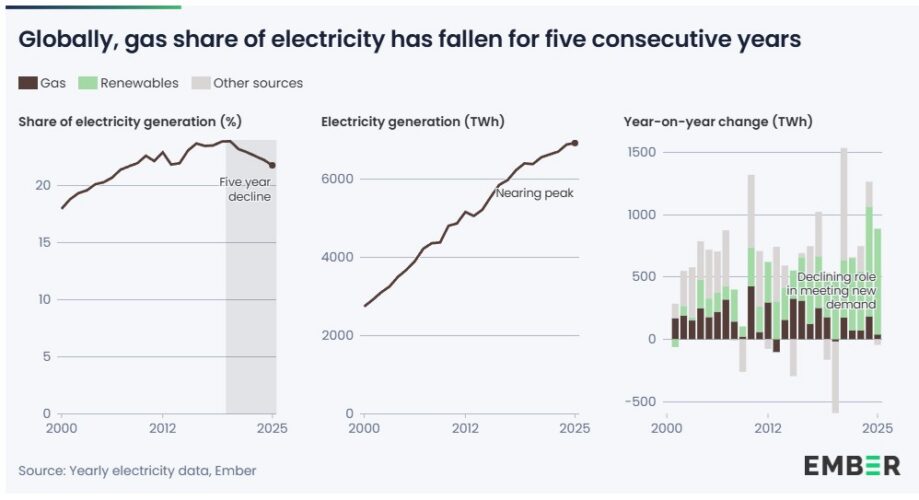
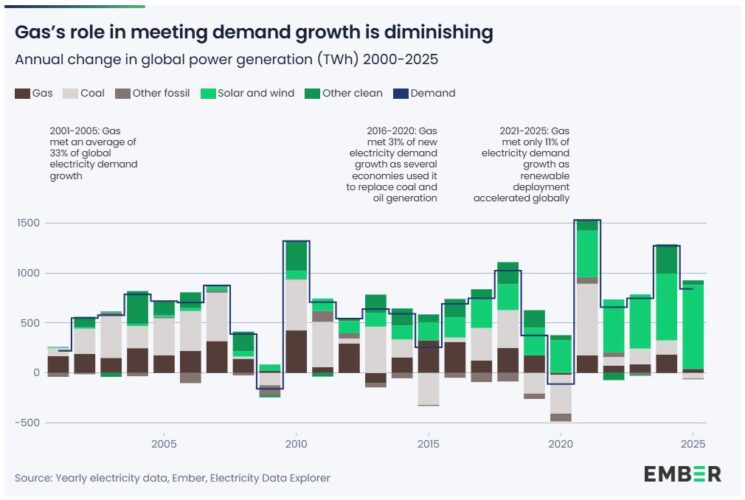
In 2025 alone, solar generation grew by 636 TWh, 17 times more than gas generation, which only increased by 38 TWh. This meant that solar alone accounted for around 75 per cent of new global electricity demand growth in 2025, while gas contributed only around 5 per cent.
In terms of the long-term decline of gas in the electricity mix, gas growth during 2021-2025 was around half the rate seen during the preceding five years (2016-2020) – an average annual rate of 1.6 per cent compared to 2.9 per cent.
Looked at another way, gas accounted for an average 33 per cent of growth in global electricity demand between 2001 and 2005, remaining high for the next 15 years, accounting for an average 31 per cent of growth in new electricity demand between 2016 and 2020.
However, as renewable energy deployment has accelerated around the globe, between 2021 and 2025, gas accounted for only around 11 per cent of demand growth.
“The economics and energy security case for electricity are increasingly moving in the same direction,” said Malgorzata Wiatros-Motyka, senior electricity analyst at Ember.
“As renewables lower costs while reducing exposure to fuel price shocks and geopolitical disruptions, gas is steadily losing the advantages that once made it the default fuel for power system growth.”
Unsurprisingly, geopolitical disruptions such as Russia’s invasion of Ukraine and the United States’ and Israel’s invasion of Iran have both contributed to exposing the volatility and energy security risks of important-dependent systems.
“Recent geopolitical crises highlighted the risks of relying on imported gas,” said Wiatros-Motyka.
“Countries are increasingly turning to renewables because they are domestically available, more price stable and faster to deploy.”
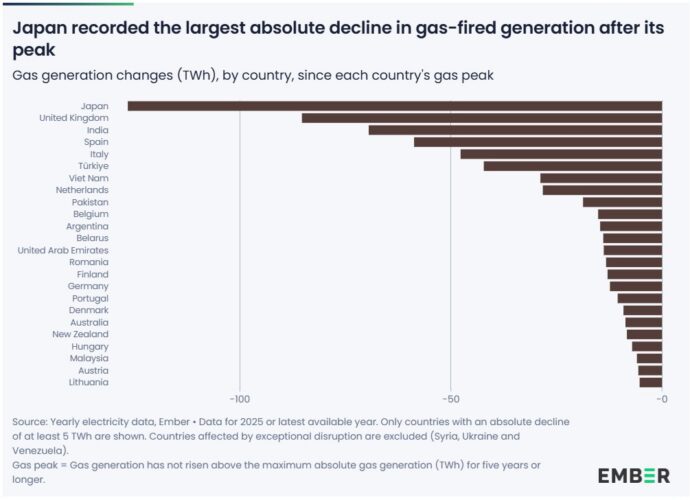
The combination of these factors has led to the share of gas in the electricity mix peaking in 61 out of 124 economies analysed by Ember, including G7 members the UK, Germany, Italy, and Japan.
Big economies like China, India, and Brazil, while collectively accounting for 42 per cent of global electricity demand in 2025, relied only minimally on gas in their power systems – though, in China’s case, coal-fired power generation remains a huge source of power.
India’s gas share in the electricity mix, for example, fell from 12.6 per cent in 2010 to just 2.3 per cent in 2025. Brazil similarly saw the gas share peak in 2014 at 13.7 per cent before dropping to 7.3 per cent in 2025. China’s gas share is even lower, at 3 per cent.
The biggest declines in gas generation since peak generation are in Japan and the UK. In Japan, gas-fired generation peaked in 2017 at 464 TWh, or 43 per cent of the electricity mix, before falling to 338 TWh and 33 per cent in 2025.
Regionally, coal-heavy regions such as Asia and Oceania have seen coal generation fall, but this has not translated into a larger role for gas, with gas accounting for only a 10.2 per cent share of the regional power mix in 2025, down from 13.9 per cent in 2015, and 15.1 per cent in Oceania, down from 18.5 per cent in 2015.
Gas peaked in Europe back in 2010 at 28.4 per cent of the electricity mix, and now only accounts for a 23.8 per cent share. Gas has also peaked in Latin America and the Caribbean, hitting a 28.6 per cent share in 2015 before shrinking to 24.3 per cent in 2025.
The same cannot be said for North America, however, as well as parts of the Middle East and Africa.
But even though gas has yet to peak in global absolute terms, the trends identified by Ember “suggest that gas power is losing momentum as a source of global growth and may be approaching a structural peak.”
If you would like to join more than 29,000 others and get the latest clean energy news delivered straight to your inbox, for free, please click here to subscribe to our free daily newsletter.