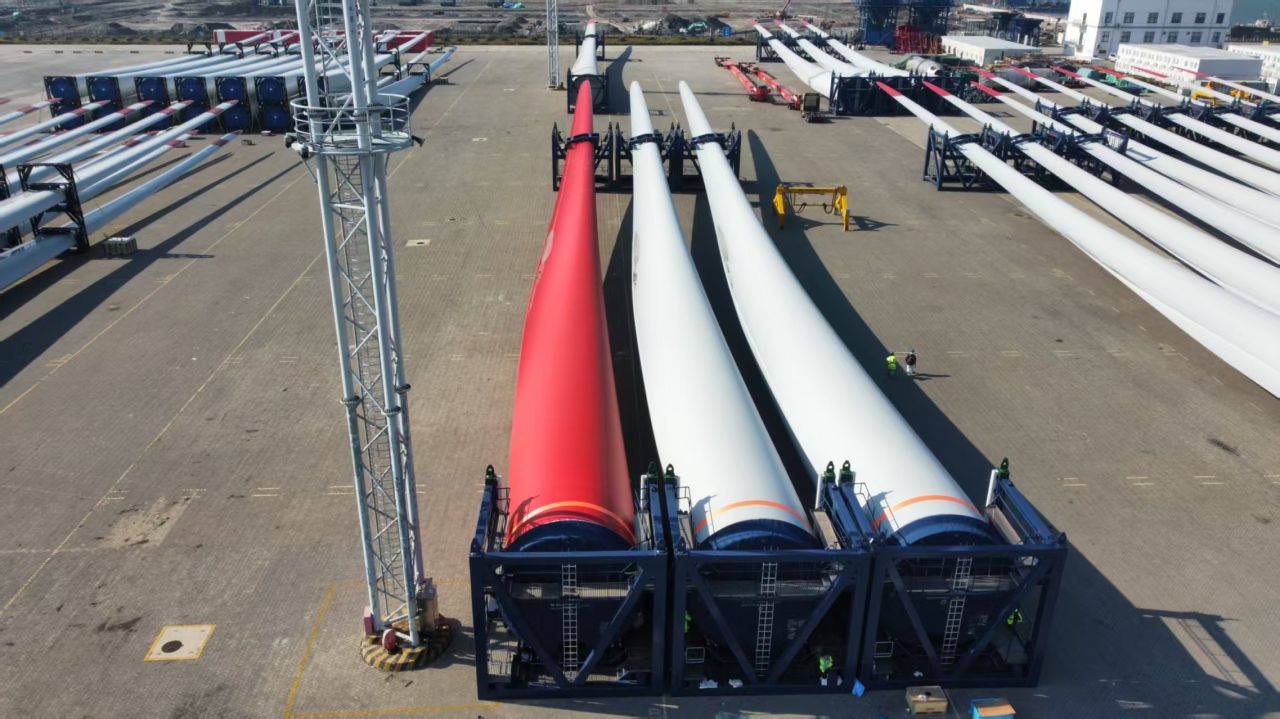
Danish wind turbine manufacturer Vestas will install one red blade on a handful of turbine towers at an offshore wind project as part of a study into whether making blades more visibile will reduce the risk of bird collisions.
One red blade will be installed at each of seven wind turbines at the 760 megawatt (MW) Hollandse Kust West VI offshore wind farm in the North Sea as part of a study led by Ecowende, the joint venture between the wind farm’s developers Eneco and Shell.
Red was chosen as the colour for the turbine blades after other colours, such as black and fluorescent, were ruled out due to various performance criteria, including the risk of overheating and its potential impacts on blade durability.
“By testing a wide variety of promising innovations, Ecowende aims to prove the most effective technologies – helping to minimise the impact on birdlife while maximising renewable energy production and driving the energy transition in harmony with nature,” said Thomas Haex, wind turbine engineer at Ecowende.
Lisa Malmquist Ekstrand, vice president of sustainability at Vestas said seabirds largely avoid offshore wind turbines, but by testing additional mitigation measures like blade visibility, the bar can be raised to avoid collisions.
“The red blade trial is one of several research initiatives intended to build understanding and help raise the bar for biodiversity-enhancing wind development, demonstrating how nature-inclusive offshore wind development can contribute to a thriving North Sea,” she said in a statement.
Ecowende has incorporated a range of innovations including taller wind turbines (to avoid migratory species) to the placement of turbines to create a corridor that connects the coast with protected Brown Bank nature Nature-2000-area.
Various deterrence measures have been incorporated focused on birds and bats, while various innovative installation methods were used to minimise the impact on marine wildlife, including reduced noise measures during pile installation.
In April, it was announced that global marine contractor Van Oord had successfully installed three monopile foundations at the wind farm using GBM Works’ VibroJet solution in combination with Cape’s Vibro Lifting Tool, technologies designed to reduce underwater noise and minimise impact on marine life.
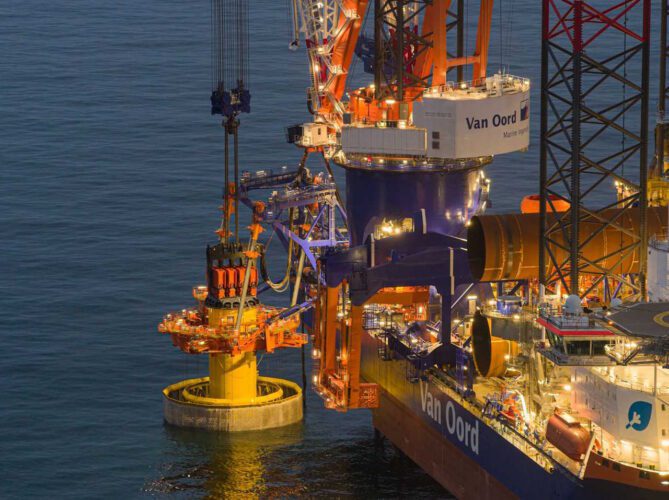
Maybe most interesting is the effort being made to encourage ecosystem growth after construction is completed, including efforts to stimulate reef formation and reintroduce the indigenous flat oyster, which became extinct in the Dutch North Sea in the 1950s.
In four of the monopiles housing the wind turbines, extra openings have been fitted alongside the traditional water replenishment holes to provide additional shelter for fish, with these monopiles to be monitored over the next three years with cameras and sensors.
All the foundations for the Hollandse Kust West VI offshore wind farm were recently completed, with tower, turbine, and blade installation to continue.
The first sets of three turbine blades – two in the normal light grey/white and one in all red – are already on their way to the Netherlands in preparation for eventual installation on the 15 MW turbines.
A recent study published by in the Journal of the Royal Society Interface similarly proposed investigating the use of blade patterns that alter the optic flow perceived by birds in an effort to create a dynamic visual contrast.
Two other recently published studies also demonstrated that birds are better at adapting to the presence of wind turbines than many reports have suggested.
The two studies demonstrated that bird mortality from wind turbine collision is “orders of magnitude lower” than existing data have previously suggested, but also that birds actively change their behaviour to avoid operational wind turbines.
If you would like to join more than 29,000 others and get the latest clean energy news delivered straight to your inbox, for free, please click here to subscribe to our free daily newsletter.