A New South Wales (NSW) cotton farm has reached financial close on a solar-backed green hydrogen project, following an extra $9.4 million top-up grant from the state government.
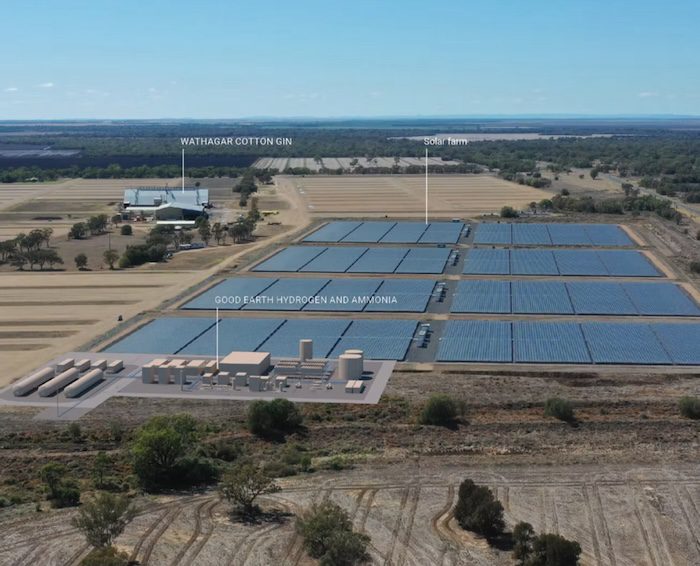
The Moree project will produce enough green hydrogen to make 4,500 tonnes of ammonia a year, for use as fuel and fertiliser, say proponents Hiringa Energy and Sundown Pastoral Company.
The “green” element comes from an existing 9 megawatt (MW) solar project and 11 megawatt hour (MWh) battery, and a new 27 MW solar project and new 30 MWh battery, a Hiringa spokesperson says.
That will be backed by a “limited” power purchase agreement, according to a spokesperson from NSW Department of Climate Change, Energy, the Environment and Water (DCCEEW).
With NSW development approval landing in late February for the $71 million hydrogen component, site works for this part of the project are pencilled in for April.
The hydrogen facility is penciled in to start operating in the March quarter next year, the company says.
The state initially gave a $35.8 million grant via the Hydrogen Hub program for a smaller project, then topped it up last week from a different fund to allow Hiringa and Sundown to build the full 4,500 tonnes per annum ammonia vision.
“This will increase the availability of low-carbon fertiliser to be available for growers in the Gwydir and other NSW agricultural regions,” a Hiringa spokesperson said in response to questions from Renew Economy.
The goal is to use the ammonia as a like-for-like replacement of conventional ammonia and of synthetic fertiliser at Sundown’s Keytah cotton farm, and to use a hydrogen/diesel blend in irrigation pumps.
A trial converting two existing 350 HP static irrigation pumps with ‘dual fuel’ technology showed “promising” performance, Hiringa says, and Sundown plans to convert 10 more pumps to blended fuel this year.
The idea is to sell any excess ammonia to farmers in the Gwydir area and create a “sovereign supply chain” of consistently-priced fertiliser.
The state funds are part of a move by NSW to support agricultural decarbonisation, particularly in the fossil fuel-heavy fertiliser sector, a DCCEEW spokesperson said.
“The Good Earth Green hydrogen and Ammonia project demonstrates how renewable energy is helping reduce emissions in sectors like agriculture that are traditionally difficult to decarbonise,” NSW energy minister Penny Sharpe said in a statement.
“NSW is building the technology to cut emissions, support our industries and create new jobs of the future.”
The project will be one of the first large green hydrogen and ammonia facilities in the state, a DCCEEW statement says.
If you would like to join more than 29,000 others and get the latest clean energy news delivered straight to your inbox, for free, please click here to subscribe to our free daily newsletter.