Construction of Marinus Link, the roughly $5 billion undersea cable project linking Tasmania and Victoria, is all but good to go, with the execution of a nearly $1 billion major works contract with TasVic Greenlink.
Marinus Link Pty Ltd (MLPL) said on Wednesday that it has signed a $994 million (nominal) contract with TasVic Greenlink (TVGL) – a joint venture of DT Infrastructure and Samsung C&T Corporation – ) to deliver the major civil and construction works for stage 1 of the huge project.
“This contract execution marks the final step in securing the capability and technology needed to commence construction, scheduled for next year,” MLPL said in a statement.
“We have secured both our cable and converter technology suppliers, our integrated delivery partner, and now our lead contractor for the substantial civils and construction campaign,” MLPL CEO Stephanie McGregor added.
Marinus Link has made significant progress in the latter part of 2025, including reachinf financial close in early September off the back of a record commitment from the federal government’s green bank of up to $3.8 billion in concessional finance.
Financial close followed the early August Final Investment Decisions (FID) from the Tasmania, Victoria and federal Labor governments, which hold 17.7 per cent, 33.3 per cent and 49 per cent shares in Marinus Link, respectively.
FID was closely followed by federal environmental approval – a three-times delayed decision accompanied by “strict conditions” for the cable, related to listed threatened species and communities, listed migratory species and an approved Commonwealth marine area.
The project has courted criticism and controversy, including around its cost, and its role as an enabler of major new renewable energy generation projects in Tasmania – like the recently EPBC-approved and highly contentious Robbins Island wind farm.
The Tasmanian Whole-of-State Business Case – released in August amidst state political upheaval and ongoing debate over the costs versus the benefits of the undersea cable to Tasmania – revealed that Marinus Link would likely lead to some unpleasant cost hikes for major industry in the state.
The project has since also secured environmental and local government approvals in Tasmania – pending the outcome of an appeals period – and is now awaiting final marine and coastal approvals on the Victorian side of the project, connected with the shore crossing.
In the meantime, TVGL is expected to start early works on the shore crossings for the Tasmanian side of the project as early as February, including laying the groundwork for the supplier of the project’s high-voltage direct current (HVDC) cables, Prysmian.
“Our Marinus Link teams, alongside TVGL, will be out and about early next year to provide detailed information about construction activities and expected timelines,” McGregor said on Wednesday.
“Our contribution in delivering these critical works will be a key enabler in connecting the 345km undersea/underground data and electricity interconnector between Tasmania and Victoria,” said John Anderson, the CEO of DTI, an offshoot of Malaysia-based infrastructure giant, Gamuda.
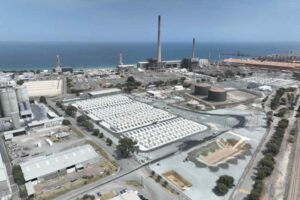
“This includes the construction of converter stations in Heybridge and Hazelwood, the installation of equipment, and the land cable civil works, spanning 90km across Gippsland,” Anderson said on Wednesday.
“Marinus Link is more than just an infrastructure project, it is a critical component of Australia’s clean energy future and a testament to the strength of the partnership between DT Infrastructure and Samsung,” said Gamuda Engineering managing director Justin Chin.
“For Gamuda, this collaboration exemplifies our strategic pivot towards high-value renewable energy infrastructure, with our expansion in Australia driven by a commitment to bring our ‘top-to-toe’ engineering expertise to the local market.”