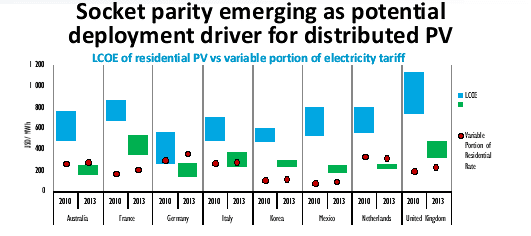
One graph in the International Energy Agency’s latest Solar Roadmap report highlights how the dramatic cost reductions in rooftop solar PV has caught the world by surprise – and caused the likes of the IEA to revisit their forecasts, and for incumbent industries to review their business models.
Four years ago, when the IEA did its last major Solar Roadmap report, socket parity (where the cost of rooftop solar is competitive with electricity from the grid) was just a distant dream – or so it seemed.
As this chart below shows, in 2010 the LCOE of rooftop solar (indicated in blue) was far above the variable rates of grid-based electricity. But in just three years, the LCOE (now in green) had caught up.
 It is for this reason that the IEA has had to double its forecast installation of solar PV over coming decades. Most of this is due to “socket parity”, where the IEA says rooftop solar is “unbeatable” by other technologies. It says rooftop solar will account for half of all solar PV installations out to 2050.
Some analysts think that the IEA is still being conservative, and may have to raise its forecasts again. But the stationary energy industry is not the only one to feel the pinch from the plunging price of solar PV, which has fallen around 60 per cent in the last three years.
This graph, which we have published before, and which its authors, the US investment firm Alliance Bernstein, dubbed the “terror dome,” shows the comparative trajectories of solar PV and liquid fuels, previously considered untouchable by solar.
The realisation that solar PV was now in a position to displace diesel fuel in some countries, oil in others, LNG in Asia, and gas in many developed countries, raised the prospect of energy deflation some time down the track. It may come in a decade, when investors realise that the money invested in more expensive oil and gas extraction might become stranded. That will precipitate a massive shift in capital – a long time before the deflation actually occurs.