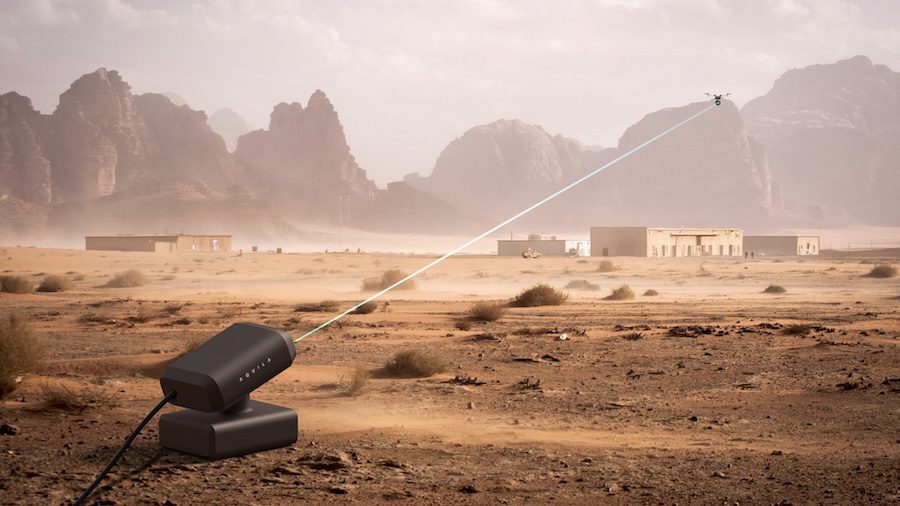
A New Zealand-founded, Australia-based company has powered a moving warehouse robot for 24 hours straight – using only a laser to beam electricity through space via infrared light.
The “world-first” demonstration, announced this week by Aquila Earth, has set two world records: highest total laser power transferred, and longest continuous duration.
In this case, the laser beam was delivering a steady 4 kilowatts of wireless electricity to a receiver on the robot, says Aquila Earth CEO Ruby Jones.
“[That] is exciting because it’s the most power that has ever been delivered to a dynamic platform. Nobody else has ever done it with that much power in power beaming, ever,” Jones told Renew Economy.
“[The] robot travelled 25 kilometres on light alone, with nominal battery [backup].”
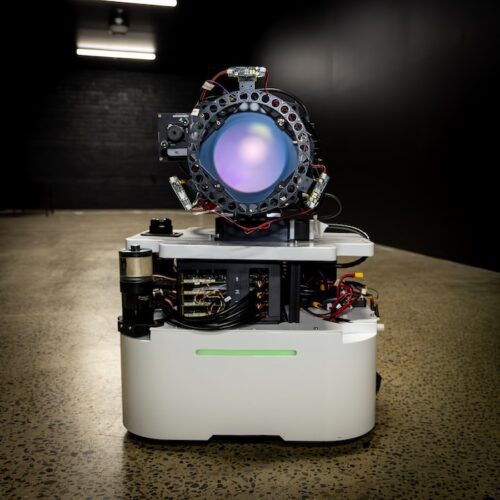
The device that proved it could be run on laser power for 24 hours. Image: Aquila Earth
It is difficult not to open any interview with Jones with a quip along the lines of “beam me up” – except we were not talking about using quantum entanglement to move bodies between spaceships and planets.
What we are talking about is the actually feasible – believe it or not – idea of sending electricity through space with a laser.
The latest test of Aquila Earth’s power beaming technology came after the company powered an airborne drone, in December last year, with a consistent 500 watts (W) of power.
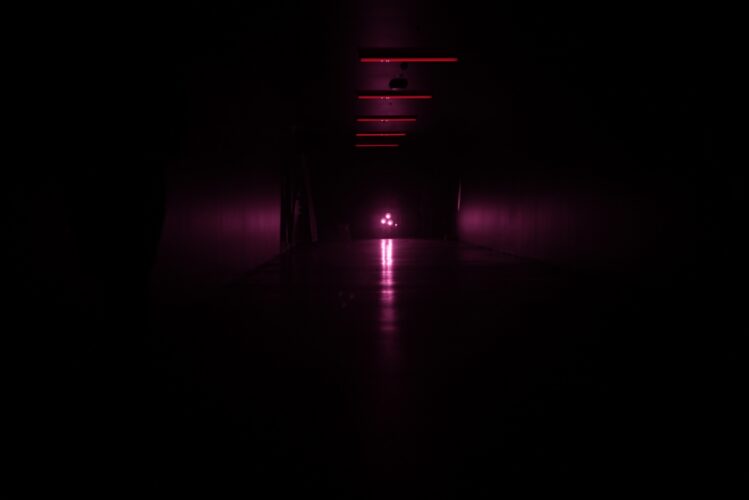
The images, this one of the power receiver, from the test are more Kubrick than Star Trek. Image: Aquila Earth
Jones says the next step will be powering airborne drones for similar lengths of time as was achieved with the robot.
The company started in 2022 and raised $3 million a year later. It is not the only – or the first – company to focus on laser-directed electricity.
Heavy-hitting rivals include Mitsubishi Heavy Industries, while the likes of SpaceX say they will beam electricity from space to earth.
Jones pooh-poohs the space-to-earth idea, not only because the cost of getting the equipment and materials into space is stupidly expensive, but because there are real questions of how it’s maintained, and protected from solar radiation, when it’s up there.
Perpetual energy
Aquila’s laser is the wireless equivalent of a power cable.
Instead of factories needing to swap or recharge batteries for autonomous robots, or drones that can only fly for a short period before losing power, the laser ‘tether’ can keep the machine running for as long as the power is switched on.
The laser switches off if an unknown body enters the area, a system that is foolproof enough to draw a bemused “it just does” from Jones when asked about what might happen if it didn’t work.
Jones’ vision is for a “perpetual” drone or robot that doesn’t have to rely on battery technology, which would need to make a big leap in power, size, and weight to achieve the same ends.
She says commercialisation of laser-powered electricity is now possible as rapid decline in cost means the technology is beginning to “make sense” economically.
“You could order a kilowatt level laser from China right now for like $6,000 if you want it… it’s amazing how easily accessible they are really, which is also a little bit alarming,” Jones says, with the proviso that it wouldn’t come with the smarts needed to send and receive electricity.
“It’s not too much of a bother for us on that end, but it does give an indication in terms of the economics of how much of a cost [reduction] you’ve seen. By comparison when we first got going [in 2022], some of the lasers that we were looking at were $120,000.
“Costs are really rapidly coming down and we’ve even seen quite a lot of that in the time that we’ve been alive.”
The company has “a couple” of partnerships penciled in with some “pretty large scale” drone companies, who are looking for long-lasting flights for quadcopters.
Aquila is aiming for commercial laser power in 2027.
Fixed wing drones can fly further but can’t take as much payload and are less simple to set up.
Jones says adding laser-power to a robot or drone is a fairly simple fix, as all the operator needs is a laser and to affix the power receiver to the device and it operates much like a battery pack – just one that is constantly plugged in.
If you would like to join more than 29,000 others and get the latest clean energy news delivered straight to your inbox, for free, please click here to subscribe to our free daily newsletter.