Home » Wind output overtakes hydro power for first time in Tasmania

Wind output overtakes hydro power for first time in Tasmania

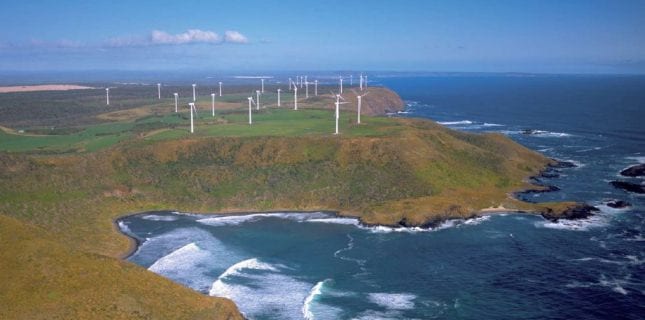
Woolnorth wind farm, Tasmania

Tasmania reached a new milestone on Friday when wind output overtook hydro output, likely for the first time.

According to OpenNem, operated by the Climate and Energy College, wind output totalled around 350MW (37 per cent) in the early hours of Friday morning, while hydro was scaled back to just 216MW (23 per cent) – see graph below.

The balance was made up from imports from Victoria. Tasmania has been importing in the morning, and exporting back to the mainland in the afternoon and evening.

It is believed to be the first time that wind power has overtaken hydro power in the island state, and comes after the recent additions of the 148MW  Cattle Hill wind farm, which starting sending power to the grid in January, and the 112MW Granville wind farm, which began operations in February. They join the existing Musselroe and Woolnorth wind farms, with others on the way.

Tasmania ostensibly runs close to 100 per cent renewables, thanks almost entirely to its considerable portfolio of hydro generators, but has been adding new wind farms in the past few months and this is starting to change the shape of the local energy portfolio.

But Tasmania has aspirations well beyond 100 per cent renewables, with the state Liberal government recently announcing a target of 200 per cent renewables, looking to export power to the mainland through the proposed Marinus Link to Victoria, and through the exports of “green hydrogen”, sourced from its hydro and wind resources.

The South Australia Liberal government also has an ambitious renewables policy, aiming for “net 100 per cent” renewables by 2030, and then becoming an exporter of renewables, to neighbouring states through new and upgraded transmission links, and through renewable hydrogen.

The ACT Labor/Greens government also has a 100 per cent renewable energy target, which it has met, and which is supported by the local Liberal opposition, and plans to do more, particularly to support a transition of its transport fleet to electric.

Tasmania, South Australia and the ACT all have one common factor which might explain their ambitious renewable energy targets: They don’t have a coal industry, or coal lobby.


 

Giles Parkinson is founder and editor-in-chief of Renew Economy, and founder and editor of its EV-focused sister site The Driven. He is the co-host of the weekly Energy Insiders Podcast. Giles has been a journalist for more than 40 years and is a former deputy editor of the Australian Financial Review. You can find him on LinkedIn and on Twitter.

Latest posts

S-curve modelling says renewables can kick coal out of Australia by 2032. But is this soon enough?

S-curve modelling says renewables can kick coal out of Australia by 2032. But is this soon enough?

In the race to renewables, the big question is whether “faster than we thought” is the same as “fast enough.” S-curves say we can do the first. Nothing in the modelling tells us we’re on track for the second.
“It’s a commercial system. And it has a customer:” Sodium-ion battery sale hailed as a first for Australia

“It’s a commercial system. And it has a customer:” Sodium-ion battery sale hailed as a first for Australia

The sale of a 100 kilowatt and 200 kilowatt-hour sodium-ion battery system is being claimed as an Australian first – and may herald next generation of storage tech.
Energy Insiders Podcast: Will the green bank save the Tomago deal?

Energy Insiders Podcast: Will the green bank save the Tomago deal?

CEFC boss Ian Learmonth explains why big wind projects may finally get delivered this year. Plus: Tomago aims for 100 pct renewables, and the big utility profits.
Balcony solar or building integrated PV? The emerging options for apartment dwellers and owners

Balcony solar or building integrated PV? The emerging options for apartment dwellers and owners

A Victorian parliamentary inquiry on apartment energy issues has recently reported and identified several issues that require urgent attention to address the failures of energy policy. One interesting issue that relates to both high rise apartments, and plug-in ‘balcony solar’, is where solar fits into apartment occupant energy costs.  High rise apartment buildings have very […]