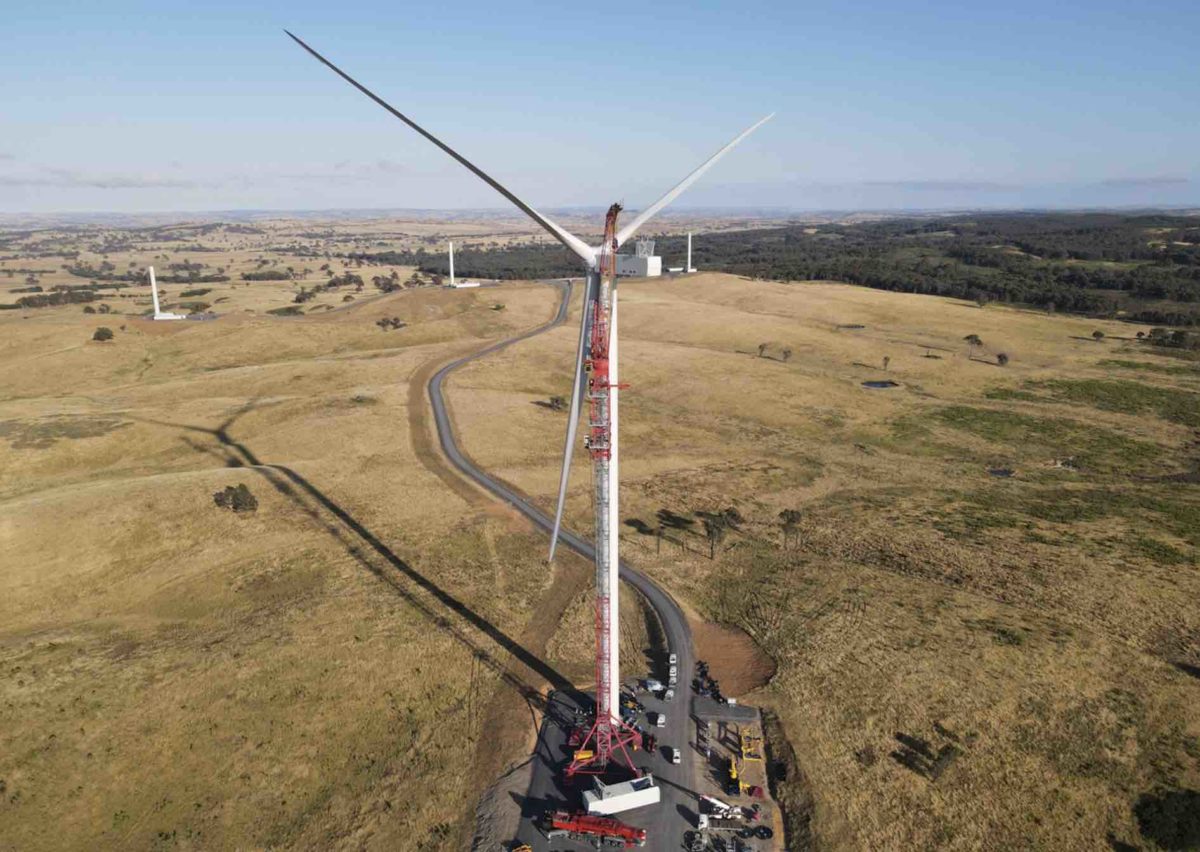
A New South Wales wind farm is seeking approval to ramp up mitigation measures after its developer revealed the project’s turbines had killed 20 wedge-tailed eagles within a period of just 18 months.
Tilt Renewables shared the grim statistics at a mid-week meeting of the Rye Park Community Consultative Committee (CCC), in the Southern Tablelands region that hosts its 360 megawatt (MW) Rye Park wind farm.
In a post shared to Facebook, Yass Valley Councillor Alvaro Charry said the CCC had requested all records of bird and bat strike incidents across the wind farm and details of mitigation measures currently in place, in response to the “deeply saddening and concerning news.”
The number and frequency of the eagle deaths will have long since triggered the threshold for Tilt to report them to the environment departments of both the state and federal governments, and to consult on and implement mitigation measures – and then report on the result.
Tilt has confirmed this to Renew Economy, saying it has been actively monitoring the project’s impacts from the start of development, and has been consulting with experts and governments on the eagle deaths for more than a year.
“Tilt Renewables takes seriously any impacts our wind farms have on the local environment – especially in relation to bird strikes,” a company spokesperson said in an email.
“Wedge-tailed Eagle impacts are higher than expected at Rye Park compared to our other wind farms, and we are doing something about this.”
Death and injury caused to birds by wind farms is a common complaint against the technology, although solid figures on this – in particular, in comparison to other energy technologies – are not easy to come by.
It is also a highly emotive issue, easily co-opted by Australian politicians known for their ideological hatred of renewables, including National Party senator Matt Canavan and One Nation senator Malcolm Roberts, who regularly refer to wind turbines as “bird-killing machines.”
Clearly, however, wind farms do result in a portion of human-induced bird deaths and the problem is taken seriously by governments, regulators and industry, with developers required to prepare and stick to comprehensive bird and bat management plans.
In a small number of cases, projects have been ruled out by federal or state environment ministers over their projected impact on critically endangered bird species, like the orange-bellied parrot.
In one case, in Victoria, a wind project was approved on the condition that construction was paused for five months of each year, to accommodate for the brolga breeding season from July to November.
Other projects have opted – or been required – to install sophisticated mitigation technologies like Boulder Imaging’s IdentiFlight cameras, which detect birds flying near turbines and shut them down to help prevent collisions.
The Rye Park wind farm won State Significant Development approval from the NSW Planning Assessment Commission in May 2017, with modifications made in 2021 allowing for fewer, but larger turbines.
The project received federal environmental approval in June 2021, when the environment minister under the then Coalition government was Sussan Ley. Rye Park officially entered full operations in late 2024.
Both the state and federal approvals were subject to a range of conditions, including to submit a Bird and Bat Adaptive Management Plan (BBAMP) that is required to achieve separate approvals before commissioning.
According to Rye Park’s BBAMP, the impact trigger threshold for the wedge-tailed eagle – which in NSW is not listed as a threatened species, but is a fully protected native animal – is “detection of two or more carcasses, injured individuals or featherspots under or near the same or adjacent turbines … in any two consecutive months.”
Once triggered, the developer must then notify the state’s Biodiversity, Conservation and Science (BCS) Directorate within one working day and – as the diagram below shows – and then with a comprehensive report on the deaths within 15 working days.

Source: Tilt Renewables Rye Park Wind Farm Bird and Bat Adaptive Management Plan
From there, the developer consults with government officials to determine whether targeted monitoring or mitigation measures are required. If so, a further report on the findings and effectiveness of the actions must be submitted within three months.
From that point, the developer and the government departments consult on whether further action is required.
According to BBAMP, the range of mitigation measures required to address wedge-tailed eagle deaths include the removal of dead animals around the turbines, to stop the eagles from hunting in areas of high danger.
The use of radar and/or camera systems like IdentiFlight is another option, such as are used for projects in Tasmania, where wedge-tailed eagles are listed as endangered. Altered land management practices and painting one blade of each turbine black are also recommended as mitigation measures.
In this case, the BBAMP does not recommend the temporary shut-down of turbines for wedge-tailed eagles, a measure reserved for mitigation of deaths of endangered species, which for Rye Park include the superb parrot, the large bentwing bat, and the whitethroated needletail.
Tilt says it has been in discussion with the Department of Planning, Housing and Infrastructure – Conservation Programs, Heritage and Regulation Group and has prepared a multi-step Wedge-tailed Eagle Mitigation Plan.
Any material changes to the project, such as the addition of cameras or the painting of turbine blades, require planning approval.
“The first step we have been doing is searching and removing any dead sheep and cattle carcasses as well as rabbit warrens that may attract eagles to our wind farm,” a spokesperson said
“We continue to actively monitor bird deaths and will put in place more mitigation measures as agreed with the Department.
“We also work with our ecologists and have sought out expert advice from a wedge-tailed eagle specialist.”
Farmers for Climate Action says active mitigation measures to avoid bird deaths should be mandatory for all wind farms from the start of operations.
“Farmers love their birds, and they especially love wedge-tailed eagles,” NSW farmer Peter Holding said in a statement on Friday.
“The shift to clean energy can be kind to nature. There are affordable and effective solutions to this issue: Cameras which stop blades spinning when eagles approach, which has worked extremely well on two Tasmanian wind farms without affecting profitability.
“Radars to detect birds and painting one turbine blade a different colour have also worked in other countries.
“The time for consideration is over. The time for action is now. We ask government to make these bird kill mitigation measures standard conditions for wind farm approval.”
According to a government fact-sheet, wedge-tailed eagles are believed to provide a range of benefits to farmers, such as pest control and property hygiene – but this was not always the case.
“In the past, the wedge-tailed eagle was the world’s most persecuted bird of prey. A bounty system in some Australian states encouraged the slaughter of tens of thousands of eagles annually,” the fact sheet says.
“The practice stopped when it was realised that eagles usually attack only sick, dying or dead lambs and rarely create an economic problem for farmers.”
These days, wedge-tailed eagles are protected under the National Parks and Wildlife Act 1972, making it illegal to kill, trap or poison them. In 2018, in Victoria, a farm worker was jailed for 14 days and fined $2,500 for poisoning 406 wedge-tailed eagles at three remote properties in the state’s east.
If you would like to join more than 29,000 others and get the latest clean energy news delivered straight to your inbox, for free, please click here to subscribe to our free daily newsletter.