Technology being used at two Tasmanian wind farms to avoid bird deaths from turbine blade strikes has drastically reduced wedge-tail eagle fatalities at the project sites, while resulting in an average of just 1 per cent curtailment of generation from turbine shutdowns.
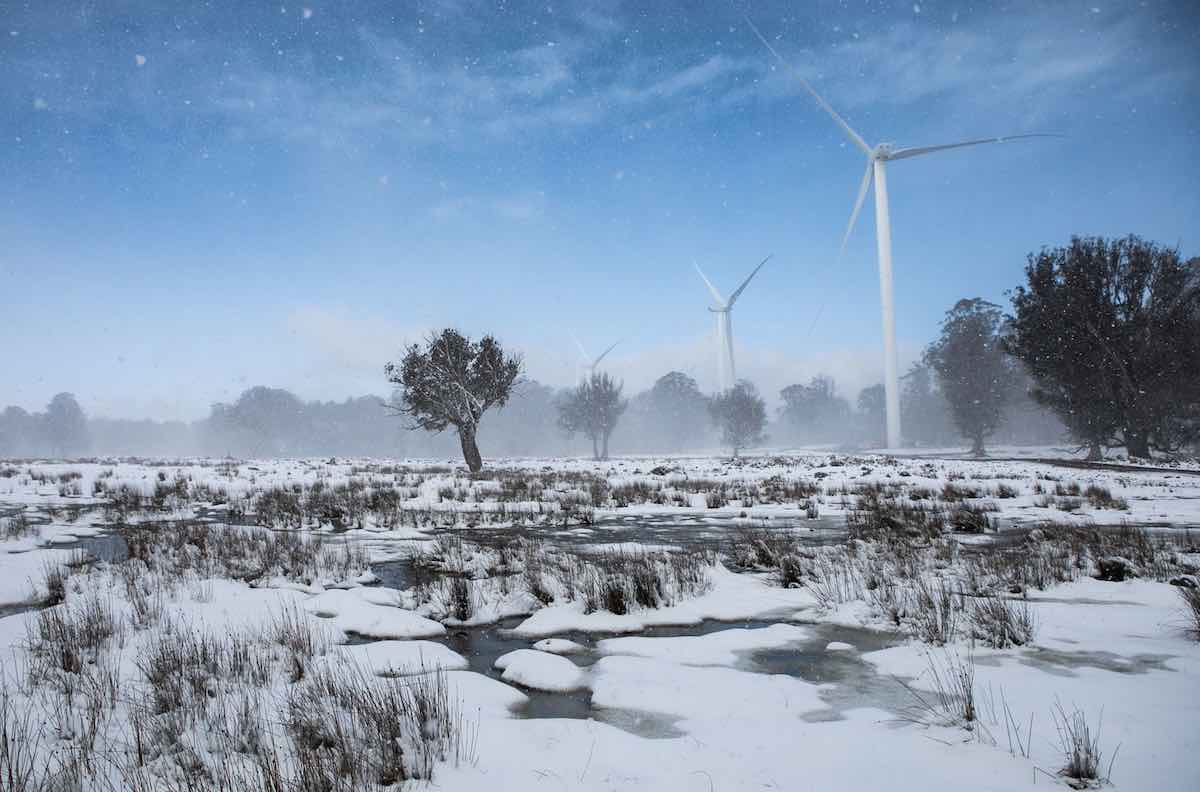
Goldwind Australia’s Medard Boutry says the 144 MW Cattle Hill wind farm in Tasmania’s Central Highlands has not had any fatalities for more than a year and a half, since an upgrade to the project’s aerial monitoring and detection system, called Identiflight.**
Identiflight, developed by US outfit company Boulder Imaging, uses machine vision and AI technology to detect, classify and analyse avian activity and – if protected bird species are detected – to temporarily shut down any wind turbines that present a risk to the bird.
Outside of the US, Tasmania was one of the company’s earliest testing grounds, with the a 16-tower system at Cattle Hill first trialled in 2019 and upgraded in the first half of 2023 to address a blind spot discovered during the trials.
A newer version of the technology, IdentiFlight V5, had its global debut at Tasmania’s Musselroe Wind Farm, in collaboration with project owner Woolnorth Renewables.
“Tasmania … was a surprising delight in our business, not only because we were able to have our first sales here, but it proved to be an incredibly fertile ground for which we could perfect our technology and our craft,” Boulder Imaging’s Don Mills told the 7th Annual Tasmanian Energy Development Conference in Devonport last month.
“I just was at Musselroe yesterday. There’s been no fatalities in our first year there.”
Mills, who is Boulder Imaging president and chief operating officer, and a developer of Indentiflight, said it was his fourth time attending the Tasmania conference, but the first time that the event did not attract protesters.
“I was disappointed to see the guy in the eagle suit was not out there this year, because last time I went up to him and I said …can I tell you the story of our technology? And he goes, ‘No.’ And I said, ‘Can I buy you a pint?’ He said, ‘No.’ So I kind of gave up.”
Death and injury caused to birds by wind farms is a common complaint against the technology, although solid figures on this – in particular, in comparison to other energy technologies – are not easy to come by.
A Canadian study in 2013 found that wind turbines did not make the list of the top 10 biggest bird killers nationally, where power line collisions and electrocutions ranked second, and collisions with houses and buildings ranked third.
Nevertheless, in certain spots considered perfect for wind farms, concessions must be made for local populations of bird species, particularly those that need to be protected. And in Tasmania, the preservation of the wedge-tailed eagle is of particular concern.
“At many of these wind sites … these large raptors in particular, you know, with 1.5 metre wingspans and above, they really don’t like to flap their wings – they like to ride the wind, and that’s why they often coexist in sites that have abundant wind energy potential.
“And so we have to make sure that [our systems don’t go] down,” Mills told the conference. “The durability is critical.”
Mills says the company is now moving into mainland Australia, with more than 500 identified units proposed in more than 35 projects.
“We’re beginning studies to incorporate the technology with some of the more endangered species in those areas, in the different states in Australia,” he said.
“And … [that] means that we’re going to grow our species list. We’re working to expand our technology into nocturnal and bat activity, as well as migratory birds that often will fly at night.”
Goldwind’s Boutry says there have been lots of learnings from the IndetiFlight system at Cattle Hill, where after five years they have gathered 700,000 eagle tracks, more than 20 million eagle photos, and more than 5 million photos of other species of birds.
“The cameras [are] … picking up any birds that are flying into the wind farm within range, and they hold on and lock on for seven seconds while they determine whether it’s an eagle or not.
“There’s an amazing catalog of information on the suite of different species … there’s a lack of data, often, on these species, and so this, I think, is a big step forward in closing that gap.”
Boutry says that at Cattle Hill, the team has found that eagle activity has actually increased since the start of construction.
“I was there last week and, yeah, you do see curtailments, they do happen quite regularly, but overall they’re managed now to less than 1%,” he told the conference. “And we haven’t had any fatalities for over a year and a half now.”
**The Cattle Hill Wind Farm EPBC Annual Compliance Report, published in November 2025 – four months after this article was published – reports that one Tasmanian wedge-tailed eagle was killed by a turbine at the Cattle Hill project in October 2024, after the upgrade of the system. The article’s headline has been updated to reflect the information revealed post-publication.