Donald Trump’s abandonment of the US’s climate goals won’t deter Australian investment in clean energy, with the sector promising tens of thousands of new jobs.
Australia has an enormous opportunity to speed up investment in clean energy after newly-minted president Donald Trump ended the United States’ embrace of renewables, the prime minister says.
Within hours of becoming president, Mr Trump has already pulled the US – the world’s second-largest greenhouse gas emitter – out of the Paris climate agreement, vowed to halt new offshore wind farm approvals and signed orders speeding up drilling for fossil fuels.
While the move spells bad news for global carbon emissions, with the US currently producing around 14 per cent of global emissions, the freeing up of financial capacity could benefit renewable energy developers in Australia.
The global pool of project finance will still remain and that capital will need to be deployed somewhere, Clean Energy Council spokesman Chris O’Keefe said.
“Given our competitive advantage here in Australia, with so much wind and so much solar, we’d be crazy not to welcome it with open arms,” he told AAP.
“That is a real opportunity for us, and that is happening already.”
Prime Minister Anthony Albanese acknowledged the US’s new climate stance would impact the world but maintained Australia would “continue to take action on climate change”.
“Even if you didn’t accept the science of climate change, the economic opportunity that is there is enormous for us, not just to reduce emissions, but to grow our economy and grow jobs,” he told reporters in Sydney on Tuesday.
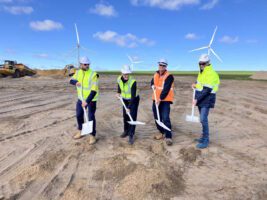
More than 40,000 jobs are set to be created in the industry nationwide over the next five years.
“It generates hundreds of thousands of dollars for farmers to mitigate the impacts of drought or flood,” Mr O’Keefe said.
“It generates millions of dollars for communities, not just in direct benefits through community benefit funds, but the jobs it generates.”
Community support for renewable energy was stronger in Australia than in the US, partly because of a lack of political tribalism but also because of an understanding of the direct benefits derived from clean energy projects.
Regardless of the politics of climate change, coal-fired power stations would have to close sooner or later and clean energy provides an opportunity for continuity of employment.
“The industry would certainly like to see a situation where you have families who’ve spent generations in the energy industry continuing in the energy industry,” Mr O’Keefe said.
“These clean energy projects offer those families choice, so the kids don’t have to move to the cities paying extraordinary housing prices just so they can get some work.”
The Australian Conservation Foundation urged the Albanese government to ramp up its Future Made in Australia agenda and commit to a strong 2035 emissions reduction target.
“In 2016, US withdrawal from the Paris Agreement was not sufficient to derail global cooperation on climate action, or the acceleration of the clean energy transition,” said ACF climate policy adviser Annika Reynolds.
“Around the world, governments, businesses and communities will continue to push for action to tackle climate change, irrespective of what the US president does.”
Source: AAP