A local First Nations group has secured an equity stake in a major $450 million battery storage project in western NSW, in a first-of-its kind deal that the developer and local indigenous leaders hope will become a template for the industry.
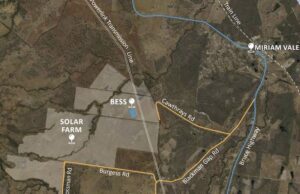
The landmark deal has been struck by Ampyr Australia, a new battery storage developer backed by Singapore-based AGP, and the Wambal Bila indigenous community corporation, for the 300 megawatt (MW), 600 MWh Wellington battery, which is to be built next to two existing solar farms owned by other parties.
Wambal Bila (a Wiradjuri word for mountain-river) has an option – through an equity right – to take a 5 per cent equity stake in the battery project. It is believed to be the first such deal with a First Nations group that does not involve Native Title or other legal rights.
It will not be a gift. Wambal Bila must secure a loan for the purchase of the stake, but it will structured to ensure that loan payments are smaller than the returns from the equity investment, which are estimated by Ampyr Australia’s Alex Wonhas as between $20 and $30 million (for Wambal Bila’s share) over the 20 year life of the project.
“It’s potentially transformational,” says Gavin Brown, a director of Wambal Bila, the new corporation that has been established for the deal.
Brown says that other renewable and storage developers (there are many around in the Central West Orana renewable energy zone around Wellington) had approached First Nations groups, usually in terms of training, some jobs and apprenticeships, but the scale of this deal mean significant social and community benefits.
“They (Ampyr) were the first to come up with the opportunity, and talk about things like equity,” Brown told Renew Economy. “We are not asking for gifts … and that for us is the strong bit of scaleability.”
Wonhas, a former senior engineer with the Australian Energy Market Operator who led the development of the Integrated System Plan, its multi decade planning blueprint, before moving to the private sector, says the company is trying to be ambitious and innovative.
“First Nations communities have been marginalised and have not got their fair share of benefits,” Wonhas told Renew Economy. He says colleague, and another former AEMO employee, Brad Hopkins came up with idea. “It’s a great opportunity to give something back to community, and a great opportunity to lead the industry as a whole.”
Wonhas says the deal is not reliant on native title interests, and it is commercial. “This is why this works, and why it is scaleable. Wambal Bila has the option to invest, they are not forced. They are taking a loan to pay for equity, but the interest for the loan is lower than the equity payout. And it is all constructed in way that has no recourse.
“It’s been a lot of hard work. I hope it becomes easier next time, because it’s the right thing to do, it helps us do something different, it helps us attract the right investors and off takers who are aligned with those values, and it helps build better connections to local community.”
Wonhas says Ampyr intends to seek a similar deal with future projects. These include the second stage of the Wellington battery, likely sized at 100 MW and 400 MWh, which is now called the Bulabul battery (Bulabul means “two acting together” in the local Wiradjuri language) and for the proposed Swallow Tail battery located near Bannaby.
Ampyr itself intends to deliver more than 6 GWh of grid-scale battery storage in strategic grid locations by 2030, providing up to 20% of Australia’s future storage demand.
“We hope this sets a new industry standard that will soon become the norm for energy projects in Australia and beyond,” Wonhas says.
“If this can be applied across the industry, and you consider that at least $120 billion of investment is required (for wind, solar and storage), that could be a total return of well over $1 billion for First Nation groups.”
The equity arrangement will see Ampyr Australia provide up to $300,000 to support Wambal Bila to establish its initial operations. The underlying equity stake includes both a right to a preferred, fixed annual return ($100,000) and a share of ongoing equity returns alongside other investors.
Corrs Chambers Westgarth advised the community and Wambal Bila on a pro bono basis on its establishment and entry into the partnership, Ashurst advised Ampyr Australia on the development of the equity structure, and Yamagigu Consulting provided financial and strategic support to the community and Wambal Bila.
See Renew Economy’s Big Battery Storage Map of Australia for more information.