We’re deep into what’s been described as “debate season”, and for a political party that began this election campaign on shaky ground, there are increasing signs of desperation and weirdness coming from the Coalition.
Part of the party’s plan to keep coal and gas at their maximum levels over the coming decades has been offering a false, manufactured vision of nuclear power for the future.
It’s an intense form of greenwashing and the important thing to remember is that the party that spent nine years not legalising nuclear power when they were in government will absolutely never, ever decide to do that if they were to win power again. Honestly, Labor is more likely to eventually legalise nuclear power than the Coalition is.
The dynamic of fabricated promises was demonstrated perfectly on the ABC’s 730 program debate between shadow treasurer and former energy minister Angus Taylor, and Treasurer Jim Chalmers. Taylor has a long and amusing history of gaffes and mistakes in energy, and during this debate, he claimed:
“We know that by building seven 2 gigawatt baseload generators which will deliver a return to shareholders, which will be the taxpayers – they’ll deliver a return – that’s how they’re paid for.”
The Global Energy Monitor’s amazing nuclear power tracker lets us quickly check out how large nuclear power units tend to be, and we can see that they’re consistently smaller than two gigawatts:
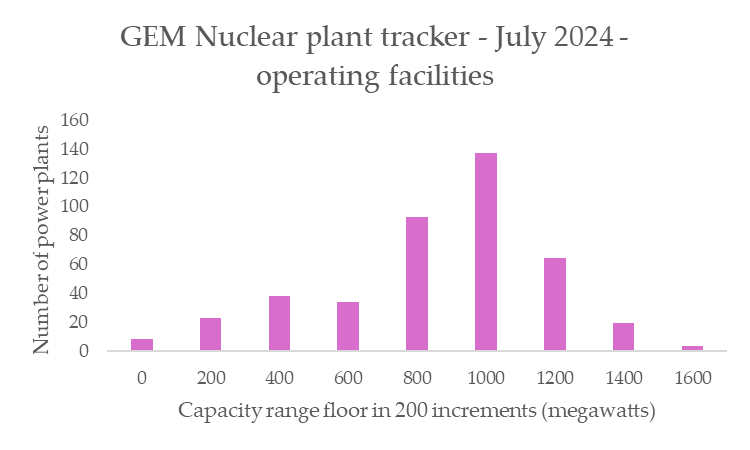
Being as generous as possible, let’s assume Taylor meant entire power plants rather than individual units or reactors. Indeed, the majority of the world’s nuclear power plants feature multiple units, and have an installed capacity greater than two gigawatts, so let’s let him have that one.
He then goes on to claim that each of these two gigawatt plants will be built for less than $20bn dollars. This is seemingly based off the Frontier Economics modelling that assumed a capital cost of nuclear plants at $10,000 per kilowatt of capacity.
As others such as IEEFA have pointed out, this is a wildly optimistic assumption that isn’t well reflected by the modern state of the nuclear industry. Eg, “For example, UK’s Hinkley C nuclear plant is likely to cost at least $27,500/kW – almost three times more than Frontier’s estimate”.
These sorts of numbers matter, because Taylor explains in the interview that this isn’t a matter for private enterprise. This is a big public investment push: the taxpayers will be left footing the bill if there are cost blowouts for plans like this, which of course there will be.
Taylor claims his figures are in line with the CSIRO’s estimates of nuclear power capital costs, but even the CSIRO’s estimates have been criticised of painting a too-rosy picture of the real costs of building this technology.
To me, this stands out as one of the most concerning elements of the Coalition’s energy plan. The technologies they are sincere and motivated in supporting – coal and gas – both bear immediate and terrible risk for the public. Not just in the health risks of their use but also the financial risks that Australians will face when taxpayer’s cash is used to extend unreliable, clapped out power plants for decades.
And once that’s all done, in the unlikely event the Coalition actually does intend to build nuclear, it’s a shift to an entirely new style but equally terrible form of financial risk as projects face cost blow-outs and delays.