Sydney-headquartered Fulcrum3D has received a grant from Arena to demonstrate and validate its “next generation of remote sensing” technology – including a 200 metres-plus high mast that will be the tallest of its kind anywhere in the southern hemisphere.
The company says its new technology, dubbed “Fulcrum3D RAS”, can remotely profile three-dimensional wind vector and air temperatures up to 300m above ground level.
Crucially, unlike traditional atmospheric monitoring technology, Fulcrum3D claims its new technology doesn’t rely on naturally occurring and unpredictable thermal turbulence or aerosols when taking measurements.
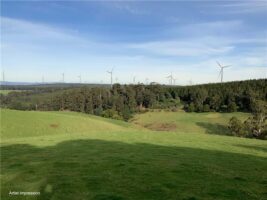
To validate this new technology, in partnership with Arena, Fulcrum3D is constructing a 200m+ mast that’s set to become the tallest of its kind anywhere in the southern hemisphere. The mast will form a key component of the country’s first “National Remote Sensing Validation Facility” in Victoria.
The proposed location for the site has been chosen due to its flat terrain and absence of nearby wind turbines. Due to the validation facility’s high sensitivity, Fulcrum3D has asked developers to maintain a 10km buffer between the new site and future wind turbines.
The entire validation facility has been estimated to cost around A$1.9 million, with A$952k of funding provided by Arena.
Fulcurm3D says the facility complies with IEC 61400, which are the set of international standards governing the safe design of wind turbines. Construction of the mast will be carried out by Fulcrum3D’s in-house rigging team, scheduled for completion by the end of this year.
Open to the whole wind industry
From the first quarter of next year, Fulcrum3D and Arena plan to open up the facility to the whole wind industry, in order for other companies to validate their own remote sensing equipment, such as SODRA and LIDAR, prior to deployment on site.
“The independently validated remote sensing devices that utilise the facility will accelerate the financial close of wind projects across Australia, as well as greatly improve our understanding of atmospheric stability, shear and temperature profiles at higher heights,” explained Fulcrum3D.
It’s hoped the new facility will “enable pre and post campaign validation of remote sensing reducing – and potentially eliminating – the reliance on per-project wind monitoring masts for the development of wind projects.”
Fulcrum3D confirmed that the Australian arm of assurance and risk company DNV will be one of the first companies to utilise the validation facility once it opens to the wider industry in 2026.
Note: The National Remote Sensing Validation Facility will be built near Leitchville, Victoria (-35.920213, 144.204135) and is expected to be completed by the end of 2025.