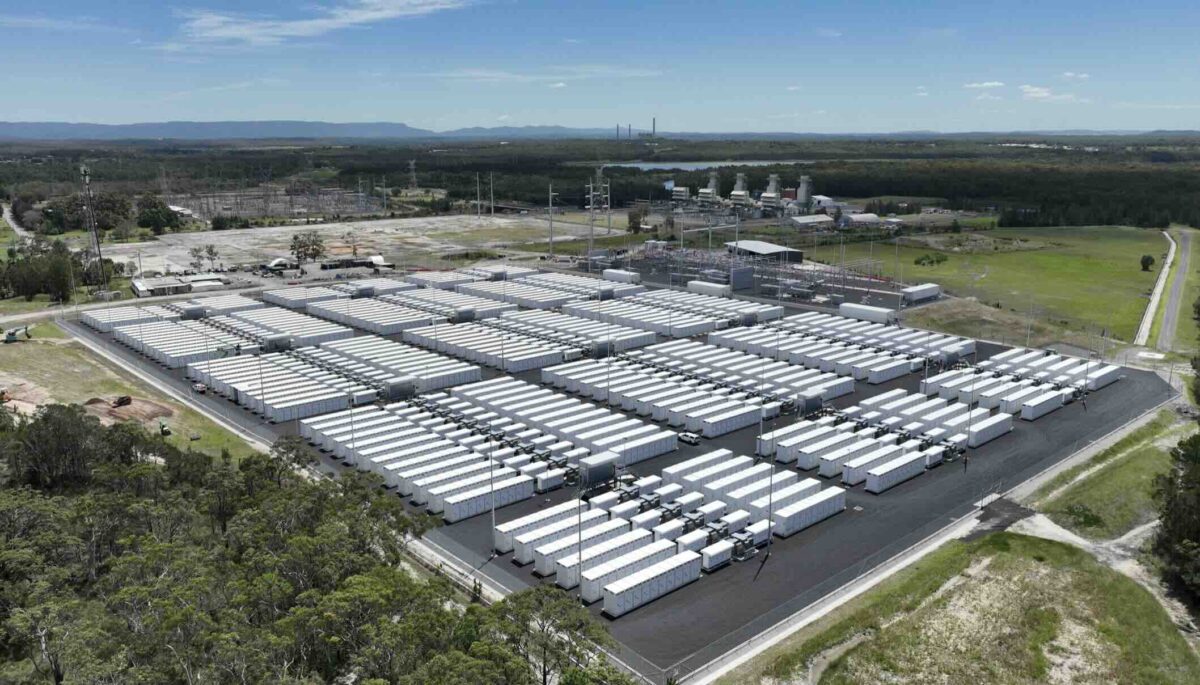
The Waratah Super Battery may no longer be the biggest battery in the country in terms of energy storage, but its sheer power is allowing it to smash new records on Australia’s main grid, for both supply and for load.
The 850 megawatt (MW) and 1680 megawatt hour (MWh) Waratah battery has been built by Akaysha Energy on the site of the shuttered Munmorah coal generator, and is contracted to act as a kind of “giant shock absorber” in anticipation of the impending closure of the country’s biggest coal generator, Eraring, located just up the road.
It has been steadily working through its commissioning process in the last few months, and it has been smashing charging and discharging records along the way. But now it is reaching a whole new level as it reaches its latest “hold point” and approaches numbers that have rarely been seen by any generator or industrial load in the country.
On Monday morning, as part of its ongoing testing, it injected up to 708 MW into the grid, and just minutes later turned around and charged at the same rate.
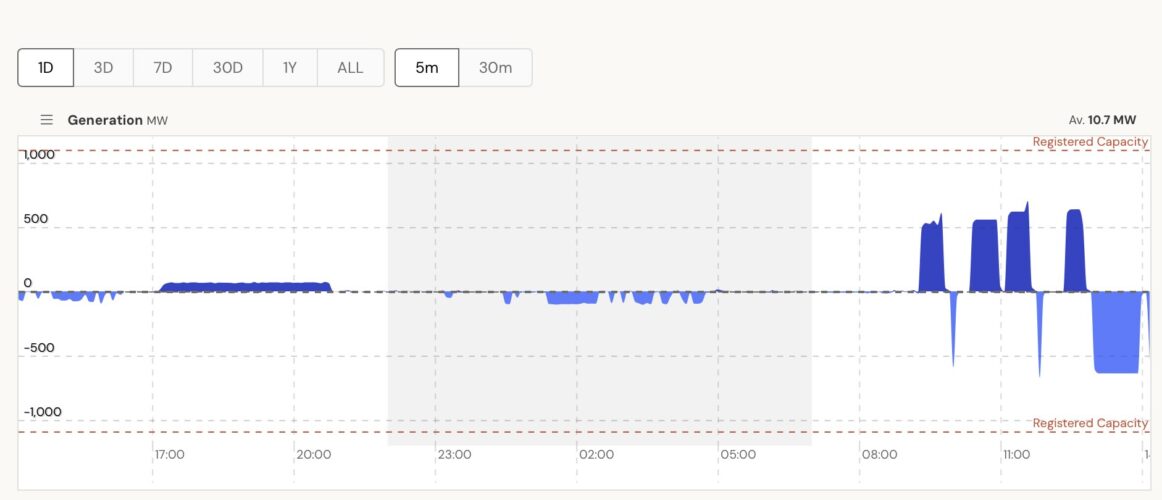
The new injections – both into the battery and into the grid – easily break the records set by the Waratah Super battery earlier this month. See: Waratah, Australia’s most powerful battery, smashes output record again
But according to Akaysha CEO Nick Carter, it is – for now, the third-largest dispatched unit after Kogan Creek (744 MW) and Eraring (720 MW).
“That comfortably exceeds previous large-battery benchmarks (~300 MW in Victoria) and confirms our ability to supply large, fast-responding capacity to the grid,” he said in an emailed statement.
When fully commissioned, Waratah will be the biggest machine of any type connected to the Australian grid, because of its 850 MW power capacity which puts it above the current title holder, the 750 MW Kogan Creek coal generator in Queensland.
But what is more interesting about the Waratah battery is the scale of its flexibility – it can change from being the biggest supplier in the grid, to becoming one of, if not the biggest, load – all in a matter of seconds if required.
Flexibility, of course, is what will underpin a grid dominated by variable renewable energy sources such as wind and solar. The reliance on “baseload”, grid operators and even coal plant owners freely admit, will fade quickly into memory.
Waratah, for the most part, will be paid to act as a giant “shock absorber”, which means ensuring it has enough capacity – up to 700 MW and 1,400 MWh, depending on the time of day – that can respond in case a lightning strike or other issue affects the transmission lines transporting power into the state’s major load centres.
The “shock absorber” contract allows the transmission lines to operate at greater capacity – and it also involves the Sapphire wind farm, the Metz solar farm and the Tumut pumped hydro facilities to also respond should the battery be called into action.
And see Renew Economy’s Big Battery Storage Map of Australia