Capacity Investment Scheme-winning wind projects struggling to meet the terms of the contract they were awarded should “relinquish” those contracts and reapply to an upcoming tender, to deliver these “important projects” as quickly as possible.
The advice was delivered direct to industry on Wednesday morning at the Australian Wind Energy 2026 conference by Matthew Brine, the deputy secretary of energy for the federal government’s Department of Climate Change, Energy, the Environment and Water (DCCEEW).
It builds on comments from federal energy minister Chris Bowen late last month that winners of the Capacity Investment Scheme (CIS) are able to re-bid, but are not able to change contracts that have already been awarded.
There has been speculation about possible changes to the CIS since Bowen first acknowledged the difficulties with wind energy in an episode of Renew Economy’s Energy Insiders podcast in late April, where the minister said wind will “require further work.”
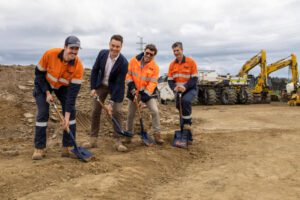
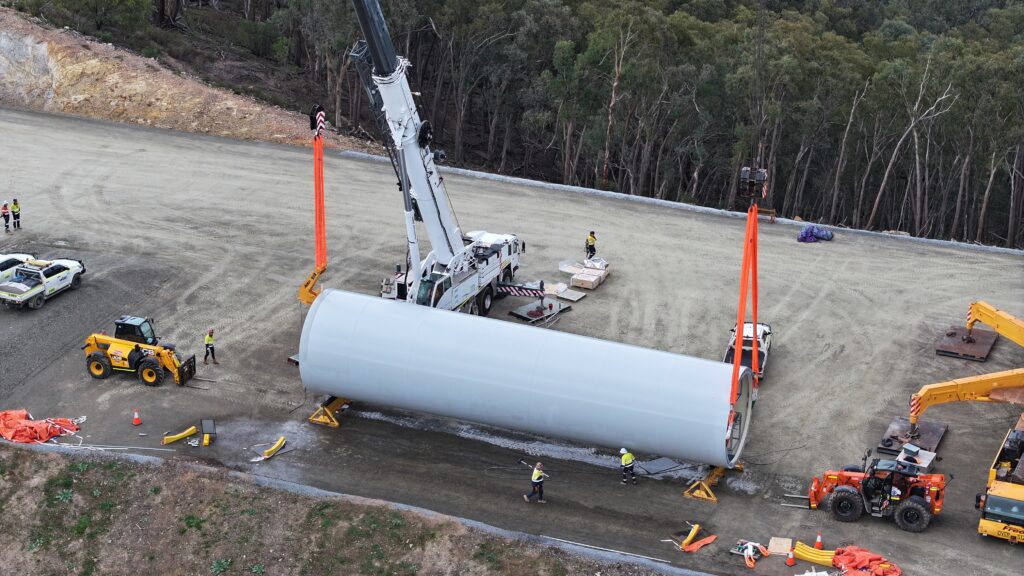
Just three wind CIS-winning projects are currently being built; Aula Energy’s 256 megawatt (MW) Carmody’s Hill wind project started construction in April, Tilt Renewables’ 108 MW Waddi wind farm in Western Australia, and Tilt’s 288 MW Palmer wind farm in South Australia.
But in comments to AuWE 2026 on Wednesday, Brine reiterated that renegotiation of existing CIS contracts for struggling wind projects was not on the cards – and warned that projects that aren’t making enough progress could get their marching orders.
“We’ve increased the priority of deliverability in the tenders compared to financial costs, and we are starting to actively manage our CIS contracts to terminate engagement if we aren’t seeing the progress that we expect – with that capacity then made available for upcoming tenders,” Brine told the conference.
“At the same time we do recognise that some projects that have signed CIS contracts are under real pressure due to changes in circumstances out of their control.
“Since 2021, wind costs have increased by up to 40 per cent, financing has become harder, supply chains remain complex, and transport and connection hurdles continue to present difficulties.”
Brine says that of the 65 renewable projects totalling 22.7 gigawatts (GW) that have been awarded CIS contracts so far, 31 projects – or 13.7 gigawatts – have been wind projects.
“That means 60 per cent of the announced his capacity has been made up of wind,” he said.
“The recognition of wind’s value is even stronger in the most recent tenders. In NEM tender seven, announced in May, wind represents more than 70 per cent of the successful capacity.
“In the WEM generation tender, wind represents 80% of the successful capacity, so we are … choosing wind projects through the capacity investment scheme.
“We really want to see these projects get delivered. However, a red line for us is that we are not able to renegotiate the terms of the underwriting arrangements after the signing of CIS agreements. Similarly, we can’t renegotiate the value of the social license commitments,” Brine told the conference.
“The CIS is a competitive process. Projects bid on their costs, assumptions, and delivery pathways. Other projects were assessed against them.
” If signed agreements were reopened after the fact, it would weaken confidence in the Capacity Investment Scheme and send the wrong signal that competitive outcomes can be revisited later if circumstances change.
“Where a project is no longer deliverable on the terms of bid, the appropriate pathway is to withdraw and [re-]bid with updated economics,” Brine says.
“There is a CIS renewable tender currently open for projects in all the NEM regions, other than New South Wales, and there is scheduled to be one further CIS tender in the NEM later in the year, and another tender in the WEM. In New South Wales, the … government has restarted the LTESA tenders.
“If you do not consider your CIS [agreement] is currently adequate to deliver your project, my recommendation would be to relinquish the [contract] and reapply into one of those tenders and secure the support you need to deliver these important projects as soon as possible.”
Brine says that while the CIS was designed to reduce some of the risks facing proposed renewable energy projects navigating the energy transition, it was never intended to remove all risks.
“[The CIS is] really focused on reducing financial risks, particularly those associated with policy uncertainty around the timing of the closure of coal-fired generators, recognising the impact this has on prices,” he told the conference.
“This gives investors certainty, while still expecting proponents to plan their projects well, manage their own costs, meet their agreed milestones, and deliver their projects.”
If you would like to join more than 29,000 others and get the latest clean energy news delivered straight to your inbox, for free, you can click here to subscribe to our free daily newsletter.