Plans to transform Tasmania’s Bell Bay port into a world-leading renewable hydrogen production hub have had new life breathed into them, with Bell Bay Powerfuels tapped by the state government to take the ambitious project forward.
Tasmania energy minister Nick Duigan announced over the weekend that the Abel Energy-owned Bell Bay Powerfuels would take the lead as the “provisional proponent” of the Tasmanian Green Hydrogen Hub, following a successful expressions of interest (EOI) process.
“The recent EOI process seeking project partners received five high-quality submissions, signalling a strong level of industry interest and confidence in establishing a hydrogen industry in Tasmania,” Duigan said.
“The Hub has the potential to produce 45,000 tonnes of renewable hydrogen a year – enough to fuel over 2,200 heavy vehicles for a year.
“Around 740 direct and indirect jobs are expected to be created, including energy specialists such as engineers and technicians. Construction will provide work for local skilled trades like concreters, metalworkers, fitters and electricians.”
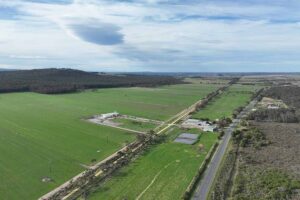
Tasmania’s Bell Bay is an industrial centre and deep-water port in northern Tasmania – and host to an aluminium smelter owned by Rio Tinto – that has long been the focus of the state’s renewable hydrogen production and export plans.
The Green Hydrogen Hub concept, which was hoped to be up and running by 2028, has had $330 million in grants from the federal and state governments poured into it. But proposals floated by the likes of Fortescue, Woodside and Origin have all so far fizzled out.
Oil and gas giant Woodside was the latest to withdraw from running, pulling its proposed H2Tas project from the federal environment approval process in August of last year.
Woodside said the decision had been informed by the “lack of availability of new renewable energy generation” in the state to underpin commercial-scale electrolysis-based hydrogen production.
Abel Energy’s Bell Bay Powerfuels project, which plans to be the nation’s first green methanol plant and produce 300,000 tonnes of renewable methanol a year, now remains the only green hydrogen currently proceeding.
South Australia-based and Ross Garnaut-backed Zen Energy is in the “advanced stages” of buying the $1.7 billion project, which is slated for construction at the site of the mothballed Bell Bay Power Station and includes a proposed 240 MW electrolyser.
It is hoped the state government’s fast-tracking of the 224 megawatt (MW) Bell Bay wind farm and four-hour big battery will help supply the renewable energy needed to produce the green methanol.
The advancement of Marinus Link, a new undersea cable linking Tasmania with the mainland electricity market, is also considered crucial to the success of the state’s hydrogen production plans.
The state Liberal Party’s announcement of Bell Bay Powerfuels as the provisional proponent for the Tasmanian Green Hydrogen Hub comes just days ahead of the 7th Annual Tasmanian Energy Development Conference, that commences in Devonport on Wednesday.
“The Hydrogen Hub, along with our ambitious energy agenda will attract investment and drive regional economic development, support the state’s transition to a low-emission economy and further strengthen our reputation as a renewable energy leader, which is what our 2030 Strong Plan for Tasmania’s Future is all about,” Duigan said on Saturday.
“We’re bringing on new generation and delivering our Tasmanian Renewable Energy Target with our $14.4m Renewable Energy Approvals Pathway, progressing clean fuels through the Tasmanian Green Hydrogen Hub and preparing to capitalise on future industries with the Renewable Energy Services Hub.
“We are demonstrating our commitment to progress Project Marinus by provisioning $300m equity contingent that will be required should Marinus achieve a positive Final Investment Decision by all three governments by August 2025.”
The Tasmanian government has also unveiled plans for Bell Bay to host a renewable energy terminal and serve as a key hub for offshore wind development, following the federal government’s declaration of an offshore wind zone in the Bass Strait.
TasPorts, the state-owned company responsible for eleven Tasmanian ports and the Devonport Airport, announced in December a “bold vision” for the offshore wind transformation, building on existing plans for the port.
*This story has been updated to reflect that Iberdrola is no longer backing the Bell Bay Powerfuels project, and to add that Zen Energy is in advanced talks to buy the project.