Two new level crossings powered entirely by solar and battery power have been unveiled in northern New South Wales, part of the Inland Rail freight rail link that is being built to connect Melbourne to Brisbane.
Billed as Australia’s largest freight rail infrastructure project, Inland Rail is a once-in-a-generation project connecting Melbourne and Brisbane via regional Victoria, New South Wales, and Queensland.
The 12 individual projects together will span over 1,600 kilometres, and once completed Inland Rail will provide a 24-hour transit time for freight travelling between the two cities.
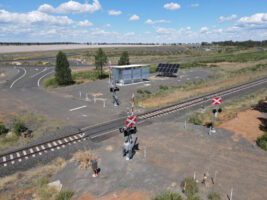
The two solar-powered level crossings were unveiled as part of the finishing works on the Narrabri to North Star (N2NS) Phase 1 section of the project.
The two new level crossings – one located north of Moree and the other north of Narrabri – are the first solar-powered level crossings on Inland Rail as well as parent company’s Australian Rail Track Corporation (ARTC), which operates and maintains Australia’s national rail network.

They are the first to have been upgraded from “passive” level crossings – those with no boom gates and only a sign such as ‘Stop’ or ‘Give Way’ that require drivers to look for trains directly – to active crossings powered by a fully solar-powered standalone power system (SAPS).
The upgrade is a huge leap and a potential boon for the country’s rail network. Level crossings, complete with automated boom gate and flashing lights, traditionally rely on grid-connected electricity and a battery back-up system.
In metropolitan parts of Australia this is a simple process, but across regional and rural Australia, where there are often scarce or no electricity infrastructure, level crossings are prohibitively expensive and complicated to build.
By relying on a solar and battery SAPS, Inland Rail avoided the need to connect to any existing power infrastructure or build new electrical assets, therefore also reducing land access requirements and minimising the impact on adjacent landholders.
Both of the new solar-powered level crossings now feature high-intensity LED flashing lights, bells, and retro-reflective boom gates. In addition, internal batteries ensure that the level crossings will work overnight or as an emergency backup, while a communications system allows for remote monitoring and fault alarms.
The ARTC is also planning to deploy solar-powered signalling systems at other locations across the alignment to supply electricity once Inland Rail becomes operational.
“Utilising solar-powered standalone power systems avoids impacts to local communities, clearing and the environment and reduces the cost of Inland Rail,” said a spokesperson for Inland Rail.
If you would like to join more than 28,000 others and get the latest clean energy news delivered straight to your inbox, for free, please click here to subscribe to our free daily newsletter.