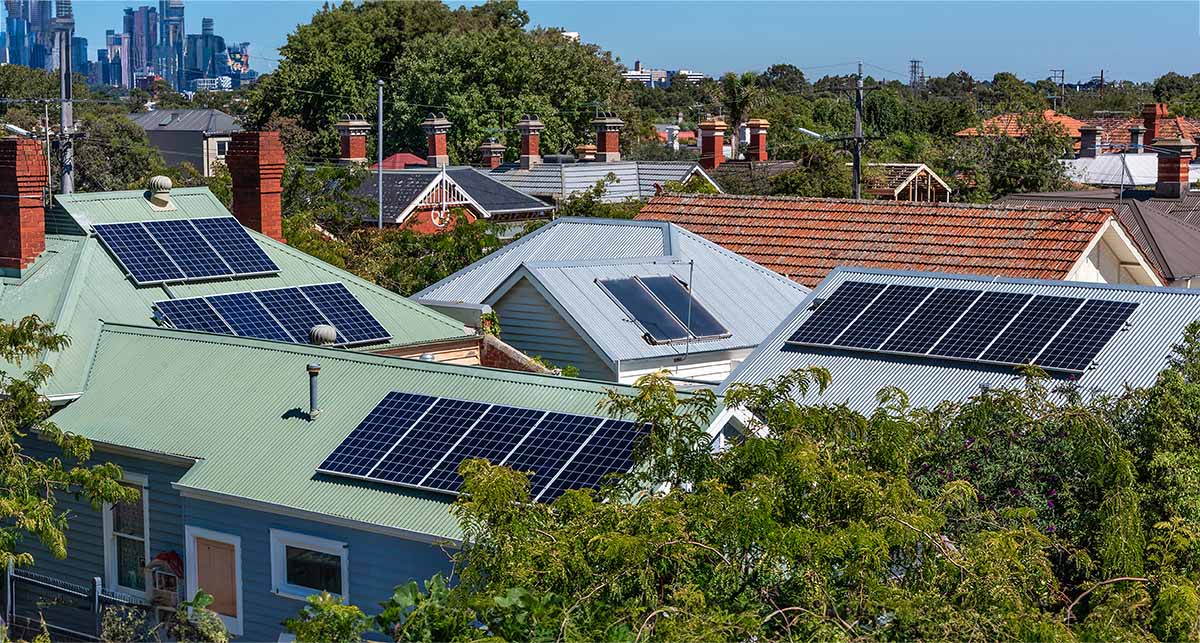
The Victorian Labor government has firmed up some of the details of its Midday Power Saver plan, revealing that the free electricity period will run from 11am to 2pm, and recalculating the potential savings this could deliver following the newly reduced default electricity prices announced this week.
Victoria announced in March that its state take on federal Labor’s Solar Sharer offer would become available to residential customers through the Victorian Default Offer (VDO) from the first of October this year – less than two months ahead of the state election.
State energy and climate minister Lily D’Ambrosio this week confirmed key details of the free power plan, and said households who took advantage of the opt-in scheme could cut their power bills by between $149 and $1,102 a year, depending on how much demand they shifted to the midday period.
The federal version, Solar Sharer, was announced last November as a one of the reforms to the Default Market Offer (DMO) and requires electricity retailers to offer free power for at least three hours in the middle of the day in DMO states, which is all National Electricity Market (NEM) states except Victoria. It comes into play on July 01.
For Solar Sharer, the free usage periods are 11am–2pm for NSW/SE Queensland regions and 12pm–3pm for South Australia. Times will not vary with daylight savings.
The idea behind both of the free power offers is to tackle energy inequity by sharing the bill-slashing benefits of rooftop solar with those who, for one reason or another, cannot install it.
It is also designed to act as an incentive for households to shift their energy loads into the middle of the day, to help soak up the excess rooftop solar that floods the grid on an almost daily basis.
And it is also designed as a re-set of the political debate around the green energy transition by making sure that more of the benefits are shared by all.
The Australian Energy Regulator, which governs the DMO, issued a reminder this week that retailers will – from July – be required to offer a default Solar Sharer Offer as an “opt-in energy plan” for any customers with smart meters, not just those on the DMO.
“The new Solar Sharer Offer is an opportunity to make further savings if households can shift some of their electricity usage, such as washing machines, air conditioning, or electric vehicle charging, into the middle of the day,” AER chair Clare Savage said on Tuesday.
“We encourage consumers to speak to their retailer about how this new option works because for some households it could be a transformative way to reduce their electricity bills.”
Savage said that making the Solar Sharer Offer part of the DMO gave it the added safety of it being a regulated price, which meant consumers could be confident they would not be overcharged outside the free power period.
The AER also notes that retailers must advise customers that Solar Sharer might not be the right fit for all households – and that an opt-in agreement is needed to put a customer on Solar Sharer.
“This means that customers cannot be placed onto the Solar Sharer Offer by default nor when they are rolled onto a deemed contract,” the AER says.
Both the AER and Victoria’s pricing regulator, the Essential Services Commission (ESC), this week published their final determinations on the default prices for Australia’s different states and distribution network zones, confirming price reductions across the board, with the exception of South Australia.
In the DMO regions, the AER said the residential flat-rate standing offer would fall by between 3.4 – 5 per cent in NSW and by 7.2 per cent in South East Queensland compared to last year.
South Australia, the regulator said, would see a slight bill annual increase of 1.4 per cent (or $33) – although for customers signed up to time-of-use retail offers, prices will fall slightly, by 1.1 per cent ($25) for residential customers and decrease by 12.1 per cent ($673) for small business customers.
For Victoria, the ESC determined that prices for domestic customers on the VDO would decrease across the board by between as much as $160 for AusNet customers down to $50 for United Energy customers, averaging out at a roughly 5 per cent drop, year-on-year.
Annual prices for small businesses on the VDO will fall across the five distribution zones by between $502 (AusNet) and $151 (Powercor) compared to 2025-26, averaging out at a 6 per cent decrease on last year, the ESC said.
In a statement on Thursday, minister D’Ambrosio took the opportunity to note that customers on the VDO are better off than customers in other states on the average DMO, with the 2026–27 VDO coming in $444 cheaper for households and $1,299 cheaper for small businesses, by comparison.
And D’Ambrosio claims the Midday Power Saver will also be the biggest offer in the country, with all of the state’s 2.6 million smart meter-equipped households eligible to access it, compared to 2.4 million in other states combined.
“Three hours of free power every day will take real pressure off household bills and lower prices outside those hours mean families save even more,” D’Ambrosio said.
“Victorians will get the biggest and best free power deal in the country.”
There are some caveats and “heads-ups” on the Victorian Midday Power Saver plan, too, however, including that “electricity prices outside these hours may be slightly higher and actual savings will be dependent on your ability to shift usage from more expensive peak periods to the middle of the day.”
The website says that to sign up to the Midday Power Saver, customers should contact their electricity retailer from October to check whether the offer is suits their needs. As part of this conversation, electricity retailers will need to:
“Inform you about any other plans your retailer reasonably believes may be more suitable for you (based on any relevant information your retailer has regarding your energy usage).
“Inform you that the Midday Power Saver may not be suitable in all circumstances and is best suited to customers who can shift their electricity usage. Not shifting usage could result in higher electricity costs and customers may be charged if they exceed the fair use cap.
“Provide information about the cost impact that the new tariff structure may have, including, in so far as possible, an estimate of the dollar impact.”
If you would like to join more than 29,000 others and get the latest clean energy news delivered straight to your inbox, for free, please click here to subscribe to our free daily newsletter.