A new study has demonstrated the regenerative effect that solar farms can have on degraded and depleted land, by sheltering it from harsh winds, pushing down surface and soil temperatures, and boosting soil moisture.
The study, published in the journal Geography and Sustainability, synthesises 147 individual studies on a range of different land types and across a range of climate variables, to see how solar farms interact with their immediate environment.
“Unlike the pollutant-dominant environmental impacts of fossil fuels, solar power exerts climate- and ecology-dominant influences on the entire environment,” the study finds.
“By changing land surface radiative properties, solar photovoltaic (PV) systems create new energy interaction interfaces with original ecosystems, thereby modifying land surface processes and associated climate variables.”
Across the 147 total studies analysed in the report’s meta-analysis, 609 solar farms were examined, the vast majority of which were located in the Northern Hemisphere, with the largest number in China (316), the United States (104), and India (44). This is consistent with their global rankings as the top three countries in terms of installed solar PV capacity.
Of the surfaces underlying these 609 solar farms, systems located on grassland were the most frequently studied (208), followed by bare land (173) and cropland (159). The majority of solar farms studied were located in arid climate conditions.
The meta-analysis showed “non-significant positive effects” on air temperature, air temperature during the daytime, and air temperature during the night time, though this varied depending on underlying surface types.
However, significant effects were recorded for other statistics, such as a 29.96 per cent overall reduction on wind speed. Specifically, solar PV systems on cropland, grassland, water bodies, and bare land saw “significantly reduced” wind speeds of 38.33 per cent, 32.67 per cent, 31.54 per cent, and 22.00 per cent, respectively.
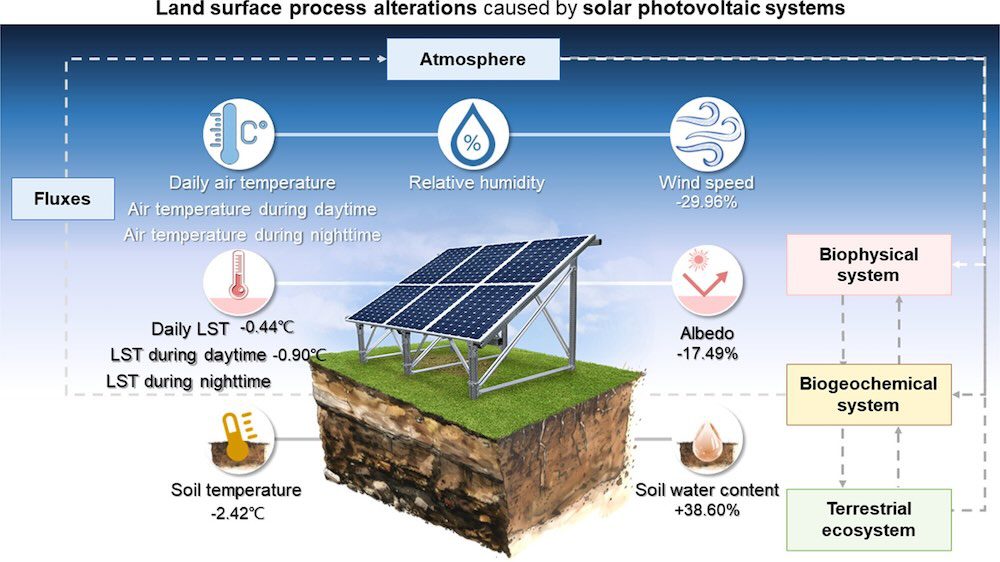
Image supplied under a Creative Commons license
Similarly, solar farms significantly reduced albedo – the measurement of how much sunlight/solar energy that a surface reflects back into space rather than absorbing as heat – across all underlying surface types and in the overall effect.
“Albedo within PV systems was 82.51 % of that in non-solar reference regions (a 17.49 per cent reduction),” wrote the authors. “The significant reductions of albedo were 9.51 per cent, 13.57 per cent, 18.17 per cent, and 19.89 per cent over PV systems on cropland, grassland, water bodies, and bare land, respectively.”
Compared to non-solar reference regions, therefore, daily land surface temperature and land surface temperature during the daytime were significantly reduced in PV systems by 0.44°C and 0.90°C, respectively, though no significant overall effect was observed for land surface temperature during the nighttime.
PV systems significantly reduced daily land surface temperature by 0.84°C and 0.30°C on grassland and bare land, respectively. During daytime in particular, PV systems on grassland, buildings, and bare land “significantly decreased” by 1.13°C, 2.54°C, and 0.76°C, respectively.
And while there was no ‘overall’ effect observed for land surface temperature during the night time, it “decreased significantly” for solar PV systems over cropland (0.42°C) and grassland (0.31°C), while the increase of PV systems on buildings was not statistically significant.
Beneath the surface, solar farms also significantly reduced soil temperature by 2.42°C and increased soil water content by 38.60 per cent relative to reference regions. The soil temperature reduction was particularly evident on cropland and grassland (2.52°C and 2.88°C, respectively) whereas the increase in soil water content “on grassland and bare land increased significantly by 41.20 % and 58.03 %, respectively.”
If you would like to join more than 29,000 others and get the latest clean energy news delivered straight to your inbox, for free, please click here to subscribe to our free daily newsletter.