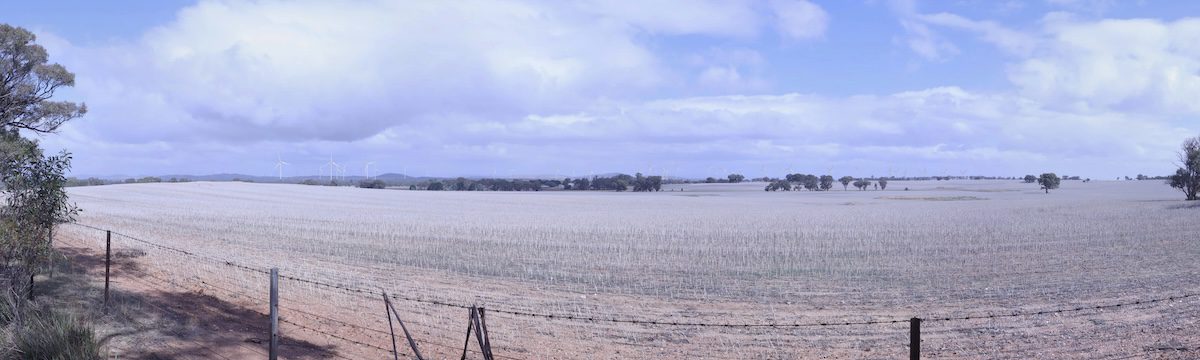
UK-based renewable energy developer RES says it received state planning approval for a $1 billion wind and battery project in north-west Victoria, a milestone that comes five years after the idea was first announced.
The Watta Wella project, which is about 16km north-east of Stawell and near the Grampian ranges, was first pitched in 2021 as a wind, battery and solar project, according to reporting by Renew Economy when it was first unveiled in 2021.
Since then it’s been slimmed down, with the small solar component dropped and the final configuration coming in at 360 megawatts (MW) of wind and a 400 MW, four hour battery.
The state took just under a year to approve the project under the fast-track program managed by the Department of Transport and Planning (DTP), and RES – which describes itself as the biggest independent renewable energy developer in the world – hopes to give the go-ahead for the project in 2027.
However, that still depends on gaining approvals under the federal EPBC process, which has been underway since 2022, as well as connection approvals and reaching financial close.
RES expects construction to slot in after the nearby 250 MW, four hour Joel Joel battery and the small 5 MW Stawell solar project are finished, which is around the end of 2027.
The Watta Wella wind project is expected to take 27 months to build, and will result in 1,816 vehicles coming and going from either Port Geelong or Port of Portland, largely in the form of light vehicle escorts.
The battery component is expected to take 13 months to build.
RES development director Greg Wilkinson says they’re still “working through the final configuration” in response to questions about whether they’re thinking about co-locating the two technologies behind the meter.
“Receiving the planning permit is an important step forward for Watta Wella,” Wilkinson said in a statement.
“This work has helped shape a project that balances renewable energy generation with the protection of environmental and community values.”
The developer dropped two turbines from the original plans and shifted others to reduce noise and shadow flicker on nearby homes, as well as avoiding patches of “sensitive” greenery, it said last year.
In comments emailed to Renew Economy, Wilkinson says moving other parts such as the battery further from homes came as part of the ongoing consultation process with neighbours, and community views and fears about visual amenity, noise, fire risk and construction impacts changed how the project will manage these issues.
“Consultation was not a one-off activity. It was an iterative, co-design process that helped refine the project to better balance renewable energy generation with local environmental and community values,” he says.
Wilkinson also says that although the original idea was for a multi-technology project, it was slimmed down over time “to focus on the site’s strong wind resource.”
A community benefits fund will provide $360,000 a year.
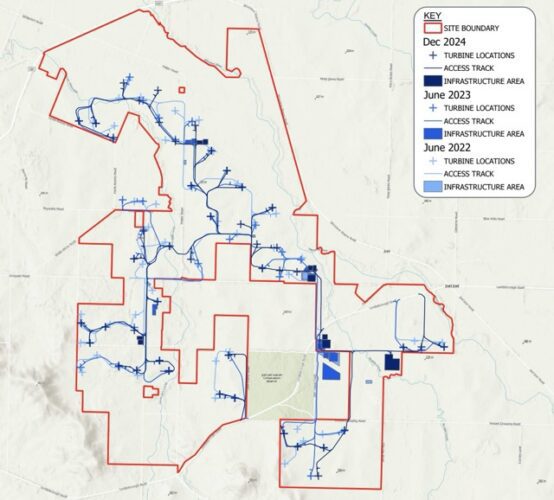
Map showing the changes from 2022 to 2024 of turbine and access track locations. Image: Res
Tucked away in the Watta Wella permit approval was a detail that highlights a shortcoming in planning regulations that is worrying Victorian councils.
The Northern Grampians shire council had fretted about a number of issues, mainly the state of local roads and lack of worker housing.
But it also asked for an upfront decommissioning bond, something councils particularly in western Victoria are vocal about. That’s not available under the state planning process, although a decommissioning plan is included as a permit condition, but that will need to be enforced by the Northern Grampians shire council.
The planning permit also noted the council repeated resident fears around renewable energy projects affecting property values and the council had also claimed there had been a lack of “independent advice”.
The planning authority disagreed. “The technical reports have been prepared by suitably, qualified professionals in their respective fields. These reports are considered sufficient to inform a planning assessment.”
The region is a hive of energy activity, hosting the two areas of the Western Renewable Energy Zone (REZ) and the proposed Western Renewables Link and VNI West, the controversial 500 kilovolt transmission lines set to feed power from the new energy lands of the north and west into the industrial hubs around Melbourne.
Gigawatts-worth of projects, both operational and proposed, are hugging the routes of these two lines.
The Watta Wella planning approval mentions just a few that will be direct neighbours: To the north is the Navarre wind project, whose plans are still being assessed by the state; to the south are the operating Bulgana, Crowlands and Ararat wind farms.
The new giants
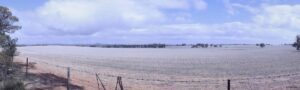
The Watta Wella project will feature 45 turbines spread over 4,850 hectares of grazing and cropping lands where it’s locked in land owner support.
The turbines, which will have a tip height of up to 255m, will be sized at 8 MW each if the goal is to reach the full 360 MW of capacity mentioned in the permit approval, a size that is among the largest yet proposed for onshore Australia.
Despite covering a huge swathe of land, the actual footprint of the project will be much smaller – at just 79.3 hectares, and RES estimates that will result in an estimated annual production loss of just $69,230.
And, unlike a coal mine or power station, the affected portions of land can be returned to agriculture at the end of the project’s life if the landowner wants.
Some 15 hectares of native flora will need to be removed, made up of 14 hectares of native vegetation patches, 51 large trees and eight small, scattered trees.
If you would like to join more than 29,000 others and get the latest clean energy news delivered straight to your inbox, for free, please click here to subscribe to our free daily newsletter.