This week, from Wednesday, electricity retailers in three of Australia’s major states will be required to offer free power to households for at least three hours in the middle of the day as part of the federal government’s Solar Sharer scheme.
Solar Sharer, unveiled by federal energy minister Chris Bowen in November last year, aims to tackle energy inequity by sharing the benefits of cheap solar with those who, for one reason or another, cannot install it.
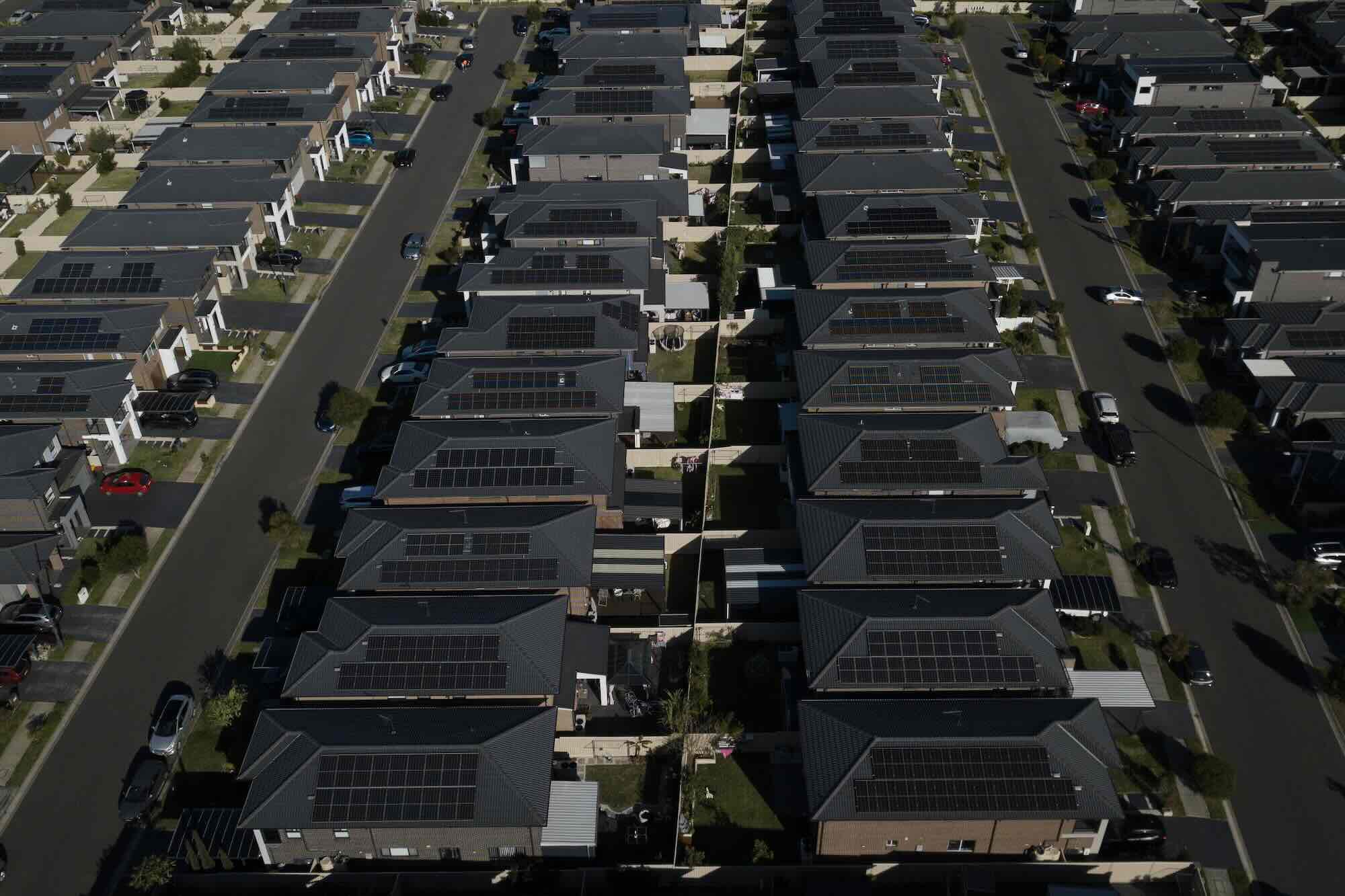
It also addresses the problem of increasingly high amounts of rooftop solar on the grid during the middle of the day, which can cause grid management headaches for the market operator and drive up costs through network grid augmentations.
But as Bowen says here, Solar Sharer is not going to suit everyone. And as Energy Consumers Australia has warned, some consumers will not be able to take full advantage of it, “and some may even be worse off if they switch to the offer.”
Here’s what you need to know about the new offer and what a range of experts are saying ahead of the Wednesday launch.
What is it?
As the Australian Energy Regulator fact sheet puts it, the Solar Sharer Offer is an opt-in standing offer for electricity that is available to residential customers with smart meters in South East Queensland, New South Wales and South Australia that includes a designated three-hour free power period in the middle of the day.
In Victoria, where the retail market is regulated separately to the rest of the National Electricity Market, a similar but separate offer – the Midday Power Saver plan – will be introduced in October; we will know more on that closer to the launch date.
What is its goal?
The two core aims of the Solar Sharer Offer (SSO) are to give more Australian households access to the benefits of abundant daytime solar – and in particular, those households like renters or apartment dwellers that are unable to install their own solar systems – and to improve overall energy system efficiency.
The latter would be achieved by incentivising households to shift their energy consumption into the middle of the day and away from the evening peaks, when the solar power exits the generation mix and households ramp up their usage – thus flattening the infamous solar duck curve that makes for a peaky market.
As Energy Consumers Australia (ECA) puts it: “The SSO sends an important message to households: we often have abundant, cheap, renewable energy in the middle of the day, making it the best time to increase consumption.”
How does it work?
On the market side, the SSO means every retailer that has more than 1,000 customers in regions that are subject to the Direct Market Offer (DMO) – NSW, Queensland, South Australia – will need to make at least one Solar Sharer Offer available for customers to sign up to.
Retailers are also required to advise customers that the SSO may not be suitable in all circumstances – such as if the household is unable to shift enough of its load into the middle of the day – and that an opt-in customer agreement is required to place a customer on the offer.
Under the Better Bills Guideline, retailers must also advise customers at least every 100 days (or in alignment with the billing cycle if that cycle is greater than 100 days) whether they could be on a better offer (the Better Offer check), as is the case across all generally available plans.
For customers, the SSO is opt in, which means you can only take part in the offer if you actively sign up to it. But customers can only sign up to the SSO if they have a smart meter. As Chris Bowen explains in the below video, it’s relatively easy for customers to check whether or not they have a smart meter, and if they don’t, they can request one from their retailer, which is then required to supply it.
Once signed up to the SSO, the three hours of power will be offered between 11am and 2pm in NSW and Queensland, and between 12pm and 3pm in South Australia – those times stay the same under daylight savings time.
There is a limit to the amount of free power that can be used in any one free-power period. This limit is known as the “solar sharer cap” and it is set at 24 kWh per day. For context, this amount sits at the upper end of the spectrum of average daily energy use for an average house in New South Wales, which is said to range between 13 kWh and 22 kWh a day.
As well as the three hours of free power, a retailer’s SSO will feature:
– A daily supply charge (the set, fixed-cost amount that a household pays for connection to the grid);
– A c/kWh usage charges on either side of the free power period, which will vary by distribution region, based on the underlying time of use network tariff structure, as shown in the diagram below;
– a c/kWh reasonable usage charge for usage in excess of 24kWh during the free usage period.
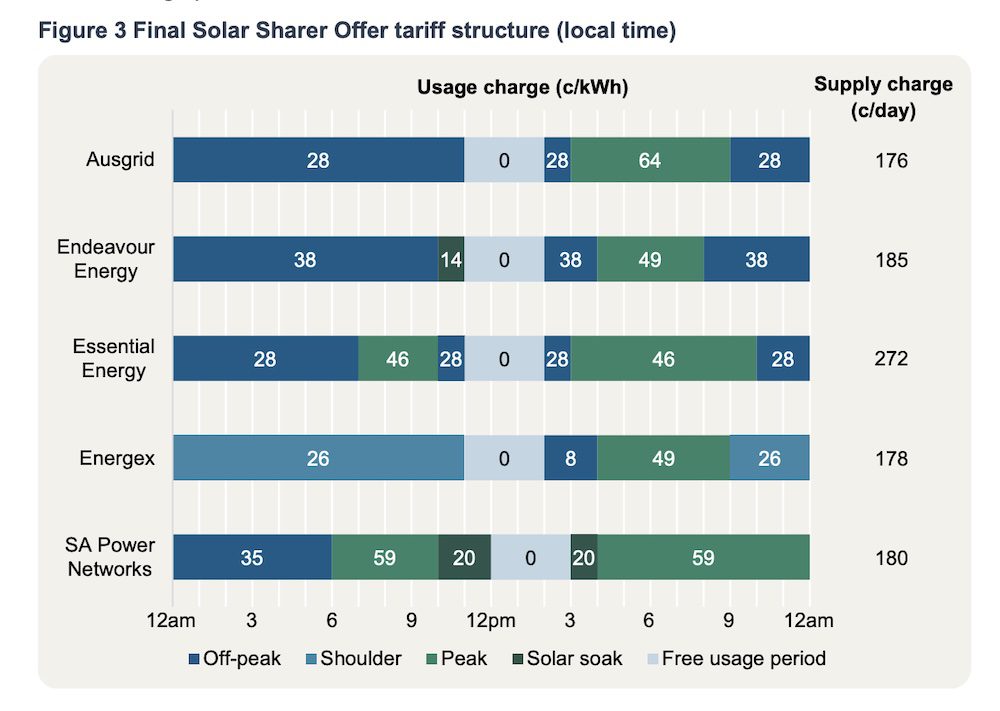
Source: Solar Share Offer design Fact Sheet, Australian Energy Regulator
Who should and shouldn’t use it?
As the federal government and the AER have both stressed, the SSO won’t suit every household. And as the ECA has said, for the wrong household, it could actually leave it worse off.
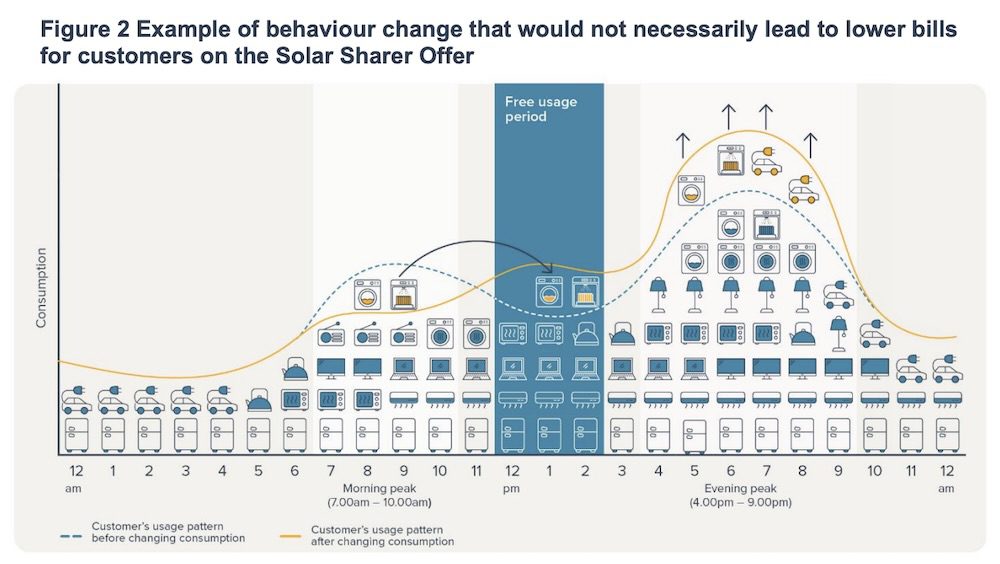
Looking at the above chart, you can see how this might happen, if a household is moving only a small amount of its consumption into the free power period and then still using large amounts of power in the peak period – potentially under the impression that the peak usage will be balanced out by the free power.
“Customers whose consumption patterns and usage amounts differ from our modelled estimates, or those who are on competitively priced market offers may not experience lower bills from transferring to the Solar Sharer Offer even if they change their behaviour,” says the AER.
“Figure 2 (below) is an example of a customer that has shifted some usage into the free period and increased usage outside of it, potentially resulting in a higher overall bill.”
Source: Solar Share Offer design Fact Sheet, Australian Energy Regulator
For comparison, ECA provides the below chart showing how the usage rates (c/kWh) differ – both withint the SSO and between the SSO and other offers in the Ausgrid distribution network zone.
This illustrates how important it will be for prospective SSO customers to have a realistic idea of how much electricity they might be able to shift into the free power period and how much will be used in the afternoon and early evening peak, when prices shoot up past 60c/kWh.
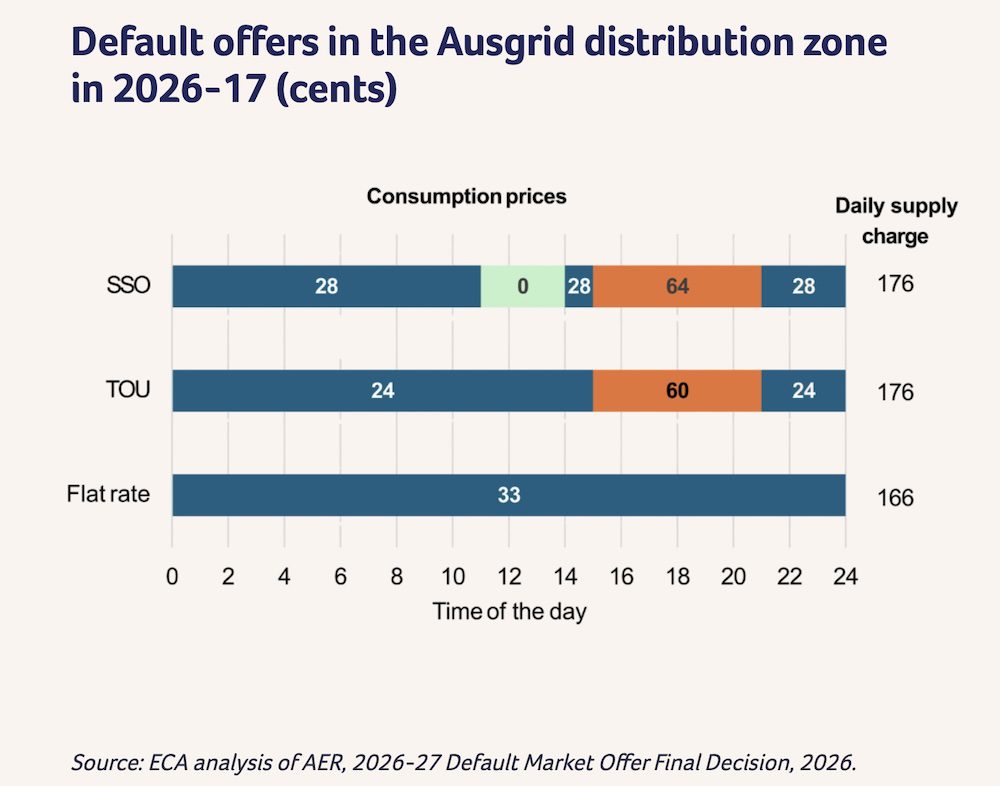
In one example, the ECA models a customer on the Ausgrid Variable Go Plan using an average of 20kWh of electricity a day and with an annual bill of around $2,800 a year.
In this case, it says “if 30% of electricity could be consumed in the free period, with 40% during the 3 to 9pm peak window, they would be around $320 worse off on the SSO. But if 30% of electricity could be consumed in the free period, with 20% during the peak window, they would be around $210 better off.”
“So while the SSO correctly identifies the societal benefits of increasing consumption in the middle of the day, governments and retailers need to clearly communicate these trade-offs,” the ECA says.
“We don’t want to have people signing up to these plans assuming it will decrease their bills, when in fact it could do the opposite.”
As Renew Economy has reported, a study published in early 2025 found that the roll-out of time-of-use electricity tariffs was in some cases leading to higher instances of bill shock and was vastly overestimating consumer engagement and understanding.
The report found that time-of-use tariffs were more likely to force lower income people to cut their energy use when they really needed it, such as heating or cooling in the evenings.
And a survey conducted by the University of Queensland, the results of which were published last month, suggests this knowledge gap hasn’t budged much ahead of the launch of the SSO.
UQ found that public knowledge about the SSO was limited at the time of the March survey, with less than half of the people surveyed having heard of the scheme, when understanding how the scheme works will be very important.
“Not everyone can shift their usage. People who are not at home during the day, for example, will struggle to find ways to benefit from the free electricity window,” the UQ’s Dr Anna Zinn and Professor Sara Dolnicar say here.
Zinn and Dlnicar say their survey showed most people only plan to shift the use of devices that are already relatively low in electricity consumption like their washing machine or dishwasher.
“This suggests that while some behaviour change is possible, people are less willing or able to move higher‑consumption activities like electric car charging or hot water use, into the free electricity window.
“It is clear that while Australians are open to the scheme, many are currently unaware of it and there is limited knowledge on how they can benefit. How the government will pitch Solar Sharer and inform the public about the specifics of the scheme will determine its success,” they said.
Do your research and compare the market
But as noted above, retailers will also have an important role to play guiding customers on whether the SSO is right for them, particularly as governments, regulators and consumer watchdogs turn their lens onto fair pricing and retailer code of conduct and whether it is being properly observed.
Meanwhile, many retailers are already offering their own version of a sort of Solar Sharer Offer, based on time-of-use tariffs that change according to demand levels. And as the ECA points out, these offers could offer a better deal for some customers than the SSO.
“As an offer regulated by government and set by the Australian Energy Regulator, it is designed to be inherently risk averse and is not necessarily designed to attract customers,” the ECA says here.
“As such, the SSO is likely to be much higher priced than competitive offers already in the market. For perspective, Origin’s Variable Go plan offers households in the Ausgrid network a flat 34-cent consumption charge, alongside a supply charge of $0.89 per day.”
ECA also notes that OvoEnergy has been providing a three-hour free consumption plan since 2024 and Globird offers a four-hour free energy plan.
Others include AGL’s “Three for Free,” which requires shifting around 5 kWh/day into the free window to access full savings. Ovo Energy is also offering free power in the middle of the day in a move targeted at EV owners.
Red Energy offers its customers four free weekend hours, from 12pm–2pm Saturday and Sunday – for EV charging and chores, it says – in return for higher weekday charges.
Further reading: Free electricity in the middle of the day is not free of risks
If you would like to join more than 29,000 others and get the latest clean energy news delivered straight to your inbox, for free, please click here to subscribe to our free daily newsletter.