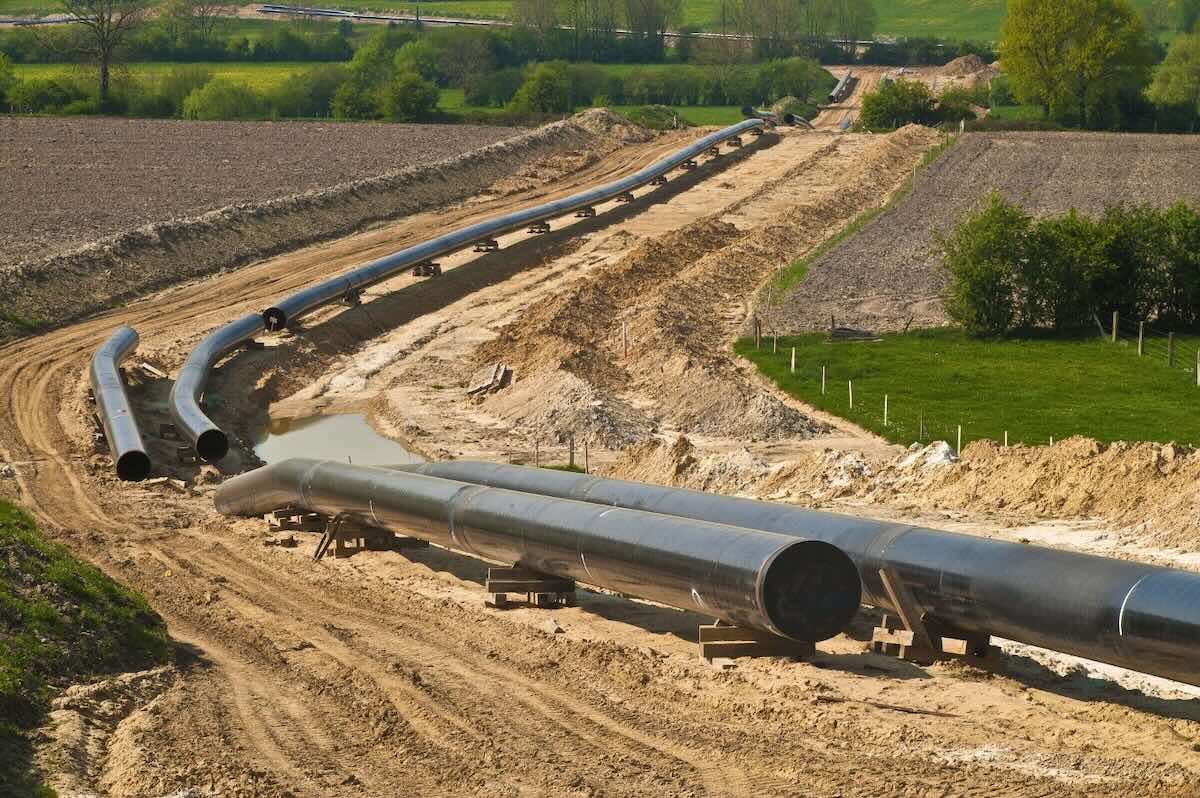
An 833 kilometre pipeline proposed by Santos and planned to run from southern Queensland to Newcastle will not have any significant impact on the environment, according to a new decision by the federal government.
The decision comes as the oil giant faces more delays on the decade-old $3 billion Narrabri project over a fresh legal challenge by the Gomeroi Nation to the sale of petroleum leases to the company.
On Tuesday last week the Department of Climate Change, Energy, The Environment and Water (DCCEEW) quietly published its decision on the Queensland-Hunter Gas Pipeline from Wallumbilla in the Surat basin to Newcastle in New South Wales finding the project was not a “controlled action”.
A “controlled action” refers to construction work on a project that is thought to have a measurable impact on the environment and biodiversity of the area. If something is found to be a controlled action, a company must show how it plans to avoid and mitigate impacts.
Campaign group Lock The Gate asked DCCEEW to reconsider its earlier decision, made in 2008, saying that clearing for the pipeline would have an impact on threatened koala habitat in the wake of the catastrophic 2019-2020 Black Summer Bushfires.
Grazier Margaret Fleck, a long-time campaigner against new gas projects on the Liverpool Plains, said she was “massively disappointed” at DCCEEW’s decision but as the notice was published without reasons there was no way to know why the decision was made.
She said the proposed route of the pipeline will involve clearing threatened koala habitat and will run through other sensitive ecological areas, including platypus nesting grounds, along its route.
“We were just looking for federal oversight on the environmental impact,” she said. “They will clear a 30m wide strip for the pipeline and in some places, they will have wider areas for turnaround areas. There’ll also be clears for all the above ground infrastructure that goes with a high-pressure gas pipeline.”
Lock the Gate is now applying for documents under Freedom of Information to determine whether it will appeal.
The approval is a necessary step by Santos towards getting the pipeline built, but Fleck said its future was far from certain owing to massive community opposition, ongoing legal challenges and ongoing questions about the project’s future.
“Santos are not in a position to make a final investment divestment. They need a pipeline licence,” she says. “There’s incredible landholder opposition, with people denying them access to their property. They’re finding it difficult to do everything they need to design the pipeline.”
Santos were contacted for comment.
The development follows a separate decision by the Gomeroi Nation to challenge a decision by the Native Title Tribunal in May that found the company may be granted petroleum leases necessary for the Narrabri Gas Project.
Santos began exploring for gas in the Pilliga in 2008 and have been working to develop a field in the area since 2011, a project that will involve the clearing of portions of scrub to facilitate the eventual installation of 850 gas wells.
An earlier approval by the Native Title Tribunal was overturned on appeal by the Gomeroi, in part because the decision failed to properly consider, and largely dismissed, concerns about how the project may contribute to climate change and how climate change may impact the relationship to country.
One analysis of the number of future act determinations published on the Tribunal’s website found that it sided with Indigenous groups just 1.90% of the time, with the remaining decisions being made in favour of companies.
In May the Tribunal took another pass at the decision, recognising the significance of the Pilliga to the Gomeroi people and that the impact industrial activity would have on their way of life, culture and traditions within the area.
“The evidence paints a picture of the Pilliga as a cultural landscape where Gomeroi cosmology is alive and the celestial bodies, animals, plants, lands and waters interact with Gomeroi people,” it said.
“Gomeroi totemic structures are linked to this landscape, and it is evident the place the Pilliga holds in the hearts of Gomeroi people as one of the last relatively untouched places they can practice their culture.”
The tribunal broadly accepted the predicted impacts of climate change on the area, the importance of water and water resources and that there is insufficient protection under existing laws for intangible cultural heritage protections but still found in favour of Santos.
The company says the projects will create 1200 jobs during construction and 200 ongoing positions, $1.6bn in royalty payments to the state government and $160m in payments to a Regional Community Benefit Fund. Opponents have challenged these figures.
In making its decision, the Tribunal gave conditional approval for Santos to go ahead saying the public interest in the benefits outweighed any harm that may come to the Gomeroi Nation and their relationship to country.
The Gomeroi Nation are now seeking to challenge the decision through a judicial review asking the Federal Court to clarify how the public interest test should be applied.
In a statement released by members of a group representing the Gomeroi during legal proceedings, they said they will take “all necessary steps to elevate the voices of Gomeroi People when it comes to the Narrabri Gas Project.”
“The Gomeroi Applicant have always maintained the view that the Pilliga is not only the lungs of Gomeroi Country but also of the State of New South Wales more broadly,” they said.