Our story on Monday about the extraordinary price hikes imposed by a state government-owned electricity retailer clearly hit a nerve. The readership and feed-back has been huge, and it turns out that other government owned retailers are also jacking up tariffs, well beyond the guidance of the regulator.
On Monday we wrote that Momentum Energy, a retailer owned by the state government owned Hydro Tasmania had lifted its tariffs by up to 25 per cent, in order to “close the gap” between market offers and the “safety net” price set by the Australian Energy Regulator.
Readers, particularly those in Victoria which have significantly lower daily connection charges, expressed astonishment at the scale of the tariffs being imposed in NSW.
See A government owned retailer has just jacked up our electricity tariffs by 25 pct – because it can
“Giles I was astounded by the prices you are paying,” said energy expert Alan Pears, who lives in Victoria. “I feel as though I am living on another planet from you.”
But others, particularly those in NSW, reported that they had also been advised by another government owned retailer – in this case the Snowy Hydro owned Red Energy (Snowy is wholly owned by the federal government) – of major price hikes for their homes and businesses.
These also appeared to be designed to “close the gap” with the Default Market Offer (DMO).
This is significant. State and federal ministers sought to play down the recent rises in the DMO announced by the Australian Energy Regulator – which varied from state to state – saying they were a safety net, would only impact a small minority of customers, and most people would be able to shop around to get better deals.
But the ability to shop around is now less clear, given that the government-owned retailers, and the privately owned competitors, are jacking up their tariffs at a ferocious pace. Rather than being faced with a $150 a year bill increase, many customers are staring at a bill rise of around $300, or even double that again.
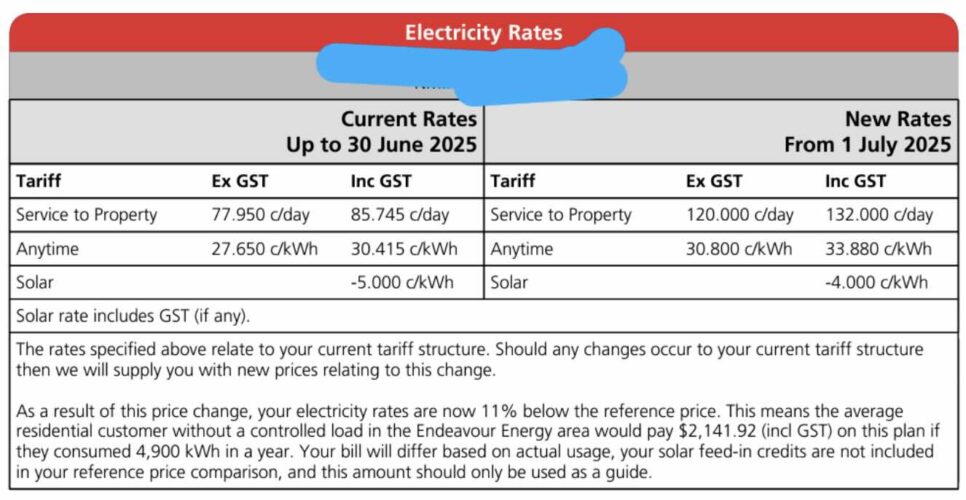
One reader in NSW noted that his standing charge would leap 65 per cent from July 1 to $1.20 a day, before GST. The anytime tariff for actual consumption will increase by 11.5 per cent, while the solar tariff will be cut by 20 per cent.
“Energy within Australia is becoming a joke,” the reader said.
Another reader also reported changes from Red Energy, for both his Sydney-based business, and the Perisher ski lodge of which he is a board member.
“It seems that Momentum is not the only government owned retailer availing themselves of the largesse of the DMO set by the AER,” writes business owner David Stuart.
“As owner of a business in the Manly and Warringah electorates, and as a board member of a ski club in Perisher Valley, I’ve received two notifications from Red Energy, owned by Snowy Hydro, of price increases to become effective from July 1.
“In the case of our small business, power costs will increase by 8.33% across the board, whilst the inescapable daily connection (Supply) charge will increase by a whopping 21.68% (thank you Ausgrid, 49.6% owned by the NSW state government).
“The increase in costs of electricity is presumably predicated on there being an increase in costs, yet the Solar Feed In Tariff (FIT) has been decreased by a further 1c/kWh, in this case, 20% or 42.85% since September 2024.
“This latter reduction presumably is a reflection of the increasing abundance of (cheap) renewables in the system that are driving wholesale costs down.
“To add further insult to injury, from July 1, our business is liable to be slugged with a surplus solar export charge from 10 am – 3 pm (a price signal based on excess energy in the grid) whilst also being subject to peak charges from 2 pm (a price signal based on a deficit of energy in the grid).
“So, heads Ausgrid wins, and tails our business loses. IMHO, that this is being allowed is extraordinary.”
Stuart says his business has slashed his electricity consumption, and his bills, with 100 kW of rooftop solar, a battery, and he operates five EVs, but says governments need to learn how to decouple the economy from fossil fuels. “That’s the hamster wheel,” he says.
He agreed with Renew Economy’s assumption that these price rises are being driven simply because the rules allow it.
Pears agrees. “My experience of government-owned energy businesses is that they are really run by Treasury and they are seen as a convenient ‘invisible source of revenue,’ as people blame the retailer and energy businesses,” he writes.
“And governments don’t complain because it helps manage visible debt and provides a bucket of dollars for sweeteners in the run up to an election.”
Former energy regulator Ron Ben-David says the DMO is not working. “For 25 years, (customers) have been told to shop around if they’re not happy — like, yeh, that’s really worked for customers,” he wrote on LinkedIn.
“The pressure is mounting on the Australian Energy Market Commission (AEMC) to get its pricing review right.”
Stuart says the increases in costs and the reduction in the solar FiT are not because of any background reality, but simply “because they can.”
“At the risk of re-stating the obvious, these electricity costs contribute both to the cost of living crisis and to reduce the competitiveness of businesses in our area,” he says.
“In the case of the ski club, whilst the connection charge has not been changed it will still be 1.39 times the metropolitan business daily charge, but the off-peak charge is being increased by a massive 19.39 per cent.
“As a ski club, over 50% of our power is used in the off-peak time slots. Again, there seems to be scant rationale for these increases other than “because they can.
“I feel very much that we are stuck on a hamster wheel with the only option to escape the egregious excesses being visited on us by these state owned enterprises being to disconnect completely from the grid. That is not what I’d see as a way to build a more resilient, better integrated society.”