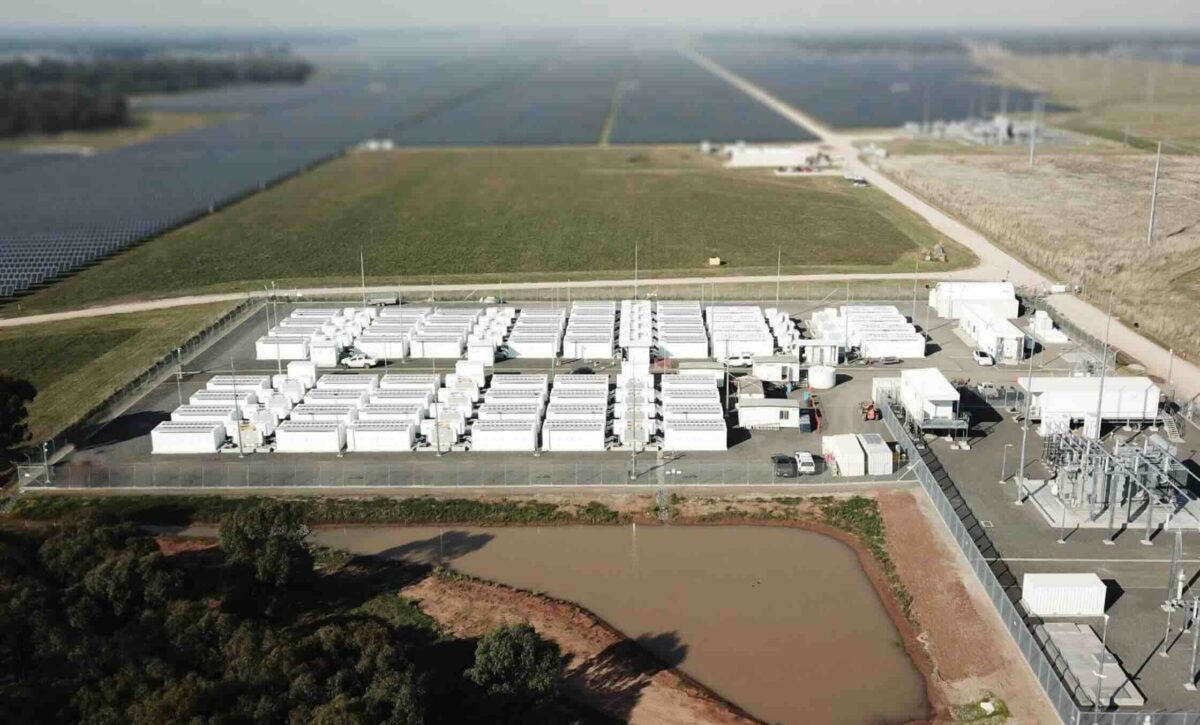
Australia’s biggest transmission company, Transgrid, is preparing to launch the first stage of what will be the biggest tender for grid-forming batteries in the country, deemed essential to protect the so-called “heart-beat” of the grid.
Transgrid on Tuesday says it will seek to award contracts for more than one gigawatt of grid-forming battery capacity in 2026, the first stage of a plan to engage 5 GW of battery capacity in coming years.
Batteries with “grid-forming” inverters are deemed critical to providing important grid services, known as “system strength”, and providing the “heart-beat” of the grid that will enable them to run at times on 100 per cent renewables.
These grid services are normally provided by coal-fired power generators, but because these are expected to shut down in the coming decade, Transgrid and other state-based transmission companies are looking for a mix of giant spinning machines known as synchronous condensers, and grid forming batteries, to fill this gap.
“Giant batteries will complement the proven grid-strengthening role played by synchronous condensers to enable the NSW power system to operate at up to 100% instantaneous renewables,” Transgrid head of network Jason Krstanoski said in a statement.
“With the recent boom in grid-scale batteries, calling on them to act as stabilisers means we can accelerate the crucial strengthening of the renewable grid without increasing its footprint.
“That’s good news for consumers, because we do not need to purchase, own, install or significantly upgrade the network to operate these energy storage devices.”
The Transgrid tender will differ from those being conducted by the federal government’s Capacity Investment Scheme, which are focused on providing levels of storage to transfer the output of wind and solar from times of excess supply to high demand.
The Transgrid tender focuses only on the ability to provide system services in “grid-forming” mode, which is just one part of the suite of capabilities that big batteries can provide. In effect, the batteries are able add this revenue as “cream” on top of the other services they provide.
Transgrid, the Australian Energy Market Operator and other state based transmission companies – who are responsible for managing system strength in their respective grids – have been wrestling with the issue over who and what will provide these services for several years.
Battery technology providers such as Tesla have argued that their grid forming battery inverters can provide all the services required, but AEMO boss Daniel Westerman repeated last week that AEMO is not yet convinced that that they can provide all the services needed, particularly what is known “fault current”.
Because of this, Transgrid and other transmission companies such as PowerLink in Queensland and Ausnet in Victoria have rolled out plans to secure dozens of large syncons – at a cost of at least $150 million each – to support the grid.
But these machines are proving hard to obtain, because of a global backlog, and Transgrid last week was allowed by NSW energy minister Penny Sharpe to skip over normal regulatory hurdles so it can put in an early order for five of the minimum 10 machines it needs.
Transgrid says the decision to contract 5 GW grid forming batteries means they will deliver half of the system strength requirements for the state and eliminate the need for around 17 syncons.
Transgrid says the grid forming batteries can stabilise the high-voltage network in the event of a major disturbance such as a lightning strike or generator malfunction. Some batteries, such as Koorangie in Victoria and Darlington in NSW, already have contacts to provide those services.
Transgrid says an earlier expression of interest process elicited interest from the owners of more than 7.5 GW of batteries, giving it a big enough pool to work from.
The first gigawatt of capacity are expected to be able to deliver their services by the middle of 2026, so these battery projects will need to be either already operating or in the commissioning process. More tenders will be held in subsequent years.
“We are finalising the technical analysis that will determine the battery capacity needed for our initial process, and we look forward to engaging further with battery owners in the coming months,” Krstanoski said.
“This will be followed by periodic tenders … so that we can progressively add additional stabilising battery capacity to our system strength portfolio, eventually reaching the 5 GW target for grid-forming batteries we put forward in our system strength plan.”
The contracts for system strength do not require the batteries to actually reserve any specific amounts of capacity, as system strength is part of the “value stack” that can be delivered in normal operations.
That is different to syncons, which have one particular purpose. Syncons are added to the regulated asset base of the transmission companies that install them. The battery contracts are not, although the costs of the contract do filter down to consumers through various charges.