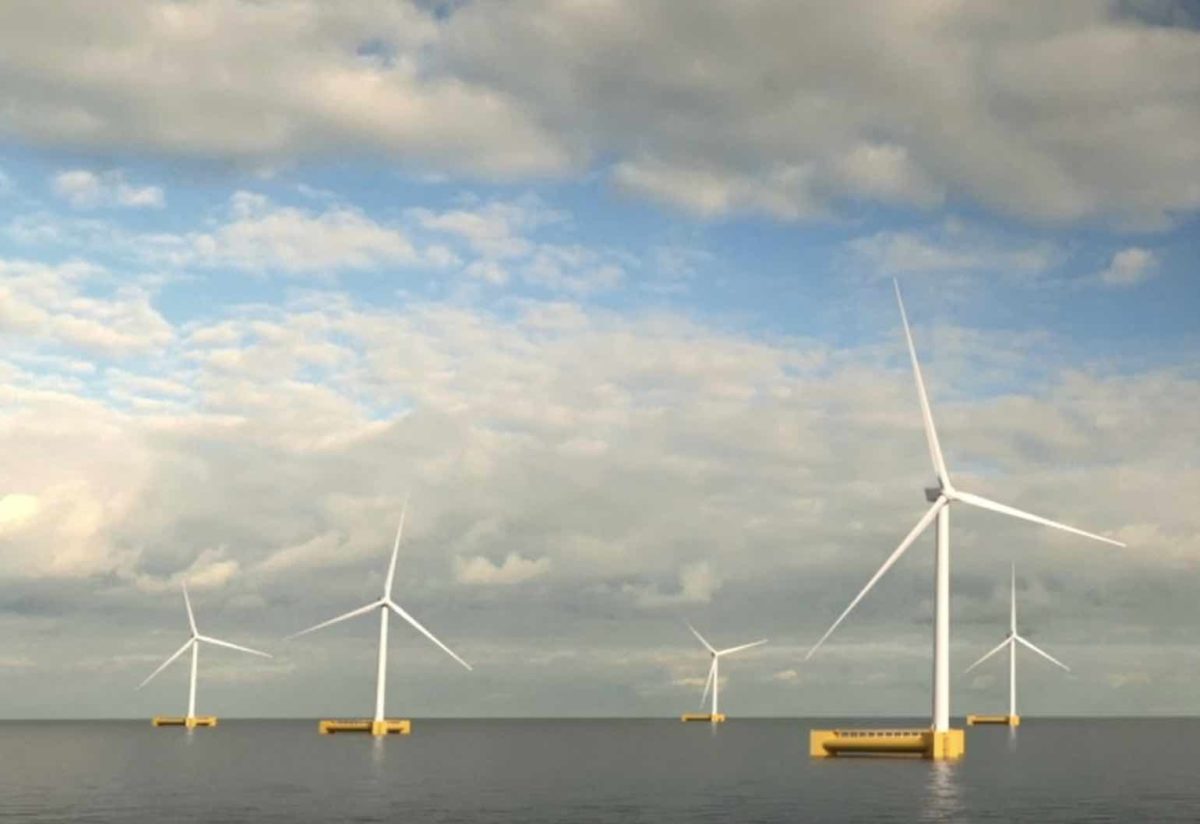
France has announced the winner of the world’s first commercial scale floating offshore wind auction which will see 250MW built off the coast of Southern Brittany in the country’s west.
A consortium consisting of Belgium’s Elicio and Germany’s BayWa r.e. AG were awarded the long-term Contract for Difference (CfD) to develop the 250MW Pennavel floating offshore wind project at a price of €86/MWh, or $A140/MWh.
This is notably lower than the eye watering £176/MWh ($A337/MWh) strike price put in place for floating offshore wind projects in the UK government’s auction scheme in September last year, after it was bumped up by more than 50% to align with rising project costs.
Expected to generate around 30% of Brittany’s current renewable energy production and power the equivalent of 450,000 homes each year, the project is intended to become a cornerstone of the region’s energy mix.
But it is the fact that the award of the CfD for Pennavel marks the first commercial floating offshore wind project in the world to be awarded a competitive contract that has this otherwise minor project making headlines.
“Floating wind is here to stay,” said Pierre Tardieu, chief policy officer of WindEurope, the European trade association for wind energy.
“The demo projects have worked. Now is the time to scale-up to large projects. The French auction was a milestone in the history of floating wind technology. It puts France up there with the leading countries in floating offshore wind.”
250MW for an offshore wind farm is comparatively small, compared to some of the multi-gigawatt behemoths being developed. But the Pennavel offshore wind project is one of, if not the largest floating offshore wind project in the world – and certainly the first commercial scale project.
Europe, which has pioneered floating offshore wind, nevertheless only has a handful of smaller demonstrator and pilot projects – including the pioneering 30MW Kincardine and Hywind Scotland projects, the 25MW WindFloat Atlantic in Portugal, and the 95MW Hywind Tampen in Norway.
Each of these projects were built with public financial support, however, in an effort to demonstrate the technical and technological ability of floating offshore wind.
Instead of traditional bottom-fixed offshore wind farms which, as their name suggests, are fixed to the seabed using massive concrete structures, floating offshore wind farms are not as beholden to sea depth.
A traditional bottom-fixed offshore wind farm can only reasonably be built in water depths of between 30 to 80 metres. Floating offshore wind turbines, however, could theoretically be built anywhere, given that their floating foundations are anchored to the seabed by cables.
The Pennvael offshore wind farm won’t be the only floating project in France, with the country expected to announce the winners of two more 250MW floating offshore sites in the Mediterranean later this year.
Similarly, Spain, Portugal, Norway, Greece, and Italy are all also making their way towards their own first floating offshore wind farms, while the UK has already tendered sea space for over 15GW worth of floating projects and just opened another seabed leasing round for a further 4.5GW of floating wind.