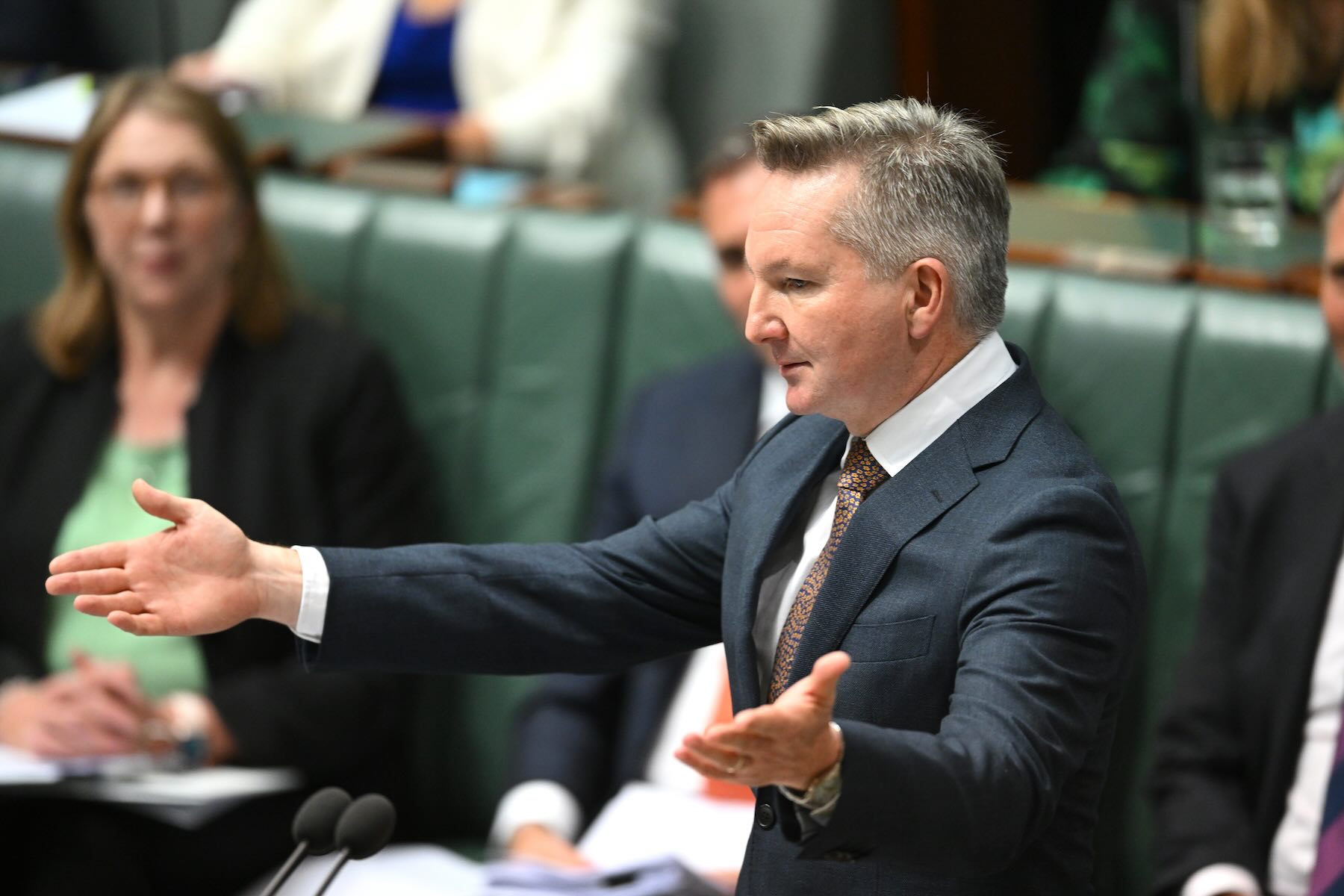
Federal energy minister Chris Bowen has conceded that the electricity price cap known as the Default Market Offer is clearly not working as hoped, and if failing to stop energy retailers from “price gouging.”
As Renew Economy has reported over the last couple of days – here and here – many energy retailers, including those owned by state and federal government, have announced huge tariff increases, admitting that they are seeking to “close the gap” between their offerings and the “safety net” offer set by the regulator under the DMO.
This is not what is supposed to happen. The DMO is supposed to set a cap that encourages competition and market offers below those price, but it appears that the energy cartel has simply to lift their collective offers to close to the price cap.
“The DMO was intended to act as a benchmark price to stop the worst forms of price gouging, while leaving the job of putting downward pressure on prices to competition between energy companies,” Bowen said in a speech at the Energy Week conference in Melbourne on Wednesday.
“However, I’ll be frank. I don’t think it’s working that way and reform is needed.”
Caps are reviewed annually to reflect the costs of generation and moving electricity around through poles and wires. In NSW, South Australia, southeast Queensland, it’s the independent Australian Energy Regulator’s job, while in Victoria, the Essential Services Commission sets benchmark prices.
Changes to AER’s price cap mechanism have not yet been locked in, but could include clamping down on what retailers can claim back from customers on their bills.
Bowen said it was hard to defend price caps when 80 per cent of billpayers could be getting a better deal.
“That’s why we have work underway to deliver a better regulated pricing mechanism which will put downward pressure on electricity bills and also ensure the energy market better utilises the huge uptake of rooftop solar and batteries,” Bowen says.
The minister said the transition to renewables depended on community support and equity.
“Australians aren’t going to continue to support our energy transformation if they don’t think our energy system is fair,” he said. “That’s why we took to the election, and are now implementing, the Cheaper Home Batteries program for 1 July.”
“While one in three homes have rooftop solar, only one in 40 have batteries. That abundant solar isn’t being harnessed as best it could – we’re fixing that with 30% off the typical small scale battery cost.
“This won’t just give solar homes a way to store their energy, it’ll help even out the grid, making the energy system fairer for all Australians.”
Bowen said final regulations for the battery scheme are being put in place, but the government will keep a close eye on the initial phases.
“We can already see it’s a popular policy – the department website’s traffic has seen more than 114,000 views, while battery sales are now outpacing new solar systems for the first time ever.
“With this significant community demand it’s vital we get the settings right so retailers and installers adhere to their responsibilities to customers and under the law. “
ACOSS strongly welcomes Minister Bowens announcement today to review the electricity Default Market Offer (DMO)* to better protect people from unreasonable electric price rises.
ACOSS CEO Cassandra Goldie said she welcomed the review of the DMO.
“Large energy retailers are making enormous profits while people are struggling with energy debt, putting food on the table and keeping their homes cool in summer and warm in winter,” she said in a statement.
“Our sector have been calling for these reforms and we warmly welcome the Governments actions.”
Note: AAP contributed to this report.
See also: Bowen says CIS tenders to be fast-tracked, new focus on local networks and grid bottlenecks
And: A government owned retailer has just jacked up our electricity tariffs by 25 pct – because it can
And: “On a hamster wheel:” More state owned energy retailers jack up prices to “close gap” on DMO
And: