The latest multi-decade blueprint for Australia’s main electricity grid was released last week, and will be the subject of intense debate for months to come – at least until the draft of the 2028 version is released at the end of next year.
The 2026 Integrated System Plan prepared by the Australian Energy Market Operator is based on the least cost pathway to replace the country’s ageing coal fleet, with the current energy and climate policies of federal and state governments top of mind.
The headline number is that it will need another 117 gigawatts of large scale wind and solar to be built over the next couple of decades, along with 87 GW of distributed solar (mostly on rooftops) and 64 GW of storage.
But what if the overriding target was to align Australia’s efforts to a target consistent with the 1.5°Ç scenario that was the basis of the Paris climate agreeement signed in 2015, rather than current policies.
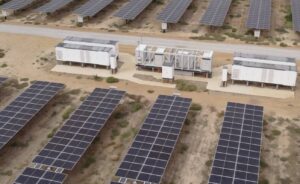
That requires a completely different focus on what’s needed, and a vast acceleration in the rollout of new technologies, in particular large scale solar and battery storage.
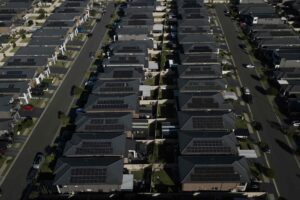
Households will also play a critical role in providing the capacity needed to meet Australia’s fair share in global efforts for a safe climate.
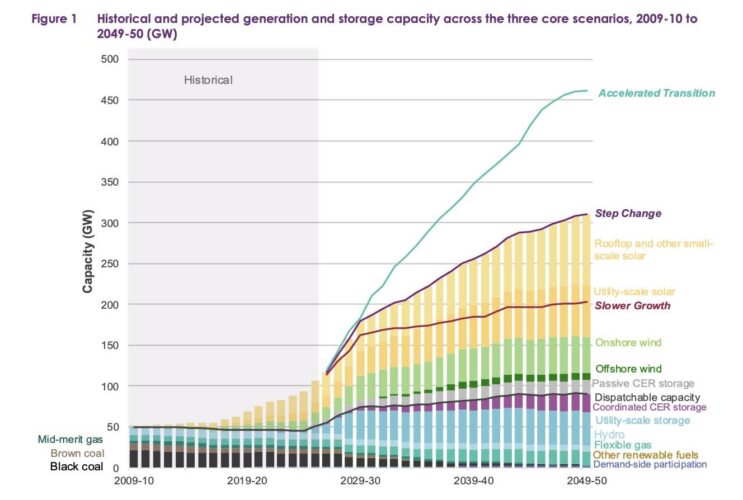
The ISP models three scenarios – slow change, step change and accelerated transition. AEMO says step change, the focus of its optimum development path, is considered most likely by 46 per cent of its stakeholders, with the rest equally favouring slow change and accelerated transition.
The difference in these scenarios is illustrated above, with the “accelerated transition” – previously called the green export scenario – calling for a 50 per cent increase in installed capacity by 2050.
But it’s the details in the following table that are most interesting, because it illustrates exactly where that extra capacity might need to come from, and what happens to the coal generators that the state LNP government in Queensland wants to keep open for decades to come.
By 2030, black coal is cut to half the capacity assumed in the step change scenario – 5.2 GW vs 10.2 GW – and all coal is gone by 2034 in this accelerated transition scenario.
Mid merit gas is little changed, but an extra 3 GW of flexible gas is needed, presumably to get through the wind and solar droughts, or dunkelflaute, that will haunt late autumn and early summer.
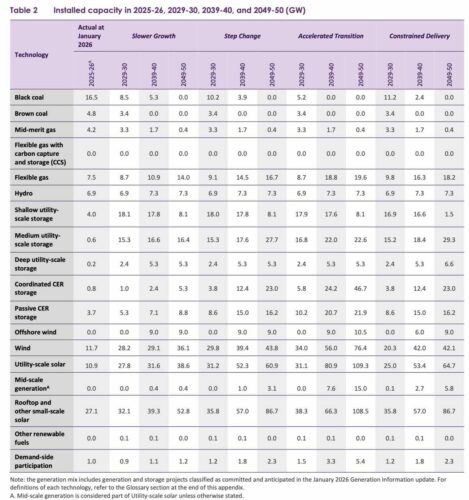
“All black and brown coal-fired generation capacities are projected to exit the market by 2033-34 under Accelerated Transition to meet the rapid emissions reduction requirements,” AEMO writes.
It notes that in addition to the emissions targets, this scenario has the smallest emissions budget of 303 Mt CO2-e from period 2026-27 to 2049-50), reflecting alignment with the ambition of limiting global temperature rise to 1.5°C by the end of the century.
More wind is needed by 2050 – around 76 gigawatts instead of the 43.8 GW assumed in step change, but the biggest change comes in utility scale solar, which will need 110 GW instead of 61 GW, although curiously there is little change in the amount of shallow, medium and deep utility stale storage required.
The other big change is in the co-ordination of household storage and consumer energy resources, which includes rooftop solar and home batteries. The required capacity of co-ordinated CER storage under the accelerated transition scenario doubles from 23GW to 46 GW, while the “passive” CER storage needs a one third jump to 22 GW.
Of course, this is just modelling, but you get the picture. Households will play a key role, solar and battery storage are the lowest cost proven technologies, and you can forget about offshore wind (apart from that legislated by the Victoria government), and flexible gas with CCS.
Where would that lead us? According to AEMO, pretty close to 98 per cent renewables within about 7 years as the last coal generator is closed down, and continuing at around that level from there, with just the occasionally used flexible gas capacity keeping the grid short of 100 per cent renewables.
One interesting note in the accelerate transition scenario is the still strong demand for hydrogen production, estimated to be 110 terawatt hours by 2050, still well below the 600 TWh imagined in the Green Energy Exports scenario in the 2024 ISP, but still significant,
It says that to service the hydrogen demand, over 16.1 GW of electrolysers are developed, with flexible electrolysers operating at 68% utilisation on a load-weighted average basis.
The higher level of flexibility is to allow more effective integration of these loads within renewable energy zones, enabling local generation to be used to operate the facilities, rather than having to import electricity when local generation is low. Perhaps Andrew Forrest and Fortescue weren’t wrong about hydrogen, just about the timing,
AEMO goes into enormous detail about potential changes to this scenario, driven by factors such as project delays, less transmission, economic growth, supply chains, data centre demand, energy efficiency uptake and the like. In all there is 88 pages of analysis over the various generation and storage scenarios.
It’s not pretending that accelerated transition is where we are headed. But it’s worth noting, because the accelerated transition scenario is where science says we should be going. And it’s interesting that one quarter of the stakeholders consulted by AEMO in preparing the ISP still think that it is the most likely outcome.
And you never know, after the impacts of the super El Nino this coming summer, we just might start believing in the science again. Or praying that the earth is flat and the easter bunny will save us all.
If you would like to join more than 29,000 others and get the latest clean energy news delivered straight to your inbox, for free, please click here to subscribe to our free daily newsletter.