A last-ditch scramble to take full advantage of federal Labor’s Cheaper Home Batteries rebate has “shattered” a range of records, including sending the average size of residential energy storage systems registered over the month of March to a whopping 40 kilowatt-hours (kWh).
In its latest update on Australia’s small-scale energy storage (ESS) market, industry statistician SunWiz reports that the national market “shattered records” set in March, with total registrations for the month reaching 1.6 gigawatt-hours – a new record, surging 35 per cent above levels recorded in February.
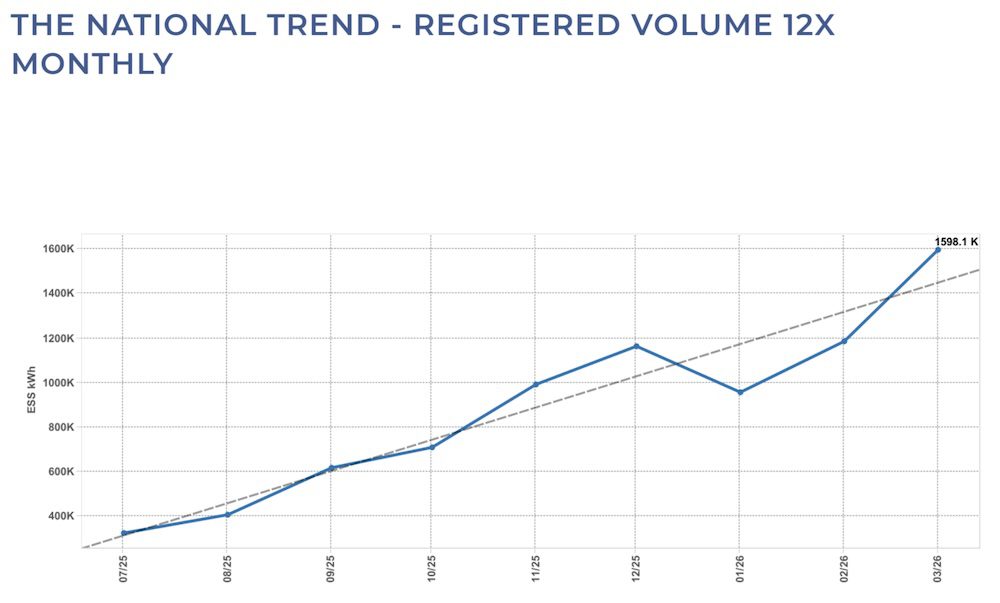
Image source: SunWiz
The surge in rebate activity is not entirely unexpected, with new rules coming into play in just a few weeks’ time that will drastically reduce the incentive for households to oversize battery systems accessed through the rebate.
Federal energy minister Chris Bowen announced in December that the government would boost total budget for the Cheaper Home Batteries program (CHBP) to $7.2 billion, while also adjusting its settings to make it last longer and go further – including by gearing it towards much smaller systems.
The changes, which come into play from May 01, will see batteries sized up to 14 kilowatt-hours (kWh) continue to receive the full roughly 30% discount off the up-front cost of a storage system. Batteries sized between 14 kWh-28 kWh will get 60% of the discount, while batteries between 28 kWh and 50 kWh will get 15 per cent.
And while there is still nearly a month to go under the rebate’s original settings, the Clean Energy Regulator – which governs the scheme – has long-since warned retailers and installers to avoid making discount promises that cannot be honoured within the remaining timeframe, given the rebates are determined by the installation date and not when a contract is signed.
At this stage, however, consumer appetite for the rebate shows no sign of slowing down – or sizing down – in the last-minute scramble to lock in maximum value.
“The race to beat the 1 May CBHP subsidy cut sent the market into a frenzy,” says SunWiz managing director Warwick Johnston.
“The urgency is written in the numbers: average ESS size hit a record 40 kWh, as buyers went big while the going was good.”

Image source: SunWiz

Image source: SunWiz
The SunWiz data shows that there was volume growth in every state and territory, topped by the Northern Territory with a 77 per cent boost to month-on-month registered capacity.
“Even the laggard of the pack, Western Australia, still clocked a solid 18 per cent,” says Johnston.
On battery size, the March data shows that the “top-heavy skew” created a sort of staircase of growth in every kWh capacity segment downward from 40-50 kWh, except for the 0-10 kWh bracket, where there was a slight contraction, month-on-month.

Image source: SunWiz
“Although we saw growth across all states, NSW stood out with a 44% surge – the third-highest growth rate nationally – delivering over 600 [megawatt-hours] MWh of battery volume registered in March and setting a new state-level record,” Johnstons says.
If you would like to join more than 29,000 others and get the latest clean energy news delivered straight to your inbox, for free, please click here to subscribe to our free daily newsletter.