It’s one of the more absurd contradictions in Australia’s clean energy transition.
Across the country, farmers are investing heavily in solar, batteries and smart irrigation systems to cut emissions, save money and reduce their reliance on the grid.
But many are discovering that the electricity generated on one part of their property can’t legally be used just a few paddocks away, simply because it crosses a boundary line on the map.
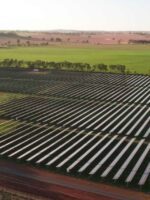
That’s the reality for Sandra Jefford and her partner, Wilco Droppert, who run the Wilandra Dairy Farm in Victoria’s Gippsland region. Four years ago, they embraced renewables, installing solar panels and batteries across three different sites on their farm, which are all connected by existing poles and wires owned by network operator AusNet.
It was a million-dollar project, expected to pay for itself within seven years, with 250 kW of solar and a sizeable battery system. At the same time they upgraded their irrigation infrastructure, adding remote control systems on all the pivots and pumps to sync with their renewable energy.
“This project was so worthwhile,” Jefford says. “It’s not just the electricity savings – it saves us about 25 hours a week on labour because of this automation.”

The solar array on the Wilandra dairy farm. (Photo by Sandra Jefford)
Wilandra’s water use is now more efficient, emissions are down, and their operations are smoother.
“It’s much safer too. My husband doesn’t have to go out during the night, so we get a much better sleep through irrigation season. There are so many benefits.”
But there’s a catch.
Each of the solar and battery installations sits on a different land title, and that means the electricity they generate can’t legally be shared between them.
Same farm, same poles and wires – ridiculous rules
“Just this afternoon during milking, we were generating some power at the dairy, but we needed more power, so we were buying that from the grid and paying about 35 cents per kilowatt hour,” explains Jefford.
“At that exact time, at two other sites on our farm, just a few hundred meters away, we were exporting power into the grid and getting paid four cents. It’s ridiculous.”

Sandra Jefford on her Wilandra dairy farm (Photo Ricky French)
The law that’s locking them out? The National Electricity Rules which govern the electricity market.
Anna Collyer, Chair of the Australian Energy Market Commission (AEMC), the agency that makes the rules, confirmed to Renew Economy that “electricity exports cannot be transferred from one National Metering Identifier (NMI) at a connection point to another.”
Once power passes through a grid connection, it must be sold on the wholesale market—it cannot be directed to another site, even within the same business.
That includes contiguous farm properties owned by the same person.
“Network pricing does not distinguish between electrons travelling a short distance and electrons that have travelled a long distance,” added Collyer. “This is traditionally for equity reasons, so as not to disadvantage customers who live in remote areas, compared to those who live closer to generation sites or generators.”
In practice, it means Australia does not have a “local tariff” that could reflect short-distance power transfers between adjacent titles, even if they are all part of the same farm business and already connected by existing poles and wires.
The system wasn’t built for farms like this
Natalie Collard, CEO of Farmers for Climate Action, says this is a widespread problem. “Many farms are on multiple titles,” she says. “That’s so you can manage and sell properties. Often, the productive parts of your farm will include separate titles, because people might buy the neighbour’s paddock or extend over time.”
She says regulators need to catch up: “I’d love those energy rule makers to invest some time and energy to change this. That’s something that could help take pressure off the grid overnight.”
Jefford agrees.
“The majority of farmers I know have several contiguous titles,” Sandra Jefford says. “You just cannot justify putting solar panels at every site where you need power.”
The restrictions also prevent Jefford from using solar power to run a water pump they installed just a few hundred meters away on a neighbouring property, where they hold a licence to draw irrigation water from the river.
A controlled microgrid that never got off the ground
At one point, AusNet showed interest in trialling a controlled microgrid across the Jeffords properties that would allow power-sharing across titles. But the company later advised it was no longer a priority.
“We were even willing to pay to use the infrastructure already on our land,” says Jefford. “We said we’d be happy to pay one or two cents per kilowatt hour just to move our own power around.”
But the roadblocks kept piling up. In addition to Australia not having local network tariffs, no local retailer was willing to develop a billing system that could support a controlled microgrid.
When asked what Jefford can do in this situation, a spokesperson for AusNet suggested to Renew Economy two options, neither of which are straightforward.
One is to combine their electricity metres, their NMIs, on to a single title, but this would require them to build “the necessary power lines on their properties compliant with safety regulations [and] each request by a customer to aggregate sites is considered on a case-by-case basis.”
Alternatively, they could set up an embedded network. However, the process of establishing an embedded network is governed by a maze of state-based and national rules and is typically designed for caravan parks, shopping centres or apartment buildings, not dairy farms.
Rules in need of reform
Dr Muriel Watt, a solar pioneer, and now advisor to ITP Renewables and the Australian PV Institute, also says the national electricity rules need a fundamental overhaul.
“The rules are making it very difficult to optimise all this fabulous renewable energy that we’ve got on the system – we’re adding to the costs instead of streamlining.”
“If we had a vertically integrated local utility it would be in their interests to use locally produced electricity locally because that’s maximising the use of existing assets and not requiring them to build new power lines.”
The irony is that the energy Jefford is generating is already physically moving through the same wires that connect her three properties. What’s missing is a regulatory and billing framework that acknowledges this practical reality.
Until that changes, Australian farmers like Sandra Jefford, on the frontlines of climate adaptation and food security, remain locked out of fully utilising the clean energy they produce.