There is a very interesting post on the website of Hancock Prospecting, the mining giant that has helped make Gina Rinehart the richest person in Australia, and which provides a platform for her strident views on how the country should be run.
“Mining is essential to achieve net zero,” the headline reads.
And the article follows: “Mining is critical to securing the minerals essential for everyday life and essential to be able to build renewable energy projects. The first step in the supply chain to create solar panels and wind turbines and EV batteries begins with mining companies like Hancock, Atlas and Roy Hill.
“Hancock Prospecting believes it is important to follow the science. We are 100 per cent compliant with all legislation and regulations established by the government targeting a reduction of emissions by 43 per cent below 2005 levels by 2030 and net zero by 2050.”
That all sounds laudable, but it is certainly not the message that Rinehart is sending out in her public appearances. And it is certainly not what Pauline Hanson, the leader of the surging One Nation political party that Rinehart openly backs, wants you to believe.
Rinehart regularly attacks net zero, demands it be scrapped and decries “toxic” solar panels, which with wind turbines and battery storage are “destroying large parts of our environment.” Hanson and her party attack the science, and think the whole climate thing is a hoax.
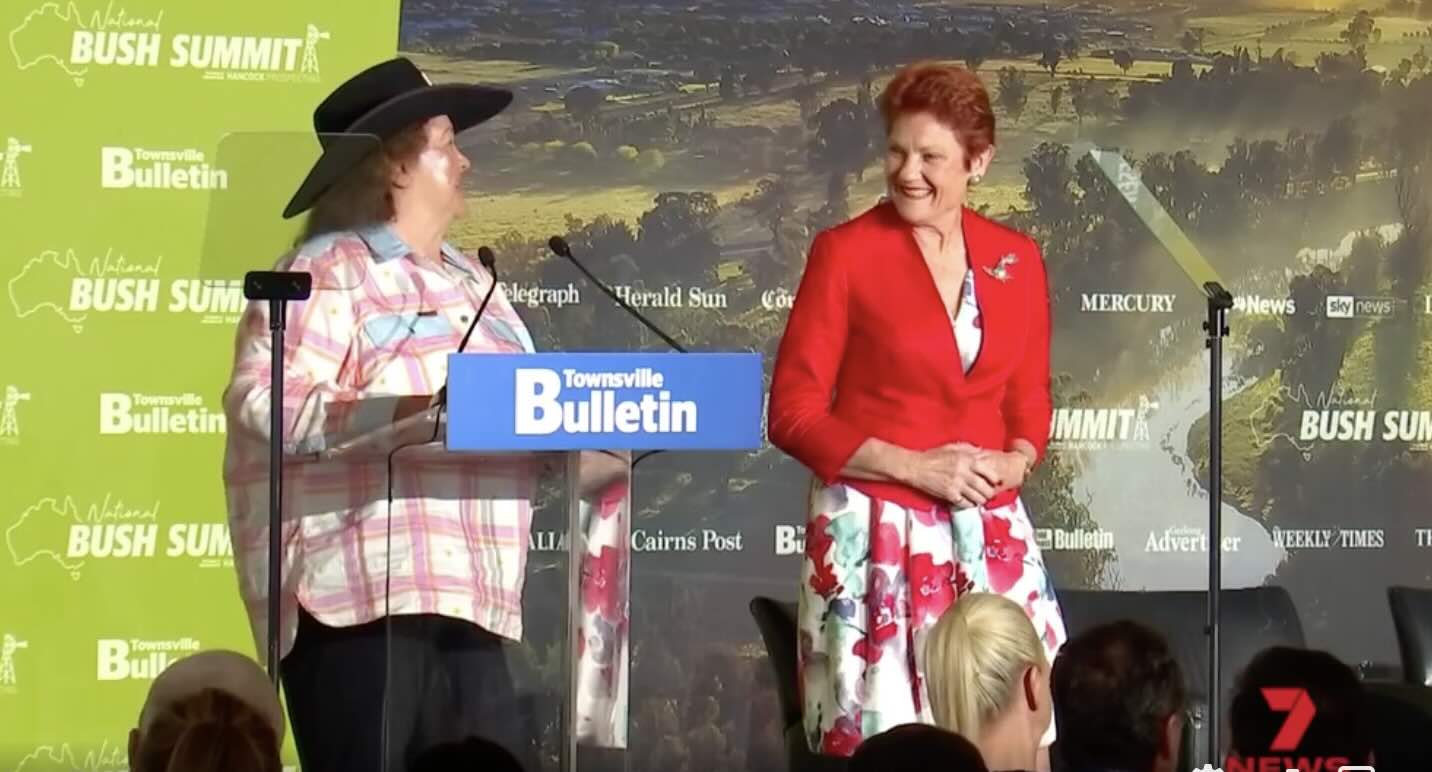
On Thursday, at the Hancock-sponsored and Murdoch-media backed Bush Summit event in Townsville, Rinehart lamented the use of spare land for renewables – rather than as launchpads for Elon Musk’s space rockets or a Taiwan computer chip factory.
“We have land out near Prairie designated for toxic, asbestos riddled, bird and bat maiming, bird and bat killing wind towers. What a waste,” Rinehart said, according to notes of the speech published on the Hancock Prospecting website.
Hanson, who had flown from Canberra to Townsville to attend the event to introduce her party’s backer to the audience, had taken up the same theme the previous day at the National Press Club.
“One Nation will end this renewable energy bribery – grants, tax incentives, concessional finance, even the government underwriting anything that sponsors the whole net zero hoax,” Hanson told the National Press Club in Canberra in a speech on Wednesday.
“Let me give you one example amongst many. Rewiring the nation to build useless transmission lines and destroy prime agricultural land, billions of taxpayer dollars. This will end. One Nation will always protect prime agricultural land. It belongs to farmers, not government transmission lines.”
Hanson used the speech to attack Snowy 2.0, which she also threatened to scrap, Andrew Forrest (over his hydrogen hyperbole), and the Clean Energy Finance Corp (which she claimed erroneously had received $200 billion of government funds).
She also complained about subsidies for anything to do with renewables, and promised to build nuclear power, which – as the nuclear industry itself makes clear – would likely require the biggest government subsidies of all.
Of course, not much of it made sense – a collection of tropes and misconceptions that could have been garnished from social media or Sky After Dark – and it ignores the realities of the global and Australian energy markets.
But what was most striking about Hanson’s speech was the similarity to Rinehart’s regular attacks on wind and solar, her outright dismissal of net zero as a viable policy, her jibes against Forrest, and her demands for small government.
In a keynote speech at the Bush Summit held in Darwin last year Rinehart took aim at the “great green incinerator,” including a thinly veiled attack on Forrest, who is not just aiming for “net zero” in a couple of decades time, but for real zero in just four years.
Rinehart didn’t mention Forrest by name, but wondered why iron ore miners were reporting their “lowest dividends in seven or eight years,” yet spending billions on the “great green incinerator.”
Forrest’s Fortescue is spending $7.2 billion on wind, solar, batteries and transmission, as well as electric trucks and other mining equipment to eliminate fossil fuels by 2030, an investment it says will deliver a quick return.
In a speech read in her absence by former NT chief minister and now Rinehart employee Adam Giles – the CEO of Hancock agriculture, she said:
“Mum and Dad shareholders, please demand answers to just how many billions of shareholders’ money – money you could otherwise enjoy as dividends – are these big companies spending on the great green incinerator, buying new expensive electric vehicles and putting in charging stations, plus paying for wrongly called renewables, storage batteries, and transmission lines, modifying equipment, and studies into all sorts of green things, including hydrogen, and call for all of those mining executives living and enjoying luxury green gab-fests at Davos and other places to pay that money back, and to pay that money back personally.”
Rinehart and Hanson are entitled to their views and to express them whenever and wherever they wish, and the views are certainly familiar to anyone who reads the Murdoch media, watches Sky After Dark, or has been observing any of the nation’s right wing parties.
Indeed, it’s getting hard to tell the difference now between One Nation and the more traditional parties – the Liberals and the Nationals – that seem destined to become junior partners in a right-wing government led by Hanson, should that ever occur. All want the end to net zero, all decry renewables.
Yet not all wind turbines are destructive.
Two mining companies that Rinehart is heavily invested in – Liontown Resources and Lynas Rare Earths, which both supply minerals essential to the green energy transition – are reaping the benefits of investing in solar, wind, and battery storage, the very technologies Rinehart and Hanson dismiss so out of hand.

Lynas has boasted of 95.7 per cent renewable penetration at its Mt Weld mine for the whole of the March quarter, (its wind turbines are pictured above), while Liontown is achieving more than 80 per cent wind and solar penetration over the year at its Kathleen Valley lithium mine.
Both companies say the benefits of their big investment renewables are significant, as they have shielded them for soaring diesel prices.
Hanson’s promise of stopping government underwriting “anything that sponsors the whole net zero hoax” would also be bad news for another major Rinehart investment, in Arafura Resources.
The company – into which Rinehart has invested another $85 million, according to the AFR – has just pressed go on the $1.6 billion Nolan’s mining project that will mostly produce minerals essential for the wind turbines that Rinehart abhors, and the EVs that she also frowns upon.
The Nolan’s mine is almost entirely funded by government handouts and discount loans, and government off-take agreements.
The Hancock Prospecting people insist that these minerals are essential for defence and medical industries, which is true. But it is the clean energy revolution around the world – in renewables and EVs – that is driving demand and will account for more than half of its contracts.
Rinehart also complained in her speech last year about the “green slush trough wasting taxpayers’ money,” and Hanson on Thursday claimed that government subsidies are not available to other industries – which will be news to the fossil fuel industry.
The Bush Summit – heavily backed by Rupert Murdoch’s media organisation and amplified in other mainstream media – has become a major tool for Rinehart and her political favourites to push their policies, with a particular focus on net zero and immigration.
“Net zero destroys real jobs in the industries that keep our country’s economy alive,” Rinehart said last year. “Vast fields of solar panels or towering wind turbines and transmission lines are essentially build and run projects. They create a short burst of jobs during their unnecessarily environmentally destructive construction.
“Once the ribbon is cut and the photo opportunities are done, they generate very few long-term jobs. Perhaps some people are employed to bury the birds and the bats that the wind towers will be killing.”
Andrew Forrest and Fortescue, of course, would beg to differ, arguing that the switch to renewables will underpin the profitability of the company’s giant iron ore operations, and bring new business opportunities, such as powering data centres or bringing value-added industries to Australia like green iron.
The Pilbara is a fascinating microcosm of the broader debate in Australia, where Rinehart and Forrest are at loggerheads over their diametrically opposed energy transition views, and where BHP is also being criticised for back-tracking on its previous commitments.
The LNP government in Queensland highlights what decisions will be taken by a government determined to rip up such emissions policies, and scrap renewable targets and “calling in” key renewable and storage projects, sending a chilling message to developers and investors.
Yet even the LNP can’t stand in the way of big industry, with Queensland’s biggest energy user – Rio Tinto’s giant Boyne Island smelters and associated refineries – committing to replacing its ageing coal generator in Gladstone with a mix of wind, solar and battery storage, just like the off-grid mines backed by Rinehart.
Note: An earlier version of this story wrongly stated that Rinehart’s address to the Darwin Bush Summit was made this month. The story has been republished updated, taking into account subsequent events.
If you would like to join more than 29,000 others and get the latest clean energy news delivered straight to your inbox, for free, please click here to subscribe to our free daily newsletter.