Angus Taylor’s ‘capacity market’ plan for households to pay to keep old coal plants running until they fall apart and are required to close, even if they’re grossly inefficient, will increase consumers’ electricity bills, not lower them.
IEEFA has calculated that households are likely to see increases in their electricity bills of between $182 to $430 a year to keep the ageing coal plants running, more than double the carbon price.
What’s striking, apart from the call to subsidize coal, is that the proposal to increase consumers’ electricity bills contrasts with the government’s ongoing efforts for years to get prices down in the electricity market.
The government has long worried that electricity prices are too high, and has gone through enormous contortions at the generation end to change that.
Remember Snowy 2.0 “had” to be urgently built by 2021 to ensure supply and lower prices, but now it is optimistically targeting an opening of 2027 and the need to ensure supply has faded into the background.
The narrative has been similar with the government-proposed Kurri Kurri diesel and gas power plant: if we don’t build this plant, prices will go up 30% according to the Prime Minister.
If the aim is to keep prices down, this is a hideously expensive way to go about it, and will not work.
As the government knows, the generation side has enough renewable capacity to meet any supply gap from the inevitable coal plant exits for the next 10 years.
Putting even more subsidies into the generation side of electricity will further distort markets which inevitably will cost consumers more.
And this latest ‘coalkeeper’ strategy to keep old coal plants operating even if they’re not efficient is also another waste of money, with electricity prices for consumers set to soar, not drop.
The Federal government can better achieve its ambition to lower electricity prices if it focuses on the transmission and distribution side of the energy market rather than the generation side.
Transmission and distribution is the easiest way to make electricity prices fall.
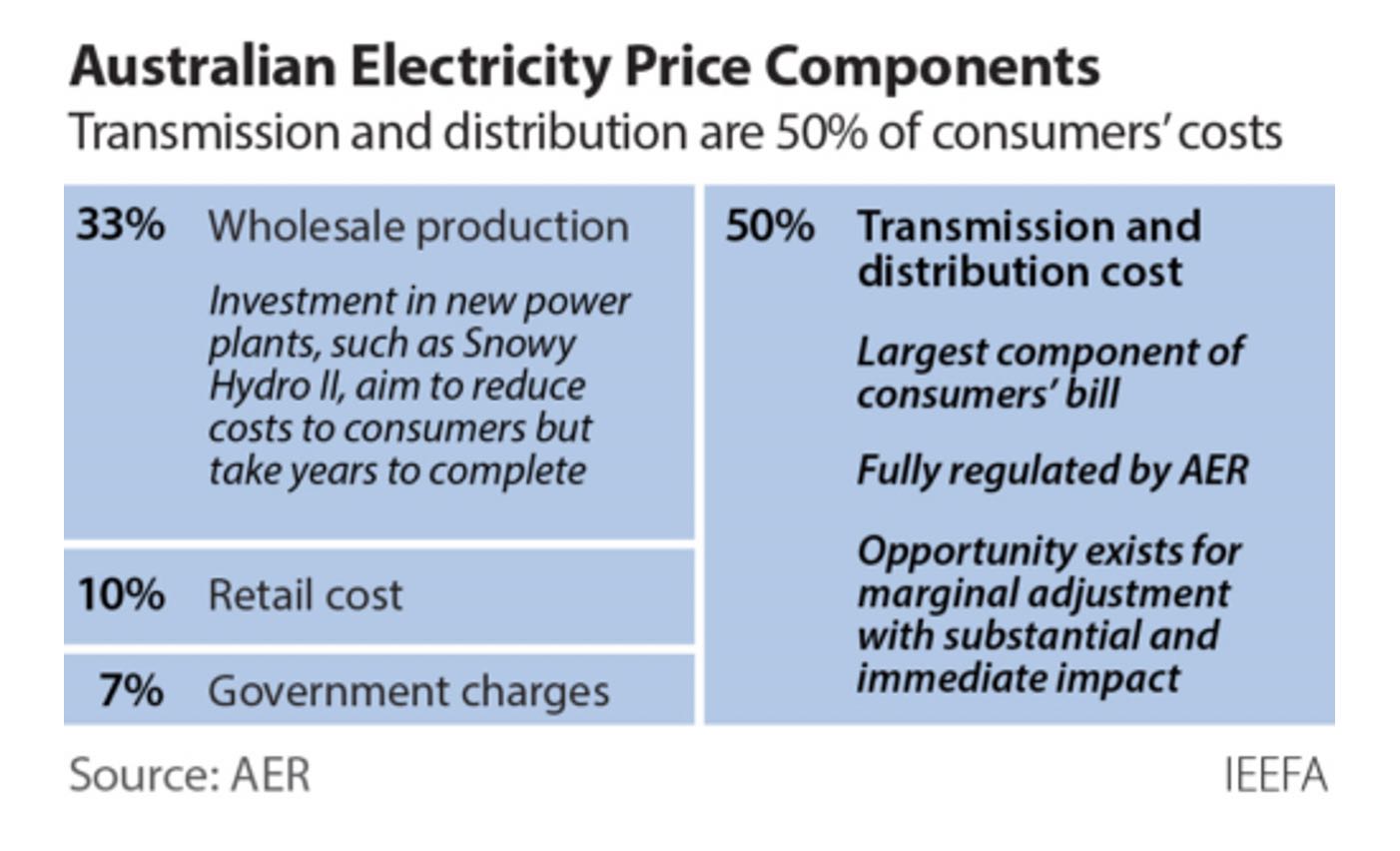
Transmission and distribution is the largest single cost in a consumer’s electricity bill at around 50% and it is the area where the government has the greatest power.
The government can influence electricity prices via the prices charged for transmission and distribution, which is regulated and controlled by government.
The Commonwealth effectively sets the price for of transmission and distribution via the regulatory structure.
The Australian Energy Regulator calls it allowable revenue – but it’s still setting the price.
The government therefore needs to look at how those prices were determined, and then look at the levers to see how prices can be changed.
All recent Australian Energy Regulator determinations – which cover $58bn of assets, result in a decline in nominal pricing driven by the impact of lower interest rates and inflation on an acceptable return (WACC) and the regulated asset base (RAB).
They continue however to allow for a very high equity risk premium component to the WACC which does not appear consistent with market valuations of infrastructure assets.
The impact on prices of lower allowable returns would be greater than the claimed impact of government investment in new firming (generation) power capacity.
The cost to government and consumers would be the writing of a letter to the Australian Energy Regulator to change electricity price settings, rather than investing $10bn needlessly in new generation, or keeping old coal plants running at a cost to consumers.
If the government were to focus on transmission and distribution, which it regulates, it would see a modestly positive trend and a potentially large lever to lower electricity prices.
Otherwise, they are just like King Canute, yelling at the blasted tides.
Angus Taylor’s capacity payment is not a long term solution to lowering electricity prices for consumers, nor is funding expensive new generation in Snowy Hydro or Kurri Kurri.
Owen Evans is a financial analyst and guest contributor with the Institute for Energy Economics and Financial Analysis (IEEFA).