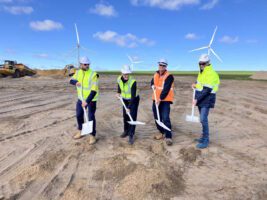
One of the world’s biggest zinc mines – the Dugald River project in north-west Queensland – is planning to build a substantial behind the meter wind farm to help it slash its crippling energy costs.
The mine currently sources most of its power from the Diamantina gas generator near Mount Isa, although it is also now sourcing around one third of its power needs from the newly expanded 88 MW Dugald River solar farm, (pictured above) which also services other big mining operations in the area.
However, energy costs are still too high, so the Dugald River mine owner, the Chinese based Minerals and Metals Group, wants to build a 48 megawatt wind farm – behind the meter – to service another 40 per cent of its electricity needs.
“The (mine) currently source electricity from the gas fired Diamantina Power Station and the Dugald River Solar Farm. Energy is currently the highest operating cost for (the mine) DRM and is subject to high pricing variability,” the company says in its EPBC application filed with the federal environment department..
“A combination of renewable energy sources will reduce operational costs and stabilise price volatility. These combined outcomes will improve the financial sustainability of the operation, whilst providing positive environmental outcomes in the form of reduced emissions.”
The proposal is for eight wind turbines, and the mining company says it has chosen the GW 165-5.2/5.6/6.0MW model, with a hub height of 130 metres and a tip height of 212 metres. They will be sited on elevated positions on the Knapdale Range, within the mine boundaries.
“The intent of the wind farm is to meet the existing electrical demand from the Project only. MMG has no intention, at the present time, to export power to the grid,” the company says.
“However, future expansions of the wind farm have the potential to provide power to the wider region, resulting in significant emission reductions. These may be investigated in future, subject to viability and additional approvals.”
The Dugald River mine is ranked as one of the 10 biggest in the world, and the company says it employs around 500 employees and contractors on a mix of fly-in, fly-out and local residential basis.
The history of the power supply in the Mount Isa region is a chequered one.
More than a decade ago the state government, under pressure from the mine’s owners Glencore, approved a new gas fired generator rather than renewables and a new transmission line linking to the main grid.
That didn’t turn out well. Gas generation has become hugely expensive, prompting Glencore to threaten to close down the mine in 2017 because of soaring energy costs. It prompted the decision in 2021, to build a first, 44 MW stage of the Dugald River solar farm, then known as Mica Creek, and then doubling its capacity to what it is now.
And, for good measure, the state government is now supporting the new transmission link to Townsville, now called Copperstring 2.0, that will unlock even more renewable energy resources and mining resources that will now be able to access cheaper power.
Output from the Dugald River solar farm – currently the biggest remote region solar farm in Australia – supports MMG, Mount Isa Mines and New Century.