Federal Energy Minister Chris Bowen has announced that electricity retailers across Queensland, South Australia and NSW will be required to offer all households 3 hours of free power in the middle of the day.
This has been branded as the Solar Sharer initiative, with the rationale being that proliferation of solar PV has given us a such a huge surplus of power that it might as well be offered for free.
Supporting this idea is that prices in the wholesale power generator market will often be close to zero or even below zero during the middle of the day across most states.
Also our residential electricity distribution networks have ample spare capacity over the middle of the day and in some cases are facing constraints in absorbing and transferring solar power (but please be aware that this issue is horribly exaggerated as touched upon in this article).
With this Solar Sharer initiative minister Bowen is suggesting that he will ensure that even those that don’t have solar panels will still be major beneficiaries of this energy source.
It’s a clever idea for the Labor Party to combat the endless stream of negativity we hear from Liberal-National Party politicians falsely claiming that renewable energy is driving up the cost of power.
But it also poses some risks and challenges. And it is no replacement for policies that would ensure a broader spread of the community, and in particular renters, received energy efficiency upgrades to their properties.
Free electricity isn’t free if you end up paying a lot more via higher fixed charges
The first and most important issue is that this initiative will benefit no one if it simply leads to a transfer of costs into the fixed daily supply charge.
This would involve networks and electricity retailers offering us zero priced electricity for three hours but then hiking up how much they charge consumers in the unavoidable fixed daily charge.
You might think you’re very clever charging up your battery in the middle of the day on free power and then using this to avoid consuming power during the higher priced peak period. But this does nothing to help you if they’ve just substantially hiked up the daily supply charge.
Large hikes in the daily fixed charge are a very real prospect. There is currently a range of highly influential organisations that are pushing to shift a large proportion of network costs into the fixed supply charge, instead of being recovered based on your electricity demand (the Nelson Review even suggests the idea in spite of it being out of scope for the review).
They want to do this because they are petrified of the potential for solar and home batteries to slash the amount many people will pay to electricity suppliers.
Will middle of the day electricity always be plentiful in winter time?
Another issue is that while we might have plentiful electricity over daytime for most of the year, that may not be always be the case over winter time.
Many coal generators are getting old and several need to close soon. We need to be encouraging people to install energy efficient equipment that will ensure their need for power to heat their home and their water in winter-time is modest. Free power in the middle of the day across the entire year won’t help us with that task.
Making sure we don’t undermine the things that made free electricity possible
We also need to be careful not to take it the current situation of plentiful solar energy and excess network capacity for granted.
Solar system sales are showing clear signs of a decline as Green Energy Markets’ Solar Report clearly illustrates. The number of solar systems sold so far this year to the end of September are down almost 18% on last year and 32% down on the 2021 year for the same months.
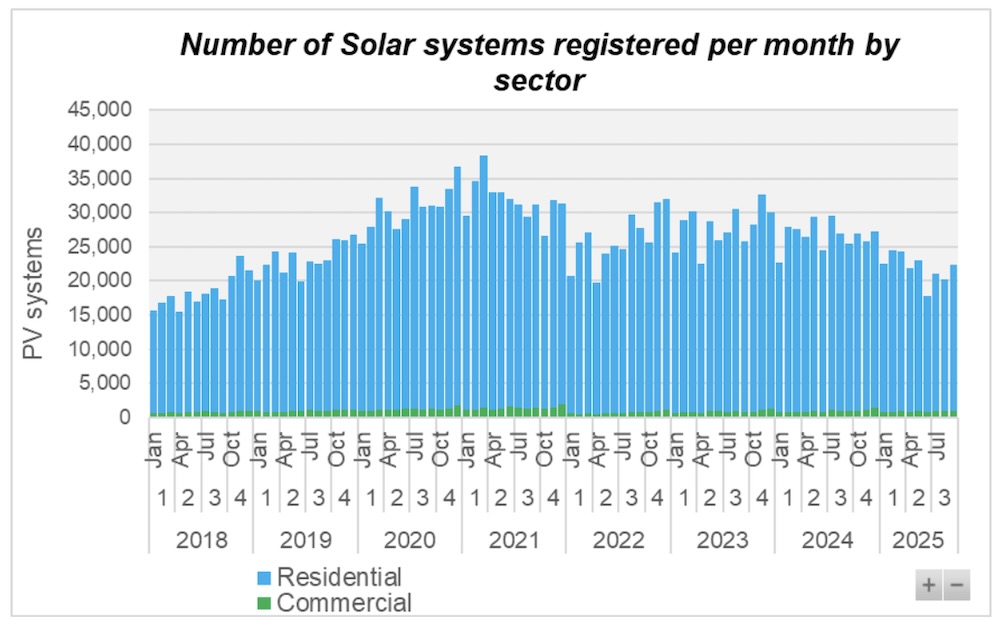
Source: Green Energy Markets’ Solar Report
Some of this decline might be a temporary phenomenon due to the fact that installers are unable to keep up with demand for batteries and so have downgraded their solar sales activity.
As the number of installers accredited for batteries increases, then this constraint will be relieved and we might see a revival in solar installs.
But there is a risk that this decline continues as people decide there’s little value in solar when power is free in the middle of the day. That isn’t going to help Labor’s already major difficulties in reaching its 82% renewables target.
Secondly while we’ve got plenty of excess capacity in residential power networks, we need to be wary about risks posed by potential large surges in electric vehicle charging.
A three-hour time window isn’t long to charge up an electric vehicle. Many people use their car to commute on weekdays leaving the weekend as their only opportunity to take advantage of free daytime power. That might mean lots of households simultaneously switching on car chargers when the clock ticks over to free power at 11am on Saturday.
In some locations you can get a high concentration of electric vehicle ownership creating a risk of transformer overloading if we don’t also have plenty of solar generation in the same location.
A better and longer-lasting solution – help renters get the good stuff
If we really want renters to share in the benefits of solar and battery storage then we should help them to get their own solar and battery system.
This requires two reforms:
- Implement reforms to electrical standards that would allow renters to do the same thing as millions are doing in Europe – install what are called “balcony solar” and balcony battery systems. These are small, do it yourself, portable systems which can be plugged into a home’s electricity circuits.
- Implement rental energy efficiency performance standards that would require landlords to install equipment that would enhance the energy efficiency of their rental properties, including the option of using solar and battery systems as an option to meet the standard.