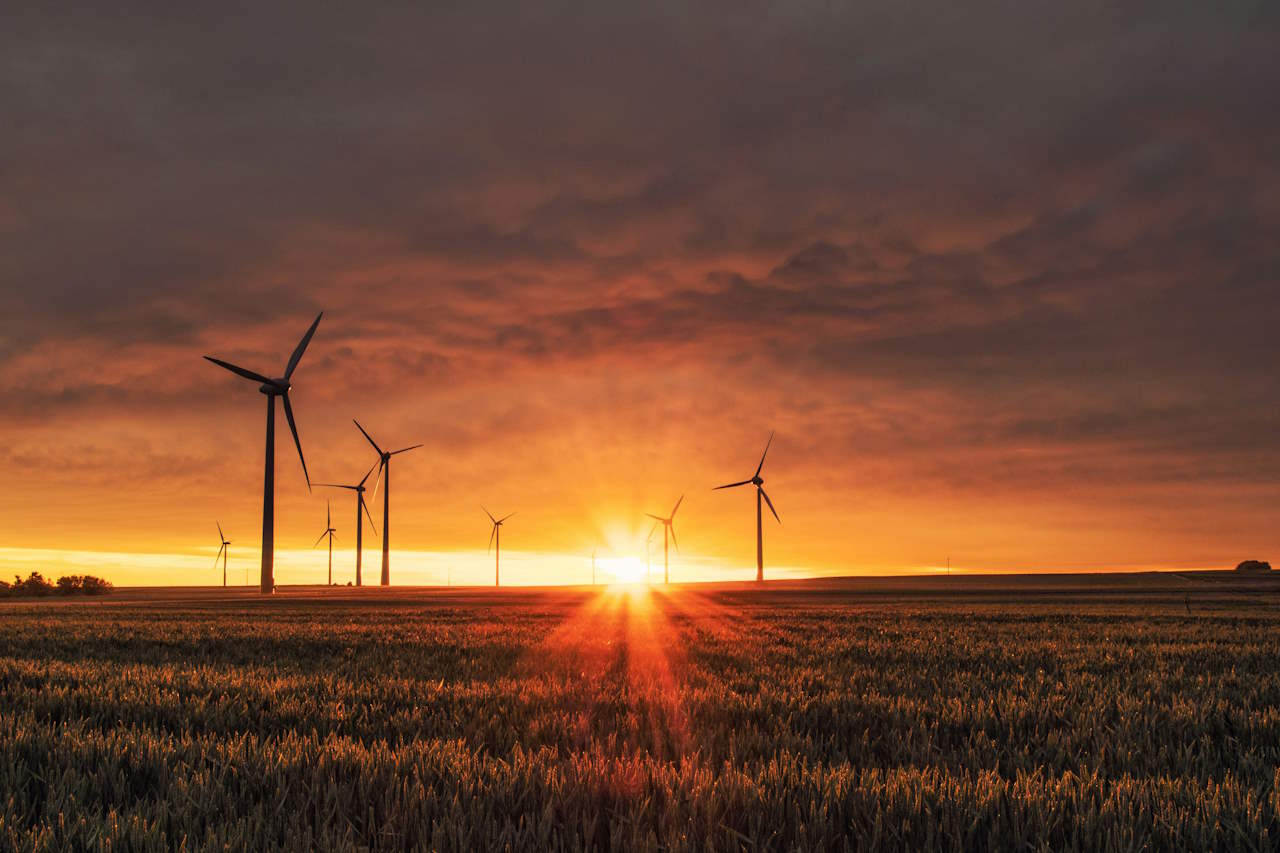
The Portugal-based renewable and storage developer TagEnergy has committed to building a four-hour big battery next to what will be the biggest wind farm in Australia and the southern hemisphere.
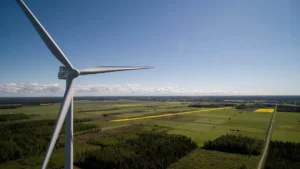
TagEnergy says it has signed a balance of plant contact with Consolidated Power Projects, and has lined up Tesla Megapack batteries for the 150 megawatt (MW), 600 MWh battery storage facility that will be built next to the 1.33 gigawatt (GW) Golden Plains wind farm.
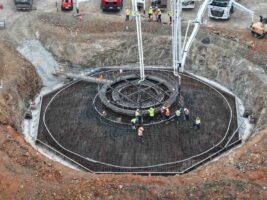
The first 756 MW stage of the wind project is now in its final stages of commissioning, and construction of the 577 MW second stage has begun. When complete in the middle of 2027, the wind and storage park will account for nearly 10 per cent of Victoria’s electricity needs.
TagEnergy says the battery will add flexibility and reliability to the grid, and Tesla says it will boost transmission capacity and allow for more renewables to be built.
The battery will be a standalone facility – with grid forming inverters that can supply essential grid services – and will store excess capacity from the wind farm, as well as charing from the grid at times of low prices.
“The addition of large-scale energy storage at Golden Plains is another vital step towards achieving a more secure and flexible supply of clean electricity for the people of Victoria,” TagEnergy’s managing partner in Australia Andrew Riggs said in a statement.
“Golden Plains BESS will help balance supply and demand on the grid and provide critical capacity during peak demand periods.
“It will optimise the use of renewable electricity as we continue to accelerate the energy transition. And it will enable more adaptable and reliable access to renewable, cost-effective energy for families, homes and business.”
Josef Tadich, Tesla’s APAC regional director said the grid-forming battery will provide a critical service for Victoria’s 500 kV transmission network in the western districts.
“By delivering 24/7 essential system strength services, it will support the transmission network in times of high renewable energy penetration in Victoria’s west,” Tadich said in a statement.
“It will also maximise renewable generation through energy arbitrage by charging in times of renewable energy abundance during the middle of the day and discharging at times when Victorians need it most in the evening peak, accelerating the state’s progress toward its renewable energy targets,” he said.
Victoria has a target of reaching 65 per cent renewables by 2030, and 95 per cent renewables by 2035, by which time it hopes that the remaining three coal fired power stations are retired.
That timeline depends on the construction of new transmission lines, the build out of local renewable zones, and the delivery of large wind, solar and battery storage projects. Victoria is also pinning its hopes on offshore wind.
TagEnergy, founded by former leaders of Neoen’s Australian business and backed by some of the same financial partners, is also considering other big battery projects in Australia, along with a pipeline of wind, solar and hybrid facilities.
Riggs told Renew Economy that there is a lot of customer interest in the Golden Plains battery, because of its grid location, and the company is already looking at a second stage around the same size.
“Battery costs continue to surprise,” Riggs said, noting the recent fall in storage costs in recent years. He also noted the progress of “second tier” battery providers who are lifting their game on integration.
TagEnergy is pursuing two big battery projects in Western Australia – Narrogin and Paterson – and potentially the biggest one of all, at Nebo in Queensland, that has permissions for up to 900 MW and 3,600 MWh. It also has federal approvals for the Forbes solar battery hybrid.
The company is also working on a near 2 gigawatt The Pines wind project in a Forestry Corp plantation in NSW. “It is the Golden Plains of NSW,” Riggs said, noting there was still a lot of community work to do.
In Victoria, it has new wind projects in development in the west of the state, and it is also working on the Devlins Bridge wind project near Wagga that has recently entered the NSW planning system.
It also has federal approvals for the Forbes solar battery hybrid, which it is looking to develop with Osaka Gas.
TagEnergy says construction of the Golden Plains battery will begin early next year and will include 168 Tesla Megapacks, a substation and an operational facility. It will be connected to AusNet’s Golden Plains Terminal Station, located off Bells Road in Rokewood, within the already operational Stage 1 wind farm.
See also Renew Economy’s Big Battery Storage Map of Australia for more information.