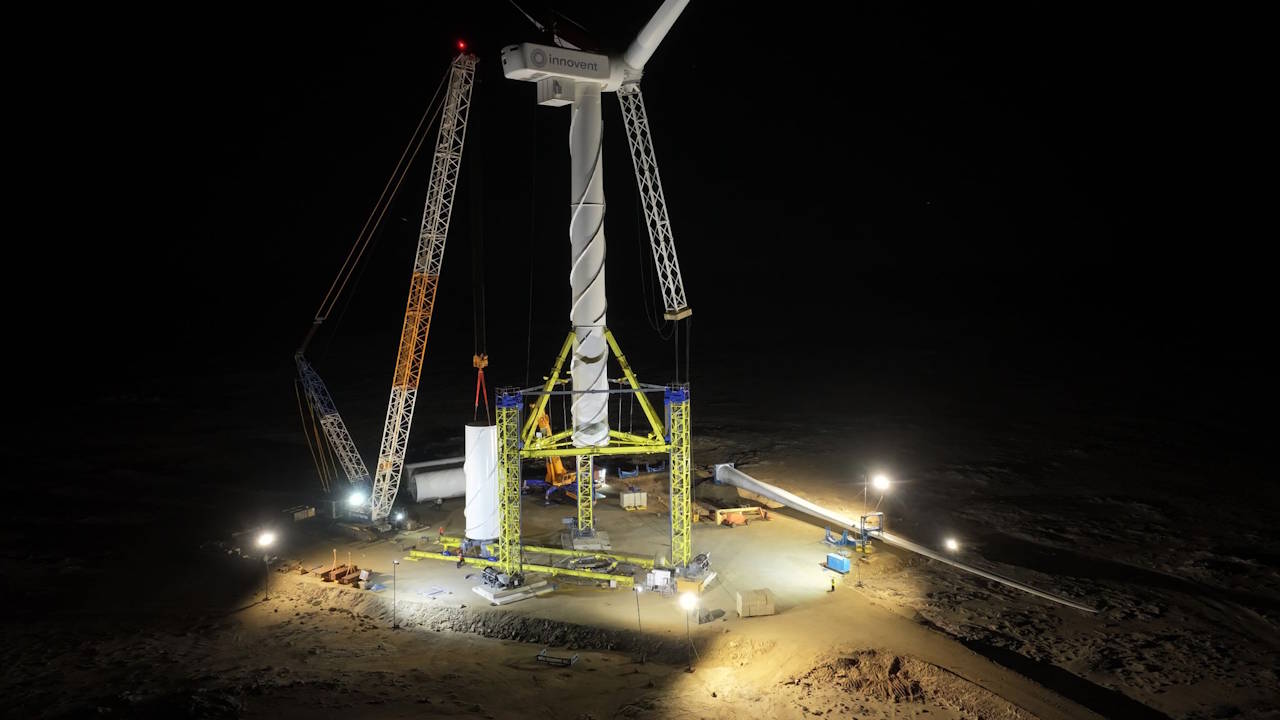
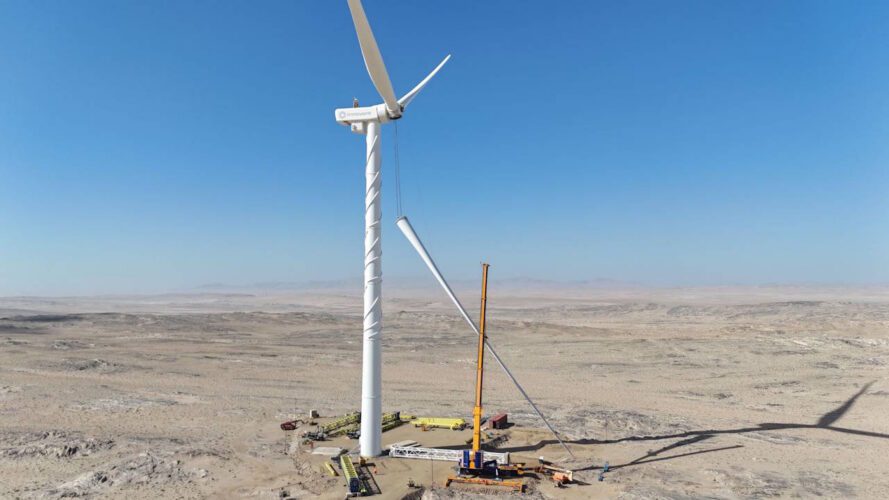
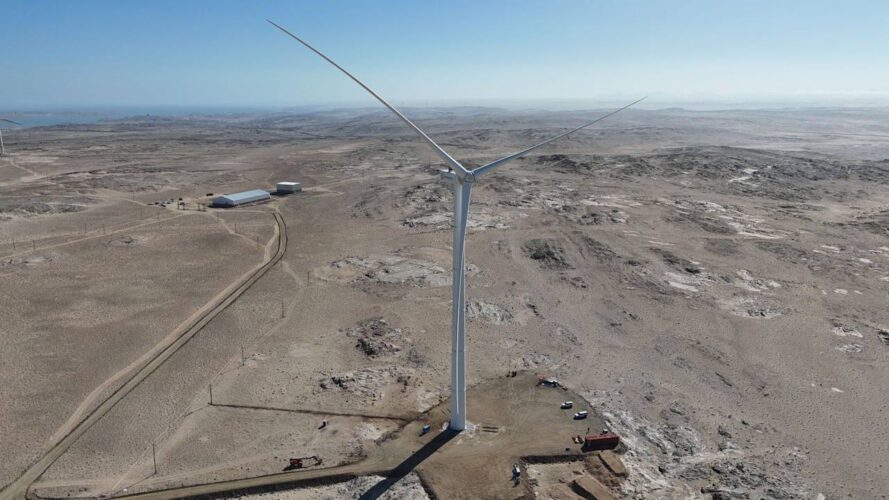
Spanish wind technology company Nabrawind says it has successfully deployed its “crane-less” system for installing wind turbines, installing the first at a wind farm in Namibia in an area with such extreme wind conditions that large cranes are unable to operate safely.
Nabrawind, which was acquired last year by Australian mining giant Fortescue following at least two investments in the company, has developed a self-lifting system for wind turbines dubbed ‘Skylift’ that eliminates the need large-tonnage cranes.
Skylift combines two Nabrawind-developed innovations: the Self-Erecting System (Total SES), which is capable of installing both the turbine nacelle and tower; and the so-called ‘BladeRunner’, which is capable of installing the blades.
By circumventing the need for large-tonnage cranes, Skylift paves the way for installation of large-scale wind turbines in locations with extreme wind conditions or in hard to navigate areas.
This was demonstrated last week in southwestern Namibia on the Atlantic coast, famed as one of the planet’s most wind-rich areas.

Nabrawind successfully completed the installation of a 6 megawatt (MW) Goldwind GW165/6000 turbine, the first of seven that will be installed at the site alongside four 2 MW wind turbines that were also installed by Nabrawind and installed on Nabrabase foundations.
The Skylift technology allows the installation of any type of tower once the rotor has been installed at a height of between 30 to 40 metres, and can be performed reliably even in unsteady winds of 15 metres-per-second (m/s) and gusts of 20m/s.
Those ratings significantly outperforming conventional cranes that can only operate in winds below 6 to 8m/s.
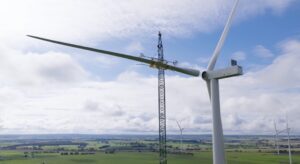
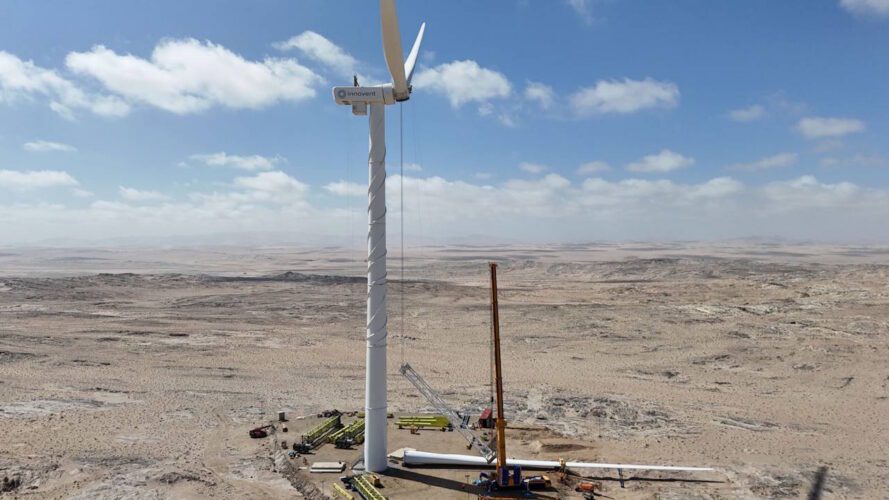
While the photos provided by Nabrawind suggest a crane was on hand to help with construction, it appears to have been a relatively small crane.
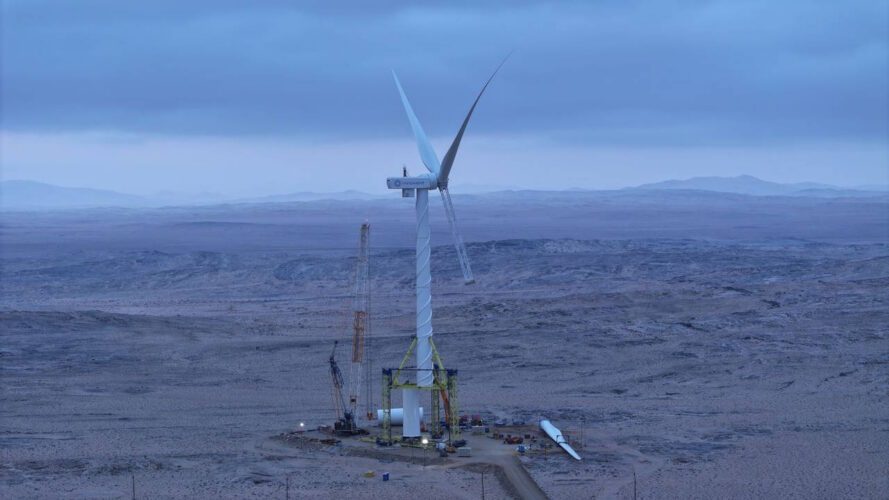
The Goldwind direct-drive turbine was installed by first hoisting the first tower section and nacelle before two blades were installed at a 30-degree angle to the ground using what Nabrawind describes as “a proprietary handling system and a counterweight that stabilizes the rotor until it reaches the final hub height”.
This counterweight was then replaced by the third blade when all tower pieces were installed.
Fortescue plans to use the self-lifting Nabrawind technology for its first 118 MW wind project at Nullagine in the Pilbara, and then for another 700 MW at the nearby Bonney Downs.
Fortescue has argued that the technology will save on costs because it will require less cement in the foundations – a major issue in such hot areas – and will not require heavy cranes that would be difficult and costly to bring to the region.