
When EnergyAustralia held the sod-turning event for its four-hour Wooreen big battery in Victoria’s Latrobe Valley in February, a team from the Country Fire Authority was in attendance.
Their presence at the event was likely mostly to do with the smoking ceremony, which was conducted expertly and without incident in a dry and windy paddock by Gunaikurnai Elder, Michelle Dow.
But the CFA was also there as a key stakeholder in the Wooreen battery; a major new industrial facility that could, theoretically, be affected by a fire or find itself in the path of one.
“Fire safety is one of the key considerations for communities when a renewable energy facility is proposed,” Victoria’s CFA said in a media release on the subject in December.
“CFA’s Specialist Risk and Fire Safety Unit (SRFSU) works with regulators and industry to ensure that fire risk management is considered in the design and operation of renewable energy facilities.
“CFA firefighters are highly trained to manage a range of hazards and risks when responding to emergency situations and have been doing so for years.”
In the case of lithium-ion batteries, the most likely emergency situation is “thermal runaway” – an uncontrollable build-up of heat and pressure that can result an intense and potentially explosive self-sustaining fire that can be difficult to extinguish.
By far the biggest risk of thermal runaway lies in portable electronic devices stored in and around the home that are being charged incorrectly, have been damaged or exposed to heat, or disposed of incorrectly – cheaply made e-bikes and e-scooters have been particularly problematic.
In big batteries, this sort of incident is rare. And yet, in Australia, community opposition to big batteries due to fire risk is developing a sort of thermal runaway of its own – self-sustaining and increasingly difficult to extinguish.
Last month, a special report on ABC TV’s 7.30 featured community members from the Victorian town of Dederang explaining that they didn’t want the lithium-ion batteries being proposed for the region because of the fire risk they would pose.
“As a brigade, we’re equipped and trained to fight grass and scrub fires,” Doug Connors, a Dederang CFA volunteer of 50 years, told 7.30. “A battery fire, all of a sudden it’s involving toxic chemicals and smoke, and we don’t have the equipment or the training to deal with it.”
Teresa Hicks, a dairy farmer, mother and CFA volunteer said she wouldn’t feel comfortable fighting a battery fire because it would be too toxic.
“No one’s going to get on the fire truck anyway, because it’s too dangerous,” she said.
Back in the paddock near Churchill in February, the team from Wärtsilä – the Finnish technology company supplying the battery energy storage system (BESS) for the Wooreen project – was keen to highlight the importance of battery safety.
A month earlier, a fire at the massive and once world-leading Moss Landing Power Station in California had destroyed most of the oldest group of batteries at the facility – which was a 300 MW array that came online in 2020. The incident significantly impacted public perceptions of BESS safety.
Wärtsilä says there’s a pressing need for a more open dialogue between battery developers, project developers, communities and first responders about the risks associated with big batteries – and how they are managed.
Mishaal SyedNaveed, the senior fire protection engineer at Wärtsilä, spoke to Renew Economy about what manufacturers are doing to douse public concern over battery fires – and what they want communities hosting their batteries to know.
“The first thing is, we’re in this battery project together,” SyedNaveed said in an interview in May, when he was visiting Australia from the US.
“We’re not here to just dump our technology and leave. We have a long-term service agreements with many of our projects. So we’re in this project together, alongside the operator.
“And then it also comes down to building public trust, so prioritising safety and being transparent as much as possible, and continuing to build that trust within the community.”
Much of the trust building comes down to communication and education – starting with what first responders should do if there is a fire in a big battery your company has supplied.
“This is a wonderful clean technology, but there are safety risks that need to be discussed and managed,” SyedNaveed says.
“[In the case of a battery fire] we really recommend a non-offensive water suppression use,” SyedNaveed says.
“So that means not directly using water to suppress these battery fires, but instead take a defensive approach and use water to cool adjacent enclosures if necessary, or take care of ancillary fires and/or bush fires.
“This is the message that we really preach to fire authorities when we do these emergency response trainings.
“I was in Australia last August, meeting with the CFA, South Australia Country Fire Service and Fire Rescue Victoria and talking about the best firefighting procedures in line with industry best practices,” he said.
“They’re coming from a mindset of going through the gates, water blazing, directly injecting water. That’s exactly what we do not recommend.
“We have advised a ‘let it burn’ approach, let that fuel consume itself out. And as long as you keep that thermal event contained … into that one spot and don’t let it spread, then that’s not such a concern for the surrounding environment and it’s a manageable event.”
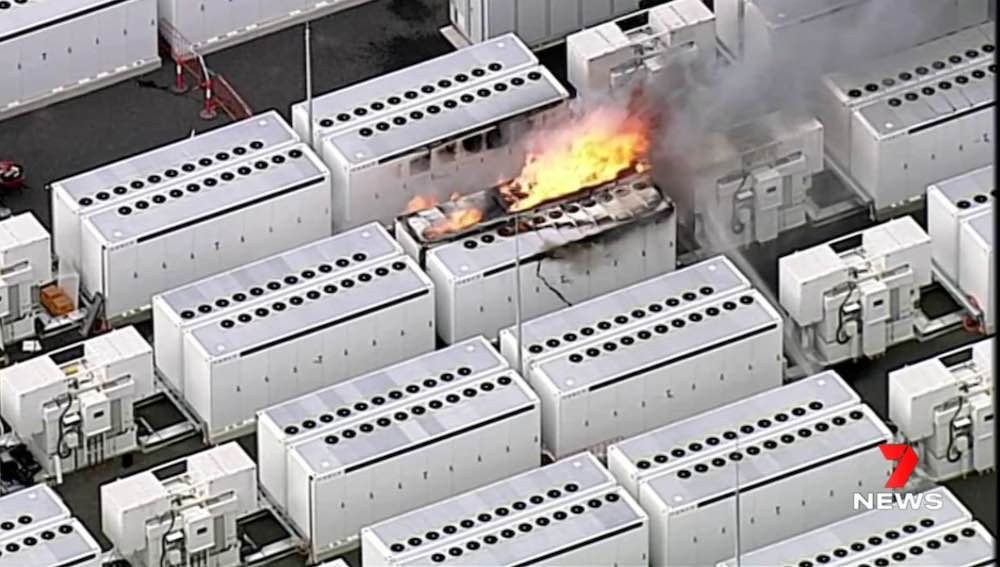
This gels with experience of the July 2021 thermal runaway incident at the 300 MW/450 MWh Victoria Big Battery in Geelong, when a Tesla Megapack “failed safely” during the commissioning process.
As the report of technical findings into the incident tells it, “the fire did not spread beyond these two Megapacks and they burned themselves out over the course of approximately six hours.
“There were no injuries to the general public, to site personnel or to emergency first responders as the Megapacks failed safely.”
And what about claims that battery fires spew “toxic chemicals and smoke,” as the Dederang CFA volunteer told the ABC? How do you address those sort of concerns?
“Yeah, good question. I’d start with explaining what a battery fire is, what actually comes out of it,” SyedNaveed says.
“The honest answer is the gas composition in a battery fire is quite similar to that of a house fire.
“Yes, batteries have electrolytes [that fuel the fire], but primarily inside BESS enclosures are plastics – and what is actually burning… is the plastics.
“BESS fires, when under combustion, release CO2, CO and there are trace amounts of hydrogen fluoride gas. All … pretty toxic.
“But compared to your house; you have polyurethane everywhere, which is glorified plastics. Everything from your sofa or your tables, almost everything has plastic-derived material in it.
“So the gas composition of a house fire is the same, roughly the same, in terms of combustion [as a battery]. And that’s something that some people don’t wrap their head around. They think of battery fire as extremely toxic.”
SyedNaveed is also keen to challenge the claim that toxic chemicals from battery fires will spread kilometers away.
“For example, in 2023, the governor of New York State created a Safety Working Group to investigate a BESS fire there. And based on the information available there was no evidence of significant off site migration of those contaminants.”
The second thing that Wärtsilä and SyedNaveed want people to know is that not all batteries are created equal – particularly in terms of safety.
“Everything from the selection of the exact cell chemistry all the way to the enclosure and beyond maintenance of the site, everything plays a role in terms of safety,” he says.
Chemistry, in particular, has adapted to reduce fire risk. For instance, the nickel-manganese-cobalt (NMC) lithium-ion cells used in the battery behind the latest Moss Landing event are now rarely used in big batteries, swapped out for lithium-iron phosphate (liFePO4) cells, which are less prone to thermal runaway.
“We are seeing a shift from NMC to LFP, because LFP provides more stability and is less prone to thermal runaway compared to NMC. This was a big lesson learned from the Moss Landing incident,” SyedNaveed says.
There are several things to look out for when evaluating different battery manufacturers on their fire safety credentials, too.
“Have they done the right modeling? Do they conduct fire testing [on their products]? What is their overall safety record? What is their track record?
“Wärtsilä has an unparalleled safety record, and that’s partly because of the robust design that we have, the way we integrate safety as a top priority from the cradle to the end of the life of the plant.”
SyedNaveed says that in terms of fire safety testing, there are various standards out there, depending on the country and jurisdiction, but these days there are also tests that exceed the benchmarks, to simulate absolute worst case scenarios.
“We have done our fire testing from a cell, to a module, to the unit, and even a large-scale test level,” he says.
“So at the module level, if there is a fire, we have seen that the fire is contained within that module and there is no propagation to adjacent modules in the container.
“When we do a large-scale test, we purposefully ignite the entire enclosure. To simulate a typical installation, we have three enclosures spaced apart by 100 millimetres, and we burn the middle one completely to the ground.”
SyedNaveed says the outcome of the large-scale tests – they have done four, to date – was that batteries in the other two enclosures remained operational and nowhere near any thermal runaway events, in terms of temperature readings.
In fact, he adds, “they were online throughout the entire event, as if nothing happened. … And that’s something that we’re proud of. It’s a good track record to have.”
A third point SyedNaveed is keen for communities to keep in mind about battery fires is that there are plenty of measures and technologies being put into place to prevent them from happening in the first place.
“These types of incidents do occur in the industry, but make no mistake, they are preventable and it’s best to be proactive and not reactive when it comes to building safety into the site,” he tells Renew Economy.
“There’s a multi layered approach in terms of detection.
“Everything, starting from the actual battery cell – whether there’s a voltage spike, a temperature increase, or there’s some abnormality – can be detected within what we call the battery management system (BMS) … which is like the brain of the actual BESS.
“And that BMS communicates to our overall energy management system …so we can understand if we are heading to a thermal event quite early on – whether we see spikes in voltage or temperature readings that are abnormal.
“And then, of course, we also have alert and enunciation for the event – if there is an event – but that’s all within the actual battery.
“If we look at it from an enclosure perspective, we have gas detection systems in some of our products. We have smoke detectors as well. So there’s a wide variety of detection for these events.”
Back in the Victorian town of Dederang, the 200 MW/400 MWh battery being proposed by Mint Renewables – and opposed by parts of the community – was last week approved for development by the state planning minister through the government’s fast-track program.
In a statement emailed to Renew Economy on Friday, Mint Renewables said there was still a lot of work to do before the project gets underway – not least of all on building trust with the community.
“We remain committed to community engagement and will continue to work hard to reassure the community and the authorities that our project can co-exist safely and provide benefits to the local area and Australia more widely,” Kim van Hattum, Mint Renewables’ interim head of Australia said on Friday.
“We hope that by continuing to be open about what we’re planning, some of the concerns held by community members can be alleviated.”