The now six-week-long conflict in the Middle East continues, massively disrupting global energy supplies with no end in sight.
This underscores the energy security risk to Australia of its extreme dependency on imported oil and resulting exposure to international fossil fuel shocks in an increasingly geopolitically unstable world.
The significant implications for national economic resilience are already apparent, with a fuel supply crunch and elevated foreign oil prices driving a cost of living crisis, inflationary pressures and surging interest rates here. At the time of writing, the Hormuz Strait, the critical chokepoint for 20 per cent of the world’s oil, including the Asian supply chains we rely on, remains blocked.
The massive blaze that shut down production at the Geelong Viva Energy oil refinery overnight on Wednesday, one of just two remaining domestic fuel refineries in Australia, further underscores the vulnerability of the Australian economy to increasingly concentrated chokepoints across the fuel value chain.
Electrification through the rollout of decentralised renewable energy is an increasing imperative to safeguard the economic resilience of Australia’s energy-centric industries in mining and agriculture.
New figures analysed by CEF demonstrate that Australia’s biggest miners each continue to enjoy many hundreds of million-dollars in exemptions from diesel fuel costs at the direct expense of ordinary taxpayers smashed at the petrol pump, checkout and on their mortgages.
Unlike other consumers of oil-based fuels, such as motorists (and notwithstanding the halving of the fuel excise at the pump – a temporary bandaid) mining multinationals making huge profits here are refunded the fuel excise they pay on diesel used in their operations via the Federal Fuel Tax Credit (FTC) Scheme, Australia’s biggest fossil fuel subsidy.
CEF has tracked 18 of the largest consumers of diesel in Australia, all of which cumulatively benefit from billions in subsidies under the FTC Scheme. In the 2025 financial year, these companies were collectively refunded $3.36 billion.
The top five beneficiaries alone – BHP, Rio Tinto, Glencore, Fortescue, and Yancoal – collectively pocketed $1.94 billion, with BHP banking $622 million, Rio $423 million, and Glencore $349 million.
This Scheme has several damaging effects. It keeps miners addicted to highly polluting imported oil, disincentivising them from transitioning their operations to clean energy, such as electric heavy haulage trucks.
And it rips billions of dollars out of federal government revenues year after year, depriving Australia of funding for critical services and infrastructure including hospitals, aged care and schools – while constraining the fiscal capacity of the government to provide the kind of consumer cost of living relief urgently needed right now.
While we understand the government doesn’t want to make diesel even more expensive in the middle of the current crisis, Australia needs to learn from this crisis and put in place clear long term policies to permanently solve our imported diesel addiction.
The solutions are staring us in the face and the imperative to act is clear.
In the last global energy crisis spanning 2020-2023, we saw rapid hyperinflation of diesel and oil imports exacerbated by Russia’s invasion of Ukraine in February 2022, which reshaped global energy dynamics. Average oil import prices rose 244 per cent from October 2020 to June 2022; while now deflated from these highs, they remain significantly elevated.
In CEF’s 2026-27 Pre-Budget submission to Treasury – a month before the US renewal of resource imperialism in Iran, thinly veiled as a regime change operation – we highlighted that a global supply shock from this position risks hyperinflation well above prices realised in 2022.
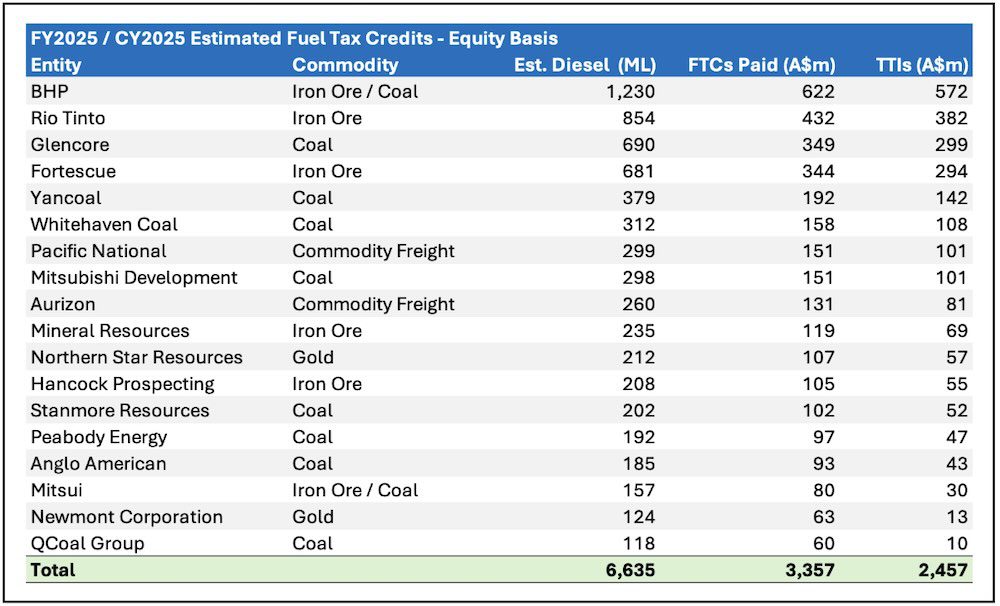
Figure: Estimated Diesel Consumption and Fuel Tax Credit Receipts, 2025
Source: Climate Energy Finance Calculations, Company Accounts, Clean Energy Regulator
We are not alone in urging energy independence.
In 2010, the NRMA warned Australia was becoming too dependent on imports from “some of the most politically unstable corners of the globe” for its surging oil and derivatives demand. At the time, imports accounted for 55 per cent of Australia’s fuel needs.
Now, Australia is reliant on imports for over 90 per cent of its crude oil and refined petroleum demand, which continues to grow. Per capita, we consume 7.67 barrels of diesel, or 1,219 litres, a year, the highest diesel consumption intensity of any major economy – 32 per cent more diesel per capita than Saudi Arabia, 83% more than the US, and 700 per cent more than China.
The NRMA proposed a range of long-term solutions, including the rapid deployment of renewable energy, fast-tracking the rollout of EVs, upgrading public transport networks, and incentivising the development of sustainable and renewable liquid fuels. These calls were not heeded.
One of the biggest opportunities Australia has to alleviate our exposure to international energy shocks is to reform the FTC Scheme.
We propose a ‘cap-and-reinvest’ fuel taxation model – a Transition Tax Incentive (TTI) – to get miners off diesel and accelerate the electrification and decarbonisation of our world-leading mining industry, a critical contributor to our economy.
Under this model, diesel fuel tax refunds would be capped at $50m pa per company. Not a single farmer or trucking company would be affected. Refunds above the cap would be retained by the company only if they are invested in clean energy initiatives such as electrified heavy mobile equipment to replace diesel fleets, renewable energy generation and firming capacity, enabling electrification infrastructure including transmission and distribution networks, or charging networks.
This revenue-neutral TTI would provide a major financial incentive to companies to accelerate the deployment of decarbonisation capex at no cost to taxpayers.
It would instantaneously reshape one of Australia’s worst fossil fuel subsidies, driving decarbonisation and electrification of mining, accelerating regional investment in renewable energy resources, and enabling us to embed decarbonisation into value-added exports as we move to processing onshore using renewables.
It would be the foundation of our permanent global competitive advantage in zero emissions, low cost energy. A win-win-win, for the environment, for Australia’s energy security and terms of trade, and for an Australian powered ‘Future Made in Australia’.
Fortescue has vocally embraced such a reform, unlike its competitors. It is shameful that BHP and Rio Tinto are noticeably undermining Australia’s efforts to improve our energy independence and align with the climate science. We need a Team Australia approach.
Australian policy reform that shifts capital and deploys resources into structural change that reduces fossil fuel demand, rather than temporarily alleviating pressures during periods of fossil fuel hyperinflation, is the key to lasting energy security, independence and resilience in a global economy undergoing a dramatic transformation in the race toward net zero.
With the critical May 2026 Budget a month away, the government is running out of excuses. At the very least, the government should outline the policy that they will advance once this latest Middle East war is brought to an end.
Matt Pollard & AM Jonson, Climate Energy Finance