Data centres could supply the wave of fresh energy demand that renewables need to get built, but they could just as likely be stymied by exactly the same things plaguing wind, solar and storage developers, a report by BNEF says.
Australia has a data centre pipeline of around 20 gigawatts (GW), or about 25 GW of peak grid load were it all to get built, says the report APAC Data Center Market Prospects: Australia, Japan and Korea.
For comparison, BNEF analysts are forecasting Australia will build about 50 GW of solar, storage and wind over the next eight years.
And while there are “genuine bottlenecks” in the Australian grid that are holding up the progress of new energy generation projects, BNEF analysts don’t see these causing data centres a problem – yet.
“The risk of securing renewables becomes more material as data centre campuses scale into the hundreds of megawatts, or as aggregate data centre demand reaches multi-gigawatt scale,” the report says.
“As the market matures and larger facilities come online, the constraints slowing renewable deployment, including long project development timelines, grid constraints and social licensing challenges, could become a handbrake on data centre development. This risk would be most pronounced if data centre load growth accelerates faster than the pace of clean energy supply additions.”
And despite the huge capacity of solar being built in the Northern Territory by Sun Cable, Australia’s north rated just two mentions in the 48-page report.
Instead, BNEF predicts that existing data centres leaders New South Wales (NSW) and Victoria will continue to attract the biggest gains.
“New South Wales and Victoria offer some of the strongest opportunities for scaling renewable investment,” said BNEF’s latest report APAC Data Center Market Prospects: Australia, Japan and Korea.
“This reflects strong policy support, concentrated corporate demand given the high share of Australian Securities Exchange-listed companies, and the need to replace retiring coal capacity.”
An article in The Australian last week speculated that US AI giant Anthropic may be talking to Sun Cable, apparently because it included a mention of the Northern Territory Electricity Market (NTEM) in a job ad alongside the Western Australian and east coast energy markets.
Sun Cable is actively courting AI hyperscalers to co-locate at its 20 GW Northern Territory solar project.
But as Lumea general manager Craig Stallan said at Australian Energy Week last week, while regional co-location is a “good concept, no one’s done it yet in Australia.”
BNEF says that as data centres get up into the hundreds of megawatts however, they will need to start moving away from capital cities.
Will BYOC solve the tenor gap?
Australia has a massive possible pipeline of 16.8 gigawatts (GW) and 3.1 GW of committed data centre developments, BNEF’s report says.

And while developers are hoping they will bring the long-term offtake contracts so desperately needed to get projects into financial close, governments such as NSW and the Commonwealth fear the consequences of their huge energy and water demands on everyone else.
Guidelines out of NSW and the Commonwealth in the last few months that data centres should bring-your-own-capacity, be it in generation or storage, are vague in how they might be executed in real life.
BNEF says that if Australia’s rules approached the stringent ones in Ireland, laid out in a panic as data centres energy use hit a fifth of energy demand, they “they would have a meaningful impact on renewables demand in the market.”
“There is a data centre pipeline of around 20 GW of IT load in Australia, which would translate to over 25 GW of peak grid load were it all built,” the report says.
“This is compared to approximately 50 GW of forecast solar, storage and wind installations over the next eight years.”

While that would cause a headache for policymakers and planners, it would be a relief for developers struggling to get their projects to financial close.
“That’s why we’re talking about the data center opportunity, and the hope that that helps with the tenor gap, because there is increasing customer interest in that,” said Engie’s Laura Caspari at the industry forum in Melbourne last week.
“But we need to see that customer interest [from data centres] materialise in more projects that are willing to underwrite renewables.
“That would be one of the ways that we’re hoping to see more demand in offtake because absent that, we’re looking at who else is going to pay the premium that we need to get, for instance, these wind projects away.”

Federal energy minister Chris Bowen has already suggested they could be a huge source of demand.
The sector has already seen big deals being made, with Amazon Web Services signing nine offtakes for 430 MW of clean energy in April alone, adding to its existing portfolio.
Other data centre operators have not openly reported their renewable energy offtakes.
Australia’s largest data centre operator, Airtrunk, for example, claims to be at 80 per cent clean energy already, but its only public power purchase agreement is a 2023 deal with Google for the 25 MW Mulwala solar project in NSW.
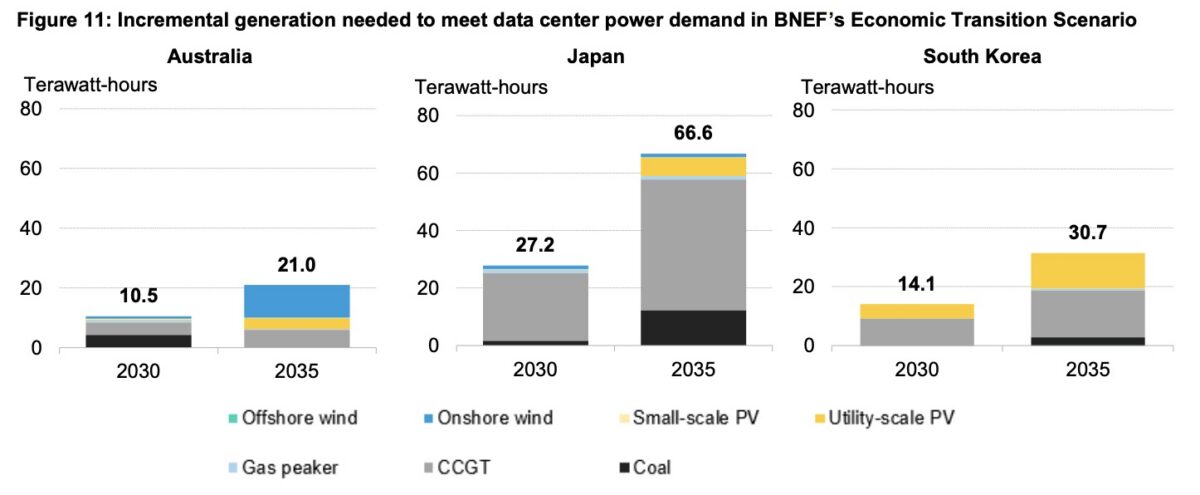
BNEF says much of the demand until 2030 is likely to be met by gas and coal power, with renewables piling in during the 2030s.
If you would like to join more than 29,000 others and get the latest clean energy news delivered straight to your inbox, for free, please click here to subscribe to our free daily newsletter.