Renewable energy developers could slash the time lost to planning processes and local opposition, if they started to look at communities as partners rather than people to consult with.
The difference is spelled out in a landmark report from the Community Power Agency (CPA), which calls on developers to start considering everything from co-ownership to joint governance.
Bringing in communities at this level is still relatively untested in Australia, but there are a growing range of local examples to learn from and these can reap outsized financial benefits, says consultant Satya Tanner.
Co-ownership, for example, may not be the cheapest form of finance for a wind, solar or battery project, she says, but local knowledge has other economic benefits.
For example, community ownership could cut planning times, by tapping deep local knowledge about areas that will be environmentally and culturally sensitive, and reducing the risk of organisational opposition.
“For a lot of developers it can feel a little bit in the too hard basket because it’s an unknown,” she told Renew Economy.
“And yet co-ownership brings goodwill, which then reduces the risk of communities organising against them. It speeds up the project and costs the developer less, but it’s not as immediately obvious to the bottom line.”
Community opposition is a risk
CPA says the Power in Partnership Guide is based on a growing recognition that Australia’s shift to renewable energy must do better at partnering with host communities if it wants to be accepted and avoid unnecessary conflict.
Renew Economy has reported on the risks of community division derailing energy projects for a number of years.
These include emotional stories of threats of physical violence and ostracism during the Senate hearings into climate and energy mis- and disinformation last year (see some of our coverage here, here and here).
And the ongoing struggles with organised groups taking planning processes hostage in New South Wales (NSW, see our recent coverage here, here and here) and now Queensland as well.
The guide offers nine models for developers and communities to consider, starting with co-investment via a fractional investment platform as Squadron Energy is doing with the Sapphire wind project.
Joint ventures are another option, which are being used at the Bulabul battery, Baru-Marnda renewable energy project, the Coonooer Bridge wind farm and the Northam solar farm.
Community energy gardens, such as the Haystacks solar project, crowdfunding as Manilla Community Renewable Energy did, alternative benefits sharing such as bill rebates or installing energy equipment locally, and community value sharing where communities get other financial benefits, such as higher returns for solar exports, are also models tried in Australia.
The guide also introduces three options yet to be tested in Australia: transmission co-ownership, subscription or lease models that give communities cheaper power from an asset, and community investment via intermediaries.
Some of these are well established, such as co-ownership which is energy policy in Denmark, while others are still in pilot phase after being brokered by grassroots organisations in collaboration with commercial developers or utilities.
Still no cut’n paste
What these models aren’t is a cut-and-paste cure-all that will solve a developer’s ‘community problem’.
The guide explicitly warns that not all delivery models will be easily replicated across different communities, because local needs and priorities differ.
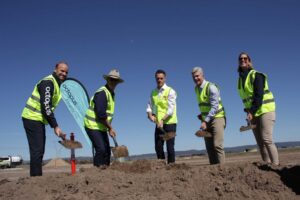
The $340 million Bulabul battery project in Wellington, NSW, is an example of this.
AMPYR approached the Wellington Aboriginal Community to see if they’d be keen to be equity co-owners, an opportunity they were able to jump on and turn around in just six months.
Several years earlier, they’d set up a group to look at community initiatives which meant they had the governance, and trust, capacity to move fast, says Gavin Brown, the CEO of the Indigenous corporation Wambal Bila established to hold the community’s equity stake in the battery.
‘We already had functional governance in place, and that was fertile ground for the developer to start with,” he told Renew Economy.
“[More generally] there’s a need for an education piece urgently for communities to understand what’s possible, and how they can get involved in a meaningful way.
“There seems like there are a reasonable number of proponents open to that [co-ownership] prospect.”
Brown says the pace of the energy transition means developers need to deploy capital very quickly, and unless communities are semi-ready to take hold of opportunities “it’s easy for them to get bypassed”.
His advice is twofold: find a way to be up to date on timelines for what is being proposed in an area and build community governance groups even before a development – be it energy or something else – is proposed. Both are issues that councils could be helping their communities with.
Renewable energy now makes up 50 per cent of Australia’s main grid, according to BNEF, and the country has four years left to make that up to the 82 per cent by 2030 policy target.
The way to do this is to start seeing communities as partners says the guide’s lead author Anna Berka.
“Unlike some other countries, Australia has done little to enable communities to participate meaningfully in the renewable energy rollout. Given the scale of additional renewable capacity needed to 2030, now is the time,” she said in a statement.
“The shift to renewable energy is happening at scale in regional Australia. Done well, community partnership models can deliver significant regional development benefits, strengthen local economies and build the social support needed to transform our energy system.”
To support independent journalism and Renew Economy’s efforts to fight disinformation and misinformation about climate issues and green energy, please consider a one-off or monthly donation. Click here if you can. And for more news and analysis about the green energy transition, you can sign up to our free daily newsletters here.