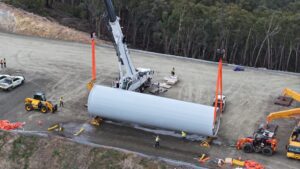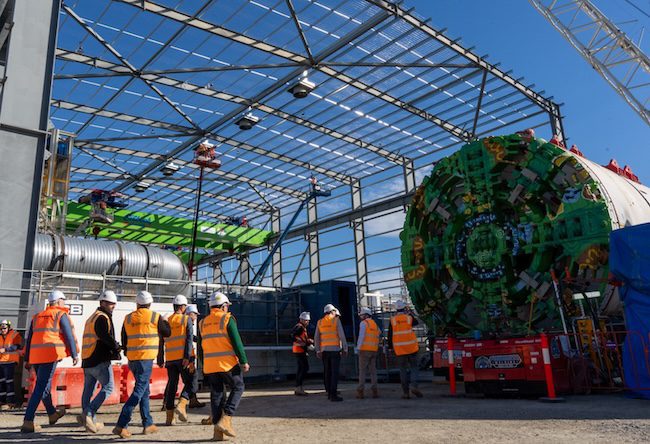
Tunnel boring machines working on the eastern section of the controversial Suburban Rail Loop (SRL) in Melbourne will be powered by completely renewable power, under a three year deal with the country’s first Indigenous-owned retailer.
The contract is to power the operations, tunnel drilling, and construction for 10 km of twin tunnels between the suburbs of Glen Waverly and Box Hill.
Yurringa Energy CEO Arron Wood wouldn’t say how much the contract is worth in terms of gigawatt-hours (GWh), revealing only that “it’s big” and started in February this year.
The boring machines themselves aren’t set to start work until later in 2026, when they’ll begin tunnelling north and south from the suburb of Burwood.
Wood says the deal, signed with SRL consortium Terra Verde, is for electrons, rather than partial green energy with gas or coal power offset by renewable energy certificates.
“This contract backed by Yurringa Energy essentially has a flex built into it for the tunnel boring machines to use energy within a certain accepted volume,” he told Renew Economy.
“We’re price competitive and contracts are negotiated on commercial rates.”
Big Build is hoping to have trains on the 26 km eastern segment, stretching from Cheltenham on the coast in the south to Box Hill in the north, by 2035.
But the project is massively controversial.
Last year, Infrastructure Australia put the total cost just of the eastern part at $34.5 billion, but likely more, because the only costings Victoria offered were from 2020.
From selling power to making it
The SRL deal is a big one for Indigenous-owned Yurringa, but not its first big government contract.
Founder Daniel Briggs started the company in 2018, and it’s part of a wider organisation that includes a labour hire business with contracts on Victoria’s Big Build projects.
But the energy division didn’t get its first break until 2024, when it won the contract to supply 137.5 GWh of electricity for 6.5 km of road tunnels for the Victoria North East Link project.
It also has contracts with NBN Co in Queensland and South Australia.
Now, it’s working to become a retailer in its own right and, soon, will move into renewable energy generation too.
“Daniel Briggs originally set up Yurringa Energy because he was looking to invest in renewable energy development, and realised you needed a pretty strong balance sheet to be going into that,” Wood says.
“He basically took that next step to establish Australia’s first indigenous owned energy retailer instead.”
The company works through an exemption with a wholesale energy partner – the identity of which Wood would not reveal, although Alinta Energy was the partner on the North East Link contract.
For the last six months it’s been working through the processes of getting its own licences in every jurisdiction in Australia, bar the Northern Territory.
Wood expects to be fully licensed towards the end of 2026, and from then on has big goals to source its own electricity.
“We’re having conversations with developers and different parties in the renewable energy sector, and it might look [like]… buying equity in a project that is going to go ahead and has some headroom in it, or it might look like forming a consortium with a development partner,” he says.
“It could be an agreement around offtake from a renewable energy developer.
“We don’t have intentions at this stage of becoming a renewable developer in our own right.”
Green and grey
Yurringa Energy is not a pure play green energy company, however.
Wood draws a line through sourcing electricity from coal power plants and says solar and wind are the “predominant” sources.
But gas remains an option if that’s what customers want.
Those customers are purely government and corporate clients, with Wood ruling out getting into the competitive residential market.
But there is still plenty of innovation happening at that level, he says.
“The market is changing so much in terms of what customers want, we’re exploring how we can partner on behind the meter solutions,” he says.
“And also… the potential for C&I customers to have two retailers. One manages their baseload power and the other retailer manages their more flexible load. We’re talking to a range of different companies with expertise in behind the meter solutions, charging as a service.”
If you would like to join more than 29,000 others and get the latest clean energy news delivered straight to your inbox, for free, please click here to subscribe to our free daily newsletter.