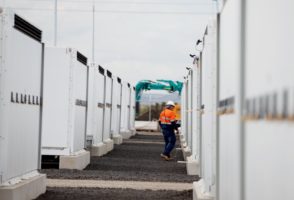
Demonstrating once again what the clean energy industry is capable of even despite strong political headwinds, the United States’ energy storage industry installed a massive 57.6 gigawatts-hours (GWh) of new capacity in 2025, the largest single year of new battery capacity additions on record.
New figures published by the Solar Energy Industries Association (SEIA) and Benchmark Mineral Intelligence showed that, despite the best efforts of US president Donald Trump and his crony-led administration, energy storage installations in 2025 grew by 30 per cent on the previous record year of 2024 – four-times what the industry installed only three years ago.
Battery energy storage system installations surpassed 28 GW/57 GWh in 2025, with the utility-scale market accounting for just under 16 GW/50 GWh, and behind-the-meter installations 12 GW/8 GWh.
Nearly 30 GWh of standalone storage capacity was added in 2025 as well as 20 GWh of storage paired with solar, while the residential energy storage sector added a healthy 3.1 GWh, representing a 51 per cent year-on-year increase.
“This record-breaking year for energy storage is just the beginning of its rise as a cornerstone of America’s energy future,” said Darren Van’t Hof, interim president and CEO of the Solar Energy Industries Association.
“Whether it’s paired with solar or standing on its own, energy storage lowers consumer costs, makes the grid more reliable, and keeps the power on in homes during outages. Deployment is rising fast, but without a course correction from federal actions targeting the industry, Americans will face higher electricity prices and a less resilient energy system.”
The SEIA expects battery energy storage system deployments in 2026 to increase to 35 GW/70 GWh, with the utility-scale market continuing to lead the way, accounting for 20.2 GW/62.4 GWh, while the behind-the-meter market will account for 14.8 GW/7.3 GWh.
By 2030, over 600 GWh of energy storage will be installed across the country, with annual installations exceeding 47 GW/110 GWh.
“The US energy storage market has entered a new phase of sustained, high volume-deployments,” said Iola Hughes, head of research at Benchmark Minerals.
“As policy, manufacturing and market demand align, storage is playing a pivotal role in meeting peak demand, reducing price volatility and improving overall system resilience. At a time of rising electricity demand, driven in part by the growth of data centers and AI infrastructure, energy storage will be critical to ensuring the grid can scale reliably and efficiently.”
Interestingly, battery cell manufacturers in the United States pivoted from producing batteries for electric vehicles (EVs) towards dedicated energy storage production, following the policy hit taken by the country’s EV industry.
The US now hosts 21 GWh of lithium-ion battery cell manufacturing for stationary electricity storage applications, while total battery manufacturing facilities now have the capacity to produce nearly 70 GWh of battery energy storage systems each year.
If you would like to join more than 26,000 others and get the latest clean energy news delivered straight to your inbox, for free, please click here to subscribe to our free daily newsletter.