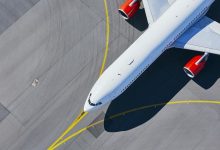
Australia has contemplated high speed rail (HSR) for over 40 years. CSIRO produced a high level proposal in 1984 titled “A Fast railway between Sydney, Canberra and Melbourne”. Since then, feasibility studies for an east coast HSR service have been completed in 2001, 2013, and recently by the High Speed Rail Authority.
Unfortunately, HSR is synonymous with the kind of high capital cost infrastructure which seems to paralyse governments in Australia. The Federal Government’s High Speed Rail Authority is investigating a short Sydney to Newcastle route as a first step in building a Brisbane to Melbourne route.
Australia has shied away from HSR mainly over the capital costs, but additional government revenue sources could help pay for the construction. We suggest a simple way to at least partially fund high speed rail through eliminating the excise relief given to the aviation industry.
Excise on fuel used for aviation
International agreements generally waive excise on aviation fuel purchased abroad. In 1995, the Federal Government amended legislation so that a small excise was applied to fuel for domestic aviation and hypothecated to the operation of Airservices Australia and the Civil Aviation Safety Authority.
We struggled to find an explanation for why airlines have avoided fuel taxes for so long, other than perhaps it was a decision of governments to make air travel cheaper during the formative years of the industry.
Gasoline and aviation turbine fuel (kerosene) used in equipment other than aircraft attract 50.8 cents per litre that motorists are familiar with. Fuel used in aircraft is taxed at a mere 3.5 cents per litre (see Table 1).
| Table 1: Excise duty rates for aviation fuels (Source: Australian Taxation Office) | ||
|---|---|---|
| Tariff item | Description | Rates from 3 Feb 2025 (cents per litre) |
| 10.5 | Gasoline (other than for use as fuel in aircraft) | 50.8 |
| 10.6 | Gasoline for use as fuel in aircraft | 3.556 |
| 10.16 | Kerosene (other than for use as fuel in aircraft) | 50.8 |
| 10.17 | Kerosene for use as fuel in aircraft | 3.556 |
Increasing excise on aviation fuel to at least the same level as all other fuels used for transport could provide a substantial, stable source of revenue which could help to fund government activities including HSR, without greatly increasing the cost for air travellers.
Transport & Environment has also proposed aviation fuel duty in the United Kingdom. It seems appropriate that an industry which is not meaningfully decarbonising should at least contribute to funding an alternative mode of high-speed, long-distance, low-carbon transport.
In 2024, 4,058 megalitres of aviation fuel were consumed for domestic aviation and approximately $144 million was collected in excise. Australia’s domestic aviation task averages about 60 million passengers per month, and a total of around 70 billion revenue passenger kilometres (RPK) per year.
Thus, the average Australian adult flies 3,500 km per year, or two return trips between Melbourne and Sydney. The distribution of kilometres flown is highly skewed. Many people will fly once every year or two while some people fly every week.
Proposed change to aviation fuel excise
We suggest that tariff items 10.6 and 10.17 in Table 1 be abolished and that items 10.5 and 10.16 would apply to any use of gasoline or kerosene including domestic aviation. This raises considerable revenue which, we argue, could be used to help fund the construction of HSR.
Excise on fuel purchased for international flights would remain unchanged in recognition of existing treaties. At 50.8c/L, the full application of excise would have raised over $2 billion in 2024, noting that higher fuel costs would contribute to a minor reduction in air passenger demand.
Impact analysis
To examine the impact of fuel excise on airfares, we modelled the change in ticket price for three domestic Australian routes using typical aircraft. Sydney (SYD) to Melbourne (MEL) is the most popular route in Australia and a route that would be included in any HSR network.
Sydney to Canberra (CBR) is one of the shortest sectors and would face keen competition by a HSR service, and Perth (PER) to Brisbane (BNE) is one of the longest.
The analysis in Table 2 assumes that airlines will pass the full increase in excise through to passenger ticket prices, although a small share of the cost would likely be passed onto air freight as well.
| Table 2: Excise revenue and cost impact for three domestic air routes. Fuel usage estimated using fuelplanner.com. | ||||
|---|---|---|---|---|
| Route | Seating capacity | Route fuel consumption (L) | Additional excise payable ($) | Additional cost per passenger ($) |
| SYD to MEL | 189 (737-800) | 4,345 | $2,053 | $11.80 |
| PER to BNE | 189 (737-800) | 17,046 | $8,053 | $46.30 |
| SYD to CBR | 79 (D8 Q400) | 474 | $224 | $2.90 |
A large fraction of flights are taken by relatively few frequent flyers. Air travel is predominantly a transport mode of the wealthy, with estimates that around half of global aviation emissions stem from the travel habits of just 1% of the world’s population.
Marginally increased ticket prices would mostly fall to those with the greatest means to pay. Another substantial fraction of RPK stems from business-related travel.
Would this pay for HSR?
The revenue raised by increased aviation excise could not fully fund HSR, but it would make a substantial contribution to the capital repayments.
Most of the revenue required to fund construction would come from general taxation, but an infrastructure project of this scale would also drive tax revenue increases through uplift in land value for property adjacent to HSR stations and services.
Conclusion
Harmonising aviation with other uses of petroleum fuels would raise significant revenue for the Australian Government. We argue this revenue could be directed to funding transport decarbonisation efforts like HSR, or at the very least, supplement consolidated revenue which could be drawn on for HSR construction.