It seems that the state and federal governments have finally found the key to unlocking the wind investment drought that has afflicted Australia’s most coal dependent state.
A week ago, the federal and NSW governments announced a $2.5 billion plan to help the state and the country’s biggest electricity customer, the Tomago aluminium smelter, move from coal power to a 100 per cent renewable supply by 2033, which will require several gigawatts of new wind capacity, as well as solar and storage.
On Monday this week, the state government doubled down with guidelines for another thirsty energy consumer, the rush of new proposed data centres, with new rules that also require them to bring their own additional energy sources, 40 per cent of which must come from wind.
NSW estimates it has 19 big data centre proposals, potentially equivalent to around 11 per cent of the state’s total electricity demand, about the same as Tomago.
Most of the data centres that have already been built have focused on solar when thinking about renewables.
New data centres, however, will be required to source 40 per cent of their electricity use from wind farms (in megawatt-hour terms), and must also have enough battery storage to meet at least 25 per cent of this generation capacity (in MW terms) for a duration of at least four hours.
These storage assets can be part of solar-battery or wind-battery hybrids (many of which are matching their rated capacity with storage assets), or standalone facilities. They can be battery projects or pumped hydro – but they must be new, and not assets which have already reached financial close.
The data centres have a four-year grace period to meet these targets, after which time they will be expected to match their electricity demand with new renewables as they expand their facilities.
The Tomago mandate is expected to require at least 3 gigawatts (GW) of new wind and solar capacity, and at least half of that is expected to come from wind, with a whole bunch of projects in the Central West Orana and South-West renewable energy zones jockeying for contracts and mandates.
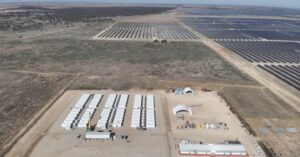
The data centre requirements will probably require that amount again, meaning about 1.4 GW of new wind capacity at the very least, and at least 700 MW and 2,800 megawatt-hours (MWh) of new battery storage capacity – or pumped hydro if someone can find a way to deliver a project in time.
These are the breakthroughs in the wind investment drought that the state and federal governments have been hoping for. And the state will need a lot more as it tries to fill the gaps created by the impending retirements of the Eraring, Vales Point, Bayswater and Mt Piper coal-fired power generators.
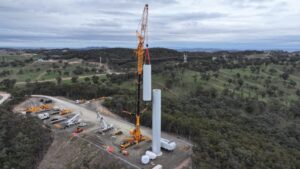
Despite the six generation tenders held by the state and federal governments over the last few years, only one wind project is currently under construction in NSW – despite the urgent need for new capacity as the already twice-delayed closure of Eraring draws closer, and the three other generators prepare to set their closing dates.
The lack of a legislated renewable energy target means that the most natural buyers of renewable energy – the big three utilities that happen to own those coal fired power stations – have not been bothered to invest or contract in new wind and solar projects.
The governments have now decided that focusing on the consumers is the best way around this problem – not just for Tomago and data centres, but also homes and businesses. Hence the federal home battery rebate, the newly announced expansion of the rooftop solar subsidy and the NSW government’s hefty support for batteries for businesses and apartments.
The NSW government estimates there are 19 data centre projects in the State Significant Development (SSD) planning pipeline, for a total value of $50.3 billion.
It says that, as of February 2026, over half of the proposed projects in the planning system had committed to some form of Power Purchase Agreement (PPA) or longer-term renewable energy sourcing.
“Between March 2023 and May 2026, 49 renewable energy projects received planning approval with 10.2 GW of new generation capacity and over 30 gigawatt-hours (GWh) of new storage capacity,” the government says in its data centre guidelines.
The specific mandate for wind energy arises because of the lack of wind projects under construction, and because data centre PPAs had largely skewed towards solar projects. The NSW government says it needs more wind and storage assets as coal fired generators retire.
“This highlights the scale of the investment pipeline and the significant opportunity for PPAs to support the delivery of new generation and storage.”
So far three generation tenders have been conducted in NSW, with three wind farms awarded underwriting agreements. Flyers Creek is operating, but had already begun construction. Uungula is now being built, while Coppabella shouldn’t be too far away after seeking approvals to add batteries with individual turbines.
NSW-based wind projects that won the right to underwriting agreements under the federal government tenders include Windlab’s Junction Rivers wind project, which has yet to secure grid access rights, Acen Renewables’ Valley of the Winds, which is being challenged in court by a wealthy neighbour, and Squadron’s Spicers Creek project.
More recent winners include Spark’s Dinawan, Tilt’s Liverpool Range, Goldwind’s Baldon, Bay-Wa’s Bullewah and Origin’s Yanco Delta wind projects.
To join more than 29,000 others and get the latest clean energy news delivered straight to your inbox, for free, click here to subscribe to our free daily newsletter.