A new floating wind turbine design could cut the cost of building by as much as 40 per cent, the researchers behind it say, but there is a catch: It won’t work for the biggest oceanic machines.
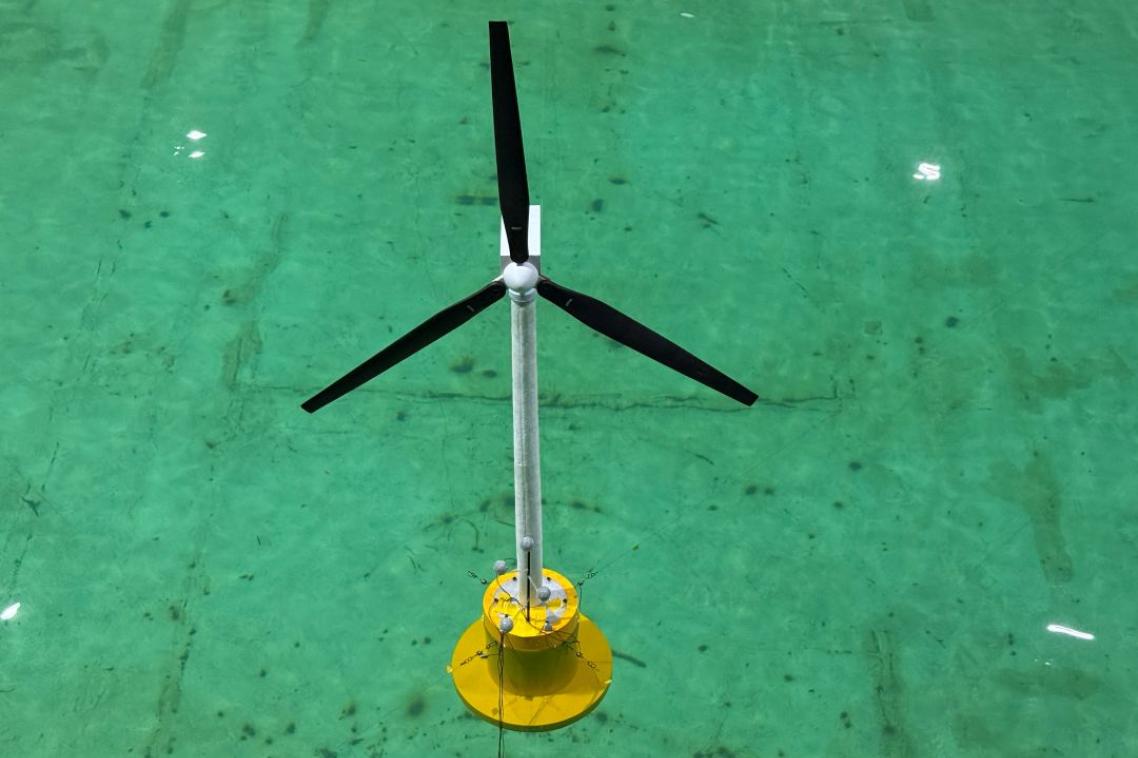
University of Queensland professor Wenhua Zhao tested a scale model of his design, a structure about 2m tall, at the wave basin in Shanghai Jiao Tong University recently.
He says the results show the design not only worked, but could support a turbine as big as 3.6 megawatts (MW) with an 87m hub height.
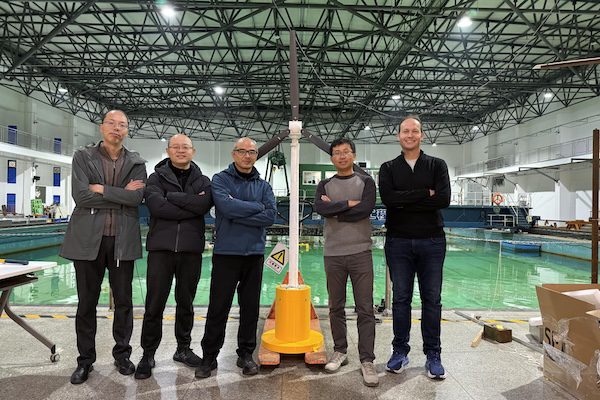
The scale model turbine produced by Dr Zhao (second from right) was put through wave basin testing at Shanghai Jiao Tong University in China. Image: University of Queensland
“This builds our confidence that this novel design can survive in extreme states,” Zhao told Renew Economy.
“This is a critical step for the concept, because… what we found is that it can survive in a big storm.”
Zhao is pitching his design for smaller applications, such as aquaculture or oil and gas platform decommissioning, rather than as a cost solution for the ocean giants designed to send power back into grids.
In May, the Global Wind Energy Council said installed offshore wind turbine sizes averaged just over 10 MW last year, but the machines being pitched for future projects are much larger.
Vestas and Siemens Gamesa are both selling 15 MW turbines, Goldwind had a 16 MW machine in the market in 2023, while GE’s 14.7 MW Haliade-X was the most powerful in the world in 2022.
Of these, floating turbines are the most expensive, costing twice that of turbines fixed in shallow waters and almost four times the cost of land-based turbines, Zhao says.
Balancing act
Floating wind turbines are the most difficult to build because they are designed for deeper waters, and typically rely on a counterweight under the ocean surface to balance the machine on top.
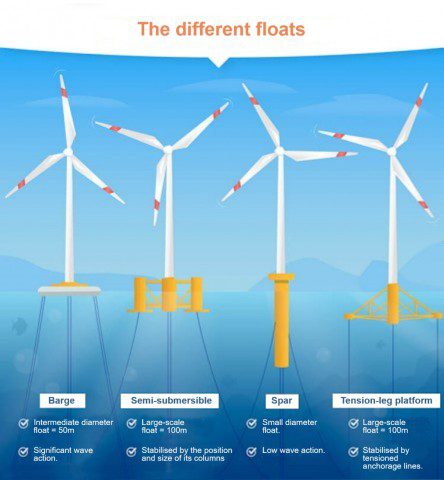
The main options for keeping a floating turbine upright. Image: EDF
Zhao’s design merges a spar design, which balances the top with an equivalent-sized single spar under the surface, and a design with three semi-submerged platforms.
The former can be used in very deep water, the latter in shallow waters.
Zhao’s design has a single semi-submerged platform that acts like a spar.
It creates more stability by factoring in wave movements that are going in opposite directions — where one pushes the structure up and another pushes it down — to reduce the overall movement of the turbine.
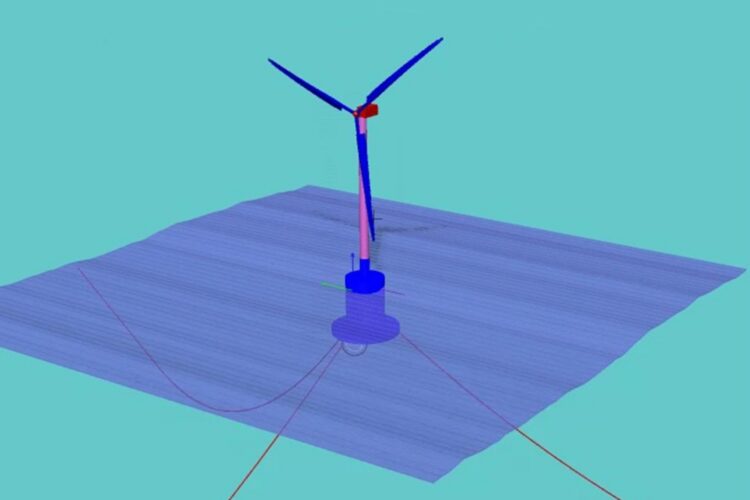
Wave basin testing showed Dr Zhao’s floating turbine model can survive a 1-in-100-year storm and be moored in up to 200 metres of water. Image: The University of Queensland
He says this also allowed them to use less concrete and steel.
“A floating structure can move up and down, and also can pitch back and forwards and rotate. For the rotational motion we take the advantage of the two existing types [spar and semi-submersible] to make it stable with less materials,” Zhao says.
“To reduce the vertical motion, we have two parts. One is a cylinder which is partially submerged and partially in the air, it’s like a vertical pile in the water.
“The other component is connected to the vertical pile… a bigger [structure] which is fully submerged.”
Internal stabilisation features lowered the centre of gravity and made the whole more steady in the water.
Zhao wants the technology to be ready for commercial adaptation within the next two years.