There is no longer any real doubt that Trump’s administration is having a material impact on a range of election campaigns around the world.
The German election was once expected to be a wipe-out in favour of the conservatives, but ended up with a relatively boring result that retained the status quo around moderates, and centre right / left parties.
Canada has seen an extremely dramatic and unprecedented flipping of party polling in direct response to Trump’s actions in his second term of office. Its election is coming up soon – Monday 28th.
The political, economic and physical proximity of the US to Canada, along with Trump’s casual threats to literally invade and take over the country, has had this effect:
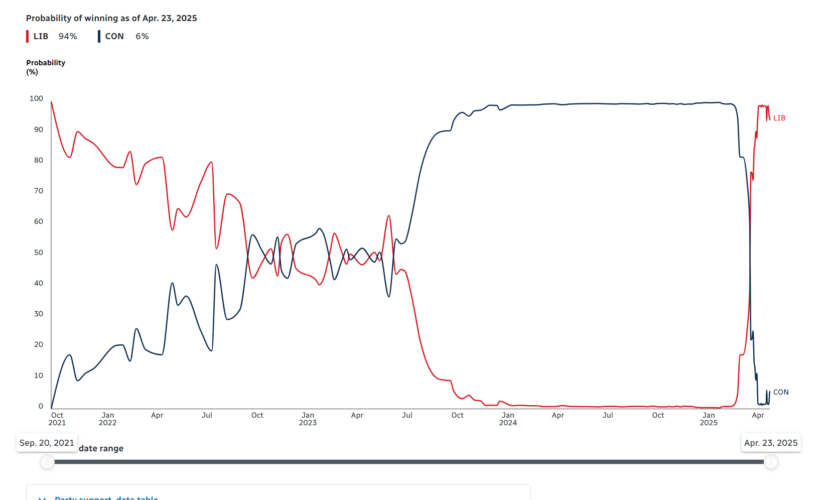
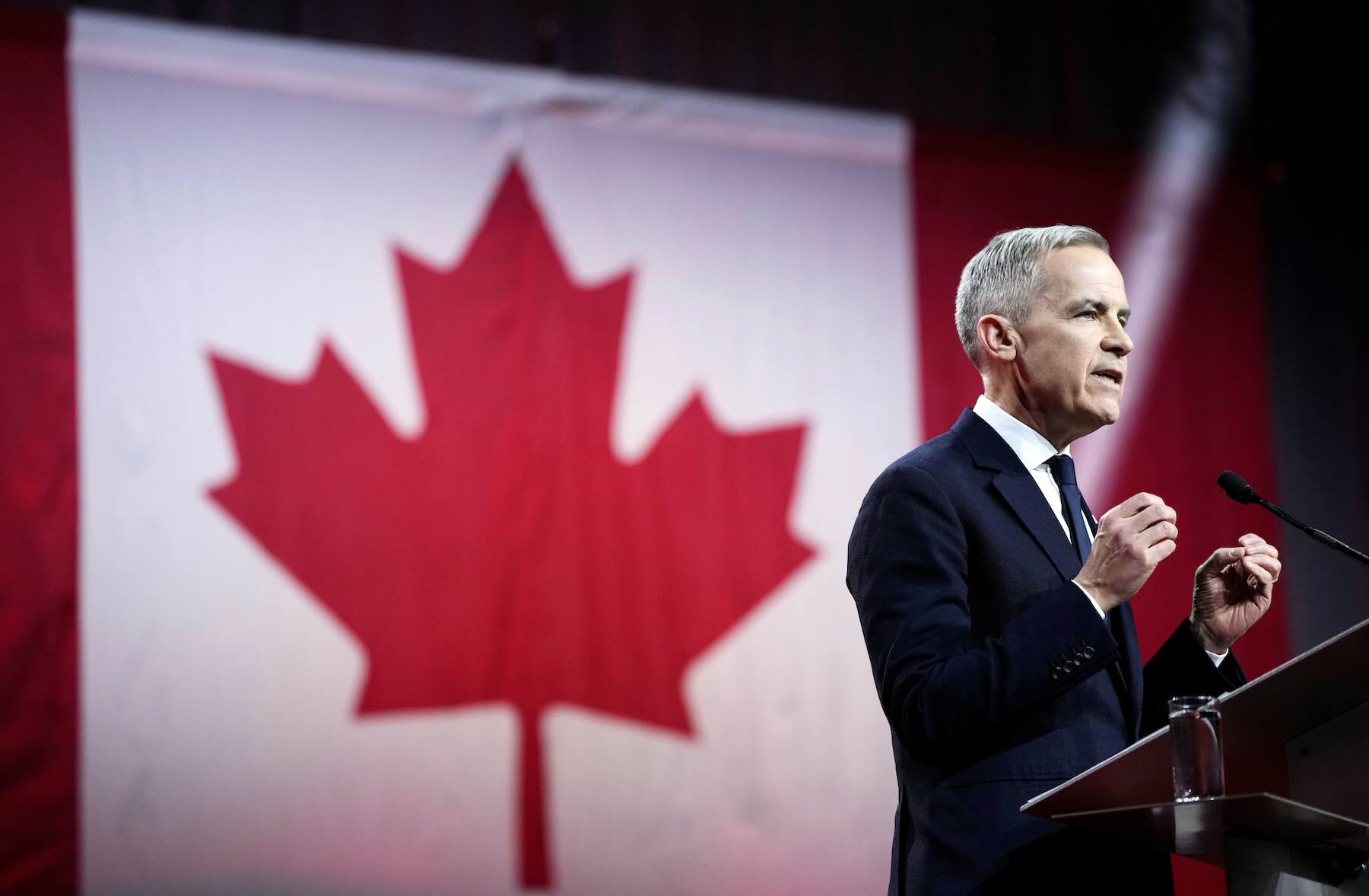
Part of this does relate to the departure of the former Prime Minister, Justin Trudeau, whose popularity had dropped. The current PM and likely future leader is Mark Carney, who has a close history with climate policy and is a former governor of the Bank of England.
Carbon Brief estimates that a conservative win in Canada would add around 800 million tonnes of additional emissions to Canada’s accounts before 2035.
But also that “analysis of the modelling also suggests that neither of the major parties’ policy platforms would put Canada on track to reach any of its climate targets”.
Both major parties in Canada are opting to abandon the country’s relatively successful carbon pricing mechanism, and that plays a major role in both parties presenting a weak climate trajectory.
It is remarkable how similar the polling picture is for Australia:
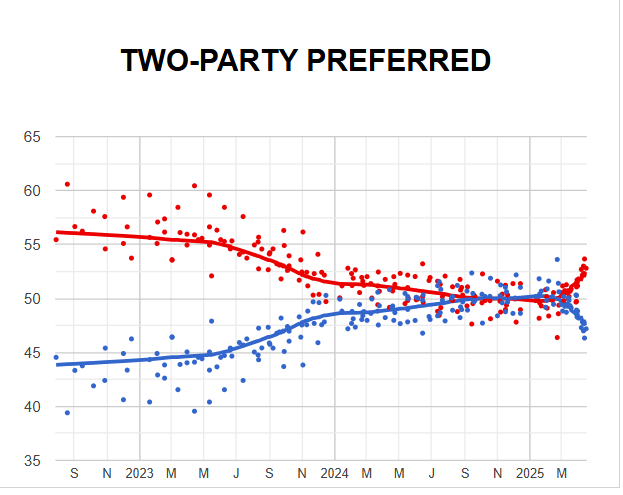
The similarities are stark. Both countries have massive extractive industries. Australia leans more heavily on coal, and Canada leans more heavily on oil, but both are obsessed with gas and both see a strong bipartisan consensus that even more fossil fuels should be dug up in the future.
Both see stagnating domestic emissions, and relatively high exported emissions:
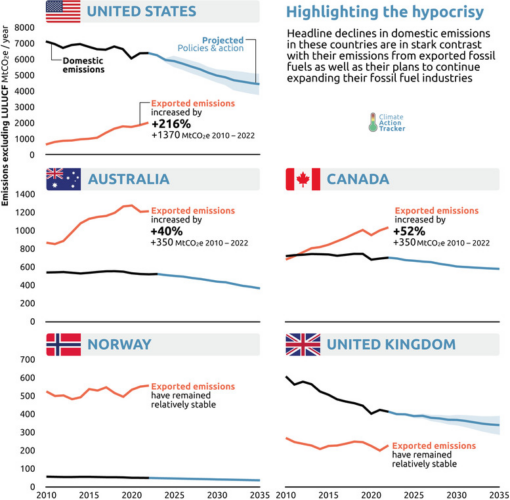
Both Australia and Canada also feature relatively unhinged conservative opposition parties, both explicitly and actively trying to court the fossil fuel industry and promising worse cronyism if they win power.
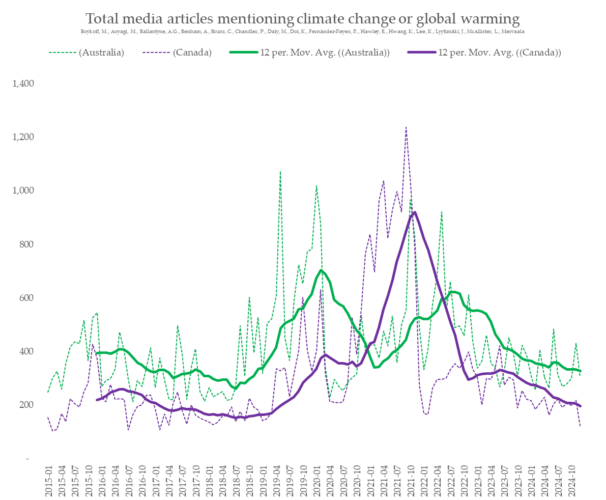
And both countries have seen a three year stretch of a significant reduction of climate mentions in mainstream print media coverage over the past three years:
A notable difference is that Canada’s grid is way, way cleaner than Australia’s grid, thanks largely to bountiful hydro reserves in Canada (and only somewhat due to nuclear power – a factor that is regularly and wildly exaggerated by Australian nuclear advocates).
Canada’s emissions have in fact been slightly rising the past three years, thanks to expanding gas-fired power generation. Rising power demand in the country might even make Canada increasingly reliant on power exports from the US. In fact, 2024 saw Canada’s lowest net power exports since 2004.
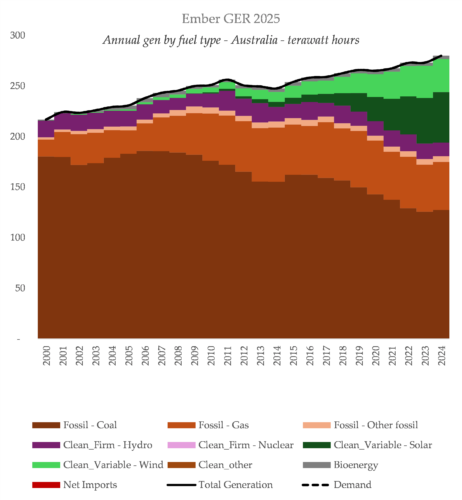
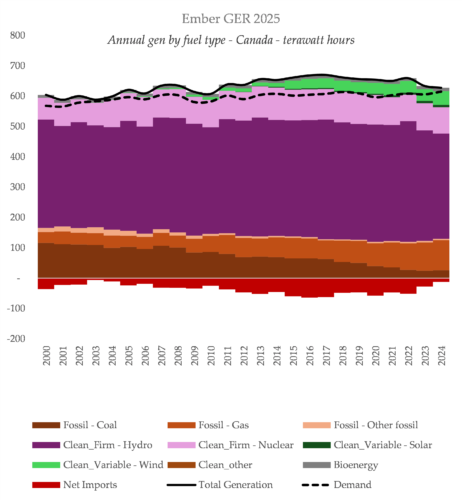
Source – Ember GER 2025
There is a massive global shift going on, and Australia – as a massive fossil fuel exporter and user but with a progressive government fighting on its climate credentials, is a big part of that.
The test is how strongly these governments stick with climate priorities, given the broader push to reframe everything around energy security, defence and energy prices. The physics of climate change has not changed at all; it remains a significant threat.
What happens when governments that were only recently facing the boot are re-elected on pure geopolitical circumstance?
They could either seize the opportunity to put climate back on the agenda, or they could retreat even further into the comfort and safety of going with the tide – and the tide is not going in the right direction, right now.