Ampyr, a major new player in the battery storage sector in Australia, says it has signed the first supplier and off take deals for its first big battery project in Australia, as it sets its sights on delivering more than six gigawatt hours of storage by the end of the decade.
Ampyr is backed by the Singapore-based investor AGP, and is led in Australia by Alex Wonhas, a former senior executive at the Australian Energy Market Operator who led the development of its first planning blueprints known as the Integrated System Plan.
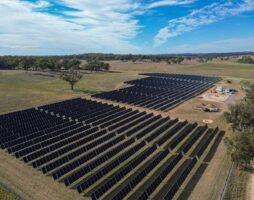
On Tuesday, the company announced it had reached financial close on the 300 MW, 600 MWh Wellington stage 1 battery, which is located next to the existing Wellington and Wellington North solar farms in western NSW.
It has landed a “virtual off take” agreement with the rapidly growing energy retailer Zen Energy for half of the battery’s initial capacity, and has also contracted the US-based Fluence to deliver the battery systems.
It has also landed $340 million in debt finance from a number of banks, including the Commonwealth Bank of Australia (CBA), Bank of China, Hongkong and Shanghai Banking Corporation (HSBC), Rabobank, Societe Generale and United Overseas Bank (UOB).
Wonhas told Renew Economy that construction is expected to start within a few weeks, with energisation in late 2026, and the battery in full operations by early 2027.
The deep pockets of AGP means that Ampyr has not needed to land any equity partnerships for the project, although that has not been ruled out in the future, and talks are also being held with the local Aboriginal community for an equity share.
Wonhas says more “virtual toll” arrangements are expected to be added to the Wellington battery project, and for the 100 MW, 400 MWh second stage of the project which Ampyr hopes to start work on next year.
“Reaching the financial close of our first grid-scale BESS project in Australia marks a significant milestone in the acceleration of Australia’s energy transition,” Wonhas said in a statement.
“(It) will play a critical role in an increasingly renewable grid whilst boosting Australia’s energy storage capacity and supporting the delivery of low-cost energy to major users.”
It is also a big deal for Zen Energy, and CEO Anthony Garnaut says it is the company’s first battery deal in NSW, and will enable the retailer to double the size of the customer base it currently serves.
“Virtual tolling agreements signal a maturing of the renewable energy transition and deliver shared value for Zen Energy and Ampyr,” Garnaut said in a statement.
Wonhas says Ampyr hopes to deliver 6 gigawatt hours of battery storage to the Australian grid by 2030, which he says will be much needed because the shortfall in wind projects means that more battery storage capacity will be required to support rooftop and utility scale solar.
See: Australia may need twice as many big batteries to make up for lost wind
Ampyr has already revealed plans for a potential 375 MW and 1,500 MWh battery project called Swallow Tail, near the Bannaby substation south-west of Sydney, but is keeping quiet on its other pipeline of projects.
Wonhas says the decision to go with Fluence was made “some time ago” – Ampyr bought the Wellington project from former partner Shell earlier this year – and is attracted to its battery management and trading software.
“Virtual toll deals are increasingly popular, Wonhas told Renew Economy. “But they are complex. It’s essentially a financial product, and it allows us to overlay several different contracts on one physical machine. That allows us to build battery developments at scale, and sell chunks of that battery to individual off-takers.
“We are doing new and innovative things. We have spent a lot of time thinking about how we are going to do it, and getting the banks comfortable with that.”
The lender group for the more than A$340 million financing for the Wellington Stage 1 BESS includes the Commonwealth Bank of Australia (CBA), Bank of China, Hongkong and Shanghai Banking Corporation (HSBC), Rabobank, Societe Generale and United Overseas Bank (UOB).
Ampyr was advised on the financing by Azure Capital as financial adviser and Ashurst as borrower’s counsel, with Herbert Smith Freehills Kramer acting as lenders’ counsel. Corrs Chambers Westgarth acted as project counsel on the virtual toll agreement with ZEN Energy.
Transaction diligence advisers were Ashurst (legal), Aurora (market), BMS (insurance), KPMG (tax), Mazars (model audit) and Worley (technical).
See also Renew Economy’s Big Battery Storage Map of Australia for more details.