Home » CleanTech Bites » Trustpower cuts value of biggest South Australia wind farm due to lower output

Trustpower cuts value of biggest South Australia wind farm due to lower output

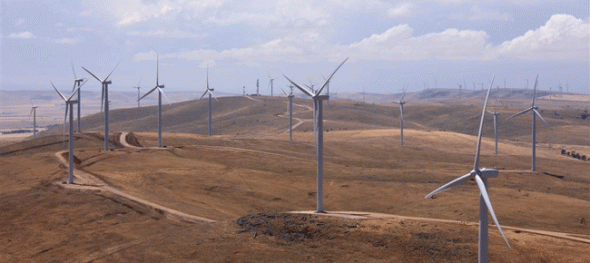
New Zealand company Trustpower has had to cut the value of newly completed Snowtown 2 wind farm after production from the 270MW facility fell nearly 10 per cent below expectations.

The company announced on Thursday that generation from the largest wind farm in South Australia would likely be 9.4 per cent below expectations, down to 892GWh from 985GWh per year.

It blamed lower wind speeds and “the limitations with industry modelling tools when applied to a site of this complexity and scale,” in particularly the use of modern large rotor turbines.

Trustpower says the lower wind production will cut earnings by around $8.5 million, leading to a cut in the valuation of Snowtown 2 by as much as $70 million.

This comes just six months after the company, on the advice of independent auditors Deloitte,  raised the book value of the wind farm by $310 million above its $A450 million cost, even though it had already reported lower wind speeds in the previous month.

The entire Snowtown project is the second-largest wind generation facility in Australia – after the 420MW Macarthur wind farm in Victoria – with a total installed capacity of 370MW. It was built in two phases, at a total cost of about $660 million.

infratil snowtown

The revised output suggests an anticipated capacity factor of around 38 per cent, still relatively high, and compared to around 27 per cent for Macarthur.

However, recent data from Green Energy Markets suggests that both the Snowtown South and Snowtown North components have been producing below that level. (The % figure to the right is year-to-date 2015, while the % figure in the third last column is output in October).

snowtown output

Snowtown was hailed as one of the cheapest wind farms in Australia, and is believed to have struck a power purchase agreement in the low $80/MWh – one of the lowest in Australia at the time. But Trustpower says the investment is still good value for shareholders.

“Energy yield modelling techniques are continuing to evolve to improve the accuracy of prediction, informed by research and analysis by wind industry participants and experts,” Trustpower boss Vince Hawksworth said in a statement.


“Trustpower has undertaken a comprehensive analysis in conjunction with independent engineering advisers to better understand the factors contributing to this revision and will apply these learnings, along with advances in modelling techniques, to future developments.”

Deutsche Bank analysts said they expect Trustpower to sell the Snowtown assets over the medium term and “this could be the first step in the process.”


Giles Parkinson is founder and editor-in-chief of Renew Economy, and founder and editor of its EV-focused sister site The Driven. He is the co-host of the weekly Energy Insiders Podcast. Giles has been a journalist for more than 40 years and is a former deputy editor of the Australian Financial Review. You can find him on LinkedIn and on Twitter.

Related Topics

Latest posts

Solar waste smuggling: The PV recycling problem kicking the industry while it’s down

Solar waste smuggling: The PV recycling problem kicking the industry while it’s down

Exports are still “the biggest threat” to solar recycling feedstock supplies, without a stewardship scheme to make recycling more attractive.
CEFC names new CEO to lead federal green bank through “decisive decade” of energy transition

CEFC names new CEO to lead federal green bank through “decisive decade” of energy transition

The federal government’s green bank has named the new CEO, to take the reins at what will be a crucial era of growth, as coal plants close and industry scrambles to meet emissions and renewables targets.
Solar Insiders Podcast: Panel recycling at the precipice

Solar Insiders Podcast: Panel recycling at the precipice

James Petesic from PV Industries on the struggle to stay afloat with the federal PV recycling pilot paused and panel smugglers chipping away at feedstocks. Plus, news of the week.

CIS shows how energy policy can deliver for First Nations. ESEM can build on this progress

The Capacity Investment Scheme (CIS) has demonstrated government market design can influence investment behaviour. Since its introduction, the CIS – Australia’s massive renewable energy underwriting program encouraging investment in new generation and storage – has progressively strengthened incentives for First Nations engagement, participation and ownership. Through successive competitive tenders, developers have been incentivised through scheme […]
1 Comment